
Proven and Free, or Flexible and Self-Run
OJS (Open Journal Systems) is free, open-source and widely used, with an active community of maintainers and a large plugin ecosystem. A custom journal management system gives you full control over workflow, branding and integration with other services, but you must build and maintain all of it yourself. Neither is universally "better" — the right pick depends on your technical resources, how unusual the workflow you need is, and whether the publisher runs a single journal or a wider multi-service network. Sketching your must-have features first makes the comparison far easier.
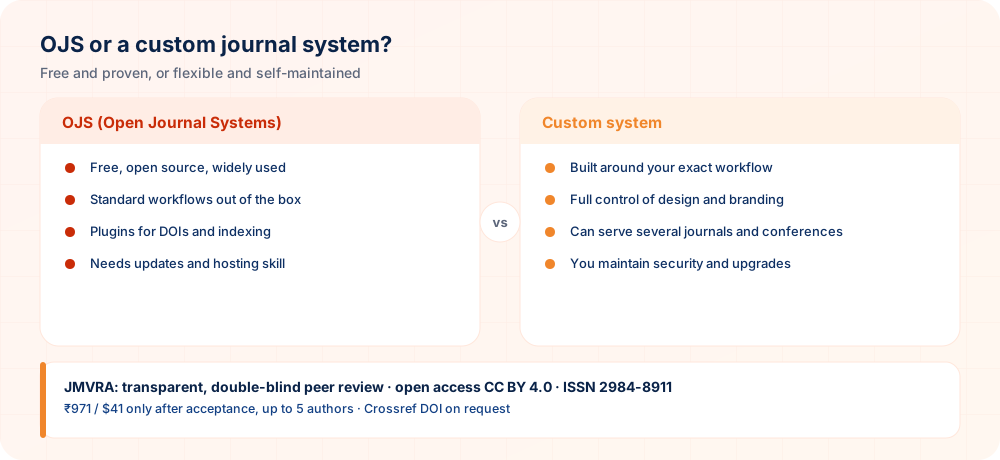
Comparison Table
| Factor | OJS | Custom system |
|---|---|---|
| Cost | Core software costs nothing; hosting and setup are paid for | Complete development cost plus continuing maintenance |
| Customization | Themes and plugins, though with some structural limits | Completely flexible, made to exact requirements |
| Maintenance | Core maintained by the community, updated from time to time | Wholly the publisher's own responsibility |
| Security | A big user base spots and patches known problems | Rests entirely on the practices of the team that builds it |
| Multi-journal support | Multi-journal installations are built in | Has to be designed in from the beginning |
| Conference integration | Achievable through plugins or extensions | Can be built straight into the same system |
| Branding | Can be themed, but is plainly OJS underneath | Entirely distinctive to the publisher |
| API | Available, documented | Made to precise specification, if included |
Which to Choose
Choose OJS if...
You prefer a free, proven and actively maintained platform, manage one journal or a handful, and have no need for highly unusual workflow integration.
Consider custom if...
You operate a bigger network that combines journals, conferences and DOI services under one brand, and have the technical capacity to build and maintain it over the long term.
Deciding Between OJS and a Custom Platform
The choice between a ready-made system and a custom build shapes workload for years. These questions help journal owners decide realistically, based on their team's skills and future plans.
- Assess your technical capacity honestly. List who will install updates, fix faults and respond to security notices. A powerful system without people to maintain it becomes a risk instead of an advantage.
- Trial before committing. Set up a test site, upload sample articles and invite colleagues to play the roles of author, reviewer and editor. Real use shows limitations that feature lists hide.
- Plan data export from the start. Check that articles, metadata and user records can be exported in standard formats. Easy export keeps you free to change platforms later without losing your archive.
- Budget for ongoing support. Include hosting, maintenance, backups and occasional specialist help in your costs. The initial setup is only part of what any platform requires over time.
- Consider the reader's experience. Look at how pages load on a phone, whether articles are easy to find and whether PDFs download properly. Readers judge the journal by this experience, not by the software name.
Choose according to your team's real capacity and future needs, and test the platform with realistic tasks before you decide.
Questions to Put Before Deciding
- Who will look after the system? — updates and security
- Which workflows do you need? — review, production, multiple journals
- Which metadata outputs are needed? — Crossref, OAI-PMH, Google Scholar tags
- What will it cost in total over five years? — hosting, staff and development
Migrating Between Systems
Keep URLs stable
Or set up redirects for old article URLs.
Make sure DOIs keep pointing to the right place
Update Crossref URLs.
Migrate metadata fully
Author names, abstracts and reference lists.
Test indexing
Make sure Google Scholar can still read the pages.
FAQs: OJS Compared with a Custom JMS
Does OJS cost nothing at all?
The software is free, but hosting, setup and upkeep usually still demand time or paid support.
What is the reason for building a custom system?
Closer integration, unusual workflow needs, a multi-service architecture, or a wish for full control of the codebase.
Is it harder to customize OJS?
Themes and plugins handle plenty, but deep structural changes may be more restricted than in a custom build.
Which of the two is safer?
That depends on implementation — OJS gains from a large user base that patches known issues.
Can OJS handle several journals?
Yes, natively, from a single shared installation.
Which works better with DOI registration?
OJS has well-established Crossref plugins; a custom system can equal that but has to build it.
Does a custom system always cost more?
Not in every case, yet OJS generally has a lower total cost of ownership, particularly at small scale.
Is it possible to change systems later?
It can be done, but moving historical records is a real undertaking.
Is OJS free?
The OJS software is open source and free of charge, though hosting and upkeep carry costs.
Would switching systems hurt Google Scholar indexing?
It can, if URLs or metadata change; plan redirects and test them.
Related Searches
Read Next
Is Your Paper Ready to Submit?
Leave the infrastructure choices aside — send your manuscript via JMVRA's official portal.
Submit Paper OnlineAt-a-Glance Checklist
- Workflow outlinedAhead of choosing
- Hosting arrangedUpdates, backups, security
- DOI and metadataSupported in either case
- Exit strategyData can be exported
- Budget sensibleBuild and upkeep
Your Paper's Journey at JMVRA, From Submission to Publication
- SubmitReceive your paper ID
- ScreenScope & similarity
- ReviewDouble-blind
- DecideEmail & SMS
- RevisionComment by comment
- AcceptCopyright & fee
- ProduceDOI at the author's request
- PublishMonthly issue
How long review takes depends on the reviewers and on any revision required, so no set turnaround is promised; you are told of acceptance or rejection by email and WhatsApp.
Ready to Publish? Submit to JMVRA
JMVRA is aligned with UGC's Suggested Parameters for Choosing Peer-Reviewed Journals.
JMVRA is a Transparent, Peer-Reviewed, Open Access Journal (Refereed Journal). Following the discontinuation of the UGC and UGC-CARE journal listing, and in alignment with the latest UGC-CARE recommendations and guidelines, JMVRA is aligned with UGC’s Suggested Parameters for Choosing Peer-Reviewed Journals.
Quick links across jmvra.org
Key Terms
Subjects and search phrases this article addresses.
Related Reading
Further reading on the same theme from the JMVRA blog.
OpenAlex Explained for Researchers and Publishers
Read the guide RelatedFind Published Theses & Dissertations on JMVRA
Read the guide RelatedJMVRA RMS Reward Points Explained
Read the guide RelatedKeeping Publication Moving Without Rushing Review
Read the guide RelatedNaming a New Academic Journal
Read the guide RelatedPrivacy Policy
Read the guideKeep Reading on the JMVRA Blog
Our JMVRA journal blog carries this guide along with other practical advice on publishing, indexing, metrics and research integrity, all written so that claims can be verified and nothing is promotional.