
Looking for journals in Saudi Arabia indexed by Scopus or Web of Science? A number of Saudi university journals report SCIE coverage. The guide gives examples, covers recent publisher changes, and demonstrates how to check indexing by ISSN before submitting. Doing that check first spares you from sending work to a journal that does not suit your needs.
Scopus and Web of Science: The Essentials
Elsevier runs Scopus, a selective index of abstracts and citations, which generates CiteScore and provides the data for the SCImago Journal Rank (SJR). Within Clarivate’s Web of Science, the Core Collection spans AHCI (arts and humanities), ESCI (emerging sources), SCIE (sciences) and SSCI (social sciences), and the Journal Impact Factor is released in Journal Citation Reports. Both databases review journals at intervals and may discontinue some. For detail, read Scopus explained and Web of Science explained.
| Term | What it is | Where to check |
|---|---|---|
| Scopus | Selectively compiled Elsevier database of abstracts and citations | Scopus Sources |
| SCIE | Science Citation Index Expanded: the science-journal index inside Web of Science | Master Journal List |
| SSCI | Social Sciences Citation Index: the social-science index inside Web of Science | Master Journal List |
| AHCI | Arts & Humanities Citation Index: the humanities index inside Web of Science | Master Journal List |
| ESCI | Emerging Sources Citation Index: vetted journals gathered within Web of Science | Master Journal List |
| Journal Impact Factor | Two-year average citations, assigned to all Web of Science Core Collection journals starting with the 2023 release | Journal Citation Reports |
| CiteScore | Scopus journals’ citation average across a four-year window | Scopus Sources |
| SJR | SCImago Journal Rank: a measure built on Scopus data that rewards prestigious sources | SCImago |
| Quartile (Q1–Q4) | The standing of a journal inside one subject category in one year | JCR or SCImago |
Indexed journals from Saudi Arabia cluster in science, chemistry, computing, engineering and medicine, and most belong to universities or medical centres. If a journal moves to a new publisher, its indexing generally carries on under the same title and ISSN, but verify that in Scopus Sources and the Master Journal List. To see the Scopus-based list, narrow SCImago’s rankings to Saudi Arabia; remember that SCImago allocates a country by publisher, so journals issued by a partner publisher may be shown under a different country.
Saudi Arabian Journals Indexed in Scopus and Web of Science
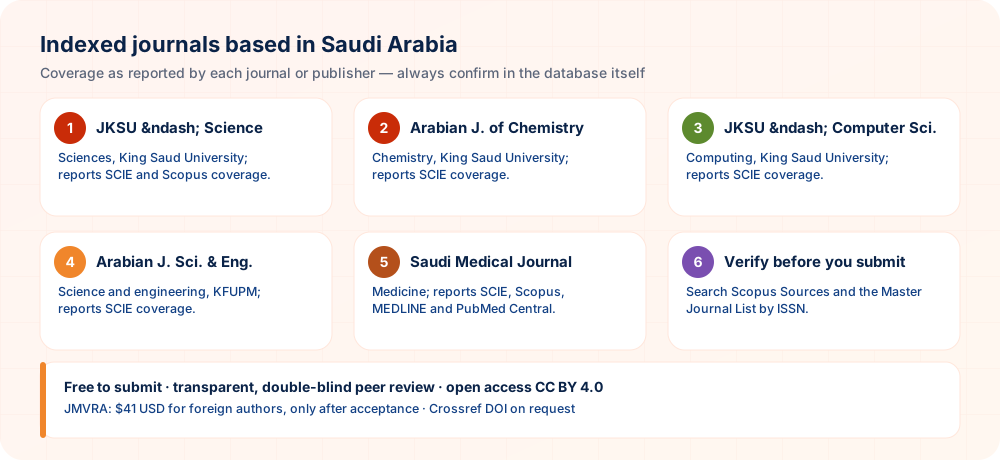
The journals below are published in Saudi Arabia and state, on their own sites or via their publisher, that they have Scopus and/or Web of Science coverage. Check each one by ISSN in Scopus Sources and the Master Journal List on the day you make your decision.
| Journal | Publisher | Subject | Reported coverage |
|---|---|---|---|
| Journal of King Saud University – Science | King Saud University, Riyadh (Scientific Scholar since 2025) | Sciences | Reported coverage: SCIE and Scopus |
| Arabian Journal of Chemistry | King Saud University, Riyadh | Chemistry | Reported: SCIE |
| Journal of King Saud University – Computer and Information Sciences | King Saud University (Springer) | Computer and information sciences | Reported: SCIE; DOAJ |
| Arabian Journal for Science and Engineering | King Fahd University of Petroleum & Minerals, Dhahran (Springer) | Science and engineering | Reported: SCIE |
| Saudi Medical Journal | Prince Sultan Military Medical City, Riyadh | Medicine | Reported: SCIE, Scopus, MEDLINE and PubMed Central |
A few other well-regarded journals, with Scopus or Web of Science indexing unconfirmed
| Journal | Publisher | Reported coverage |
|---|---|---|
| Annals of Saudi Medicine | King Faisal Specialist Hospital & Research Centre, Riyadh | Reported: SCIE, Scopus and MEDLINE — confirm current status |
Checked 4 October 2026. “Reported” means the journal or publisher says so; we have not independently confirmed it.
Indexing Verification Checklist
- Write down the ISSNBoth ISSNs, print and online, from the official website
- Scopus SourcesSearch the ISSN to confirm status and years covered
- Master Journal ListSearch the ISSN, then see if it is SCIE, SSCI, AHCI or ESCI
- Look for discontinuationRead through Scopus’s discontinued titles list
- Make a noteTake screenshots showing dates for your grant or promotion file
Publishing Abroad From Saudi Arabia
Saudi Arabia has more indexed national journals than many countries do, yet in most fields the broadest choice lies abroad. When searching internationally, look at the article processing charge (APC), whether a publisher agreement at your university pays for it, and whether a diamond open access journal (free for both authors and readers) exists in your discipline — DOAJ lets you filter by “without fees”.
Find out if your university has publisher agreements or research-deanship funding for APCs before you submit.
Quartiles, Impact Factor and Top-Tier Journals
Remember which source each metric comes from. The Journal Impact Factor for Web of Science titles is shown in Journal Citation Reports, while CiteScore and SJR rest on Scopus. Q1 means a journal falls in the top quarter of its subject category for that year only — compare journals only when category and year both match.
Most researchers in Saudi Arabia will find the highest-impact options in their field among international journals, not local ones. Locate them by subject category in Journal Citation Reports, Scopus Sources or SCImago, and read some recent articles to judge suitability. Our walkthrough on finding journals with a high impact factor covers the method step by step. Reading a few articles also shows the writing style and depth of methods the journal expects.
Picking an Indexed Journal for Your Subject
| Field | Saudi-published journals | Then search |
|---|---|---|
| Sciences | JKSU – Science | SCIE and Scopus |
| Chemistry | Arabian Journal of Chemistry | SCIE and Scopus chemistry |
| Computing | JKSU – Computer and Information Sciences | SCIE and Scopus computer science |
| Engineering | Arabian Journal for Science and Engineering | SCIE and Scopus engineering |
| Medicine | Saudi Medical Journal; Annals of Saudi Medicine | JCR and Scopus classification of medicine |
Getting Your Paper Ready for an Indexed Journal
At a selective journal, desk rejection is what most submissions meet, yet it can often be avoided. Before you send the paper:
- Test the fit by reading the aims and scope statement and three recent articles; if your manuscript would look out of place, choose another journal.
- Explain why a local study has wider value. Spell out what your data or setting can teach readers in other places.
- Refine language and formatting. A colleague’s read-through, or professional editing, helps authors whose first language is not English.
- Respond to every reviewer point. If revision is requested, address each comment in a response table.
Frequent Mistakes With Indexed Journals
- Believing a badge on a journal’s website and not consulting the database record.
- Failing to name the index — “Web of Science” could be SCIE, SSCI, AHCI or ESCI.
- Neglecting discontinuation — what was true of indexing last year may not hold now.
- Deciding on the metric alone — papers that fall outside a journal’s scope are rejected promptly.
How JMVRA suits authors in Saudi Arabia
Based in India, JMVRA (ISSN 2984-8911) is an international open access journal covering many disciplines. It is not a Saudi journal, but it accepts papers from authors in Saudi Arabia. JMVRA is not in Scopus or Web of Science; it serves authors who want an affordable, peer-reviewed open access journal rather than an indexed one.
- Fee: foreign authors owe $41 USD, which is settled once the paper is accepted and is shared by up to 5 authors.
- Review: subject experts run the peer review, which is double-blind and transparent; the similarity level has to be below 15%.
- Access: anyone can read the papers under CC BY 4.0, and authors may request a Crossref DOI.
- Our position on indexing: Google Scholar indexes it, whereas Scopus, Web of Science and DOAJ do not.
A Preparation Kit for Submitting to Indexed Journals From Saudi Arabia
| Item | Tip |
|---|---|
| Manuscript | Laid out in the journal template, with an English title, abstract and keywords |
| Cover letter | Sets out the journal fit and the reasons readers beyond Saudi Arabia will find the work valuable |
| ORCID iDs | It applies to all authors, helping keep records accurate |
| Approvals | Ethics clearance and any research permits that Saudi Arabia requires |
| Data availability statement | Where the data sits, or the reason sharing is impossible |
International Collaboration Starting in Saudi Arabia
Regional collaborators
Collaborative projects around the Gulf (GCC) pool data, methods and reviewers.
Researchers in the diaspora
Saudi Arabian researchers based overseas make natural co-authors and mentors.
Co-supervision
A thesis with co-supervisors produces papers with co-authors.
Agreeing authorship
Settle roles, author order and data ownership in writing before you begin.
Practical Tips for Saudi Researchers Navigating Indexed Publishing
Saudi universities support research across many fields and encourage international visibility. These tips help you select suitable journals and communicate your work in a way that stands up to careful review.
- Reconfirm publisher details regularly. Journals sometimes change publisher or platform. Before submitting, check the current publisher on the journal's website and in the official database record rather than relying on an older listing.
- Tell a clear methodological story. Describe design, instruments and analysis in enough detail that a stranger could repeat them. Methods sections are where many otherwise promising manuscripts lose reviewer confidence.
- Share data where policy allows. Deposit datasets in a recognised repository when ethics and institutional policy permit. Mention the access route in your data statement to demonstrate openness.
- Use a consistent author name. Choose one spelling of your name and affiliation for all outputs, and link it to a researcher profile. This avoids split records that make citations hard to trace.
- Read editorials in the target journal. Editorials often reveal what the editors want more of and what they decline. A few minutes of reading can redirect an unsuitable submission before it is sent.
Confirm current publisher details, describe methods transparently, and keep your name and affiliation consistent across every publication.
Questions Researchers Often Ask
Summary and What to Do Next
Saudi Arabia has indexed journals across several scientific and medical fields. Confirm the present publisher and indexing status, then select by suitability.
- Look into whether your rule calls for Scopus, Web of Science, a quartile or an index.
- Pick out journals for your field by combining the tables above with international databases.
- Check each title by its ISSN and keep a record of what you find.
- Turn to the directory of research journals in Saudi Arabia for titles without indexing.
Ready to send in your paper?
Submission to JMVRA is online and free. Review always comes first; the $41 USD publication fee applies only after your paper is accepted.
Related searches
Researchers in Saudi Arabia who use this guide commonly search for paper publication fees, journal publication in Saudi Arabia, affordable open access journals, high impact factor journals and Scopus and Web of Science indexed journals too. The guides that follow cover those topics:
- Low-cost journal publication in Saudi Arabia
- High impact factor journals in Saudi Arabia
- Research journals in Saudi Arabia
- How a low-fee journal is funded
- Locating high impact factor journals
- How to choose a journal
- Checking an indexing claim yourself
- Recognising a predatory journal
- Publishing with JMVRA from outside India
- JMVRA publication charges
References and Sources
Checked on 4 October 2026. Indexing status can change, so confirm it before submitting.
- SCImago journal rankings — Saudi Arabia
- JKSU – Science
- JKSU – Computer and Information Sciences
- Saudi Medical Journal
- Scopus Sources
- Clarivate Master Journal List
- ISSN Portal
- SCImago Journal & Country Rank
- Journal Citation Reports
Submitting to JMVRA From Saudi Arabia
- Submit onlineSaudi and overseas authors may apply; there is no submission charge
- ScreeningFit with scope plus similarity test (below 15%)
- Double-blind reviewSubject experts evaluate it; you are told the result by email
- Accepted — $41 USDOnly one fee, for up to 5 authors
- PublishedOpen access, licensed under CC BY 4.0
Details: Publication charges · Peer review · Advice for authors outside India.
Ready to Publish? Submit to JMVRA
JMVRA is aligned with UGC's Suggested Parameters for Choosing Peer-Reviewed Journals.
JMVRA is a Transparent, Peer-Reviewed, Open Access Journal (Refereed Journal). Following the discontinuation of the UGC and UGC-CARE journal listing, and in alignment with the latest UGC-CARE recommendations and guidelines, JMVRA is aligned with UGC’s Suggested Parameters for Choosing Peer-Reviewed Journals.
Quick links across jmvra.org
Key Terms
Subjects and search phrases this article addresses.
Related Reading
Additional reading for researchers in Saudi Arabia on picking a journal.
Affordable Journal Publication in Saudi Arabia
Read the guide RelatedHigh-Impact Journal Selection in Saudi Arabia
Read the guide RelatedA Researcher’s Verified Guide to Journals in Saudi Arabia
Read the guide RelatedResearch Journals in Oman: A Verified Guide
Read the guide RelatedResearch Journals in Egypt: A Verified List
Read the guide RelatedWhat International Authors Should Know About JMVRA
Read the guide RelatedChecking a Journal’s Indexing Claims
Read the guideKeep Reading on the JMVRA Blog
Our JMVRA journal blog carries this guide along with other practical advice on publishing, indexing, metrics and research integrity, all written so that claims can be verified and nothing is promotional.