
Nearly every journal website claims to be “peer reviewed”. Among low-cost, quick-turnaround journals that statement needs a closer look, since real review is the part that consumes time and money. Fortunately, genuine review leaves traces you can verify. Below is how peer review works, followed by six ways to confirm it really takes place before you entrust a journal with your article.
The Mechanics of Peer Review
| Model | How it works | Main benefit |
|---|---|---|
| Single-blind | Reviewers know who the authors are; authors never learn who the reviewers are | Widespread and easy to administer |
| Double-blind | Neither party can identify the other | Lessens bias tied to names and affiliations |
| Open | Names, and at times the reports, are made public | Transparency and accountability |
| Editorial review only | The editor alone makes the call, with no outside reviewers | Quick, yet it is not peer review |
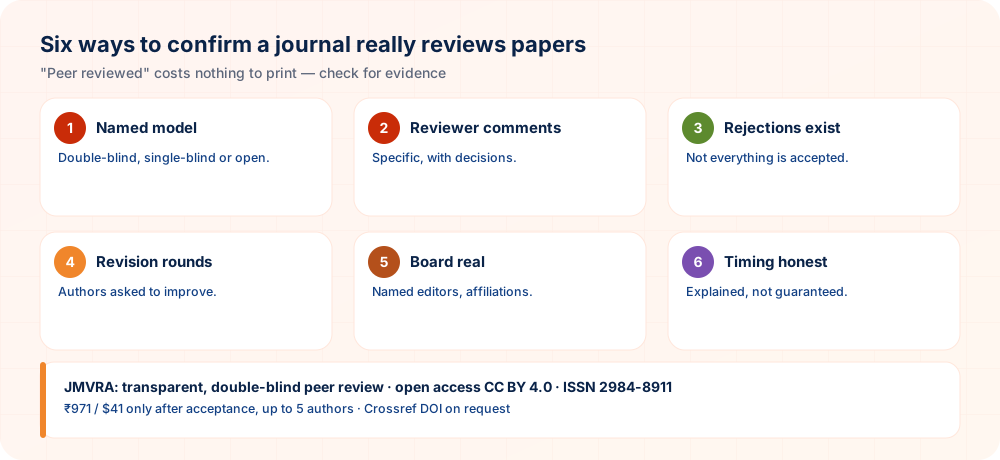
Six Checks That Prove Review Is Real
- A process that is spelled out. The journal describes its review model, how many reviewers it uses and the possible decisions.
- Reviewer reports delivered to you. Comments aimed at your own paper rather than a stock template.
- Changes are asked for. Genuine review frequently demands revisions, so blanket “accept as is” outcomes are rare.
- A visible set of reviewers. Editors and reviewers listed by name, or an explicit reviewer policy.
- Some papers get turned down. A journal that reviews honestly does reject certain submissions, so enquire about its acceptance rate.
- Fee due after acceptance. Billing only for accepted papers ties the charge to the outcome of review.
Is It Possible for Review to Be Quick and Genuine?
Yes, up to a point. A journal with a big reviewer panel, automated screening and swift editorial handling can send a first decision within days to weeks. It cannot, however, promise acceptance or issue a verdict before somebody has actually read your manuscript. Whenever turnaround looks suspiciously short, ask what was done during that time.
How Low Fees and Real Review Go Together
Most reviewing is carried out by academics who volunteer their time, so a journal’s expenses are mainly the platforms and staff that coordinate the work. Efficient journals handling large volumes can thus keep charges modest without skimping on review, as long as the process is run honestly.
Which Article Types Low-Cost Journals Typically Take
- Original research articles
- Review articles
- Short communications
- Case studies
- Technical notes
What an Authentic Reviewer Report Contains
Summary: This paper studies [topic], applying [method] to [data].
Major comments: 1) With only 84 respondents, the sample is too small for the SEM model; justify it or enlarge it. 2) Table 5 gives significance values but omits effect sizes. 3) The literature review leaves out recent studies on [topic], for instance [reference].
Minor comments: The axes of Figure 3 are missing units, and some references are incomplete.
Recommendation: Major revision.
See how detailed that is. Writing reports of this kind takes effort, which is precisely why real review can never be immediate.
The 10 Most-Searched Questions on This Topic
Here are the ten questions researchers search for most on this subject, each with a direct answer.
low cost peer reviewed journal
A journal charging a small fee yet still passing manuscripts to independent reviewers — confirm it using the six checks.
fast peer reviewed journal
A journal with streamlined review; decisions come promptly but are never promised.
how to check if journal is peer reviewed
Seek a stated process, paper-specific reviewer reports, requests for revision and a fee collected after acceptance.
single blind vs double blind review
Single-blind conceals only the reviewers; double-blind conceals authors and reviewers alike.
editorial review vs peer review
In editorial review the editor decides alone, whereas peer review brings in independent outside specialists.
acceptance rate of journal
The proportion of submissions that get accepted; a figure close to 100% hints at hardly any genuine review.
reviewer comments example
Concrete remarks on the methods, data, clarity and references of your paper.
publish articles fast peer reviewed
Pick a journal with efficient review and answer revision requests promptly.
peer review certificate
A few journals hand reviewers a certificate, but that is no evidence that authors’ papers were reviewed.
journal without peer review
A route to print with no outside review — generally not recognised for academic credit.
How JMVRA Fits In
JMVRA is a Transparent, Peer-Reviewed, Open Access Journal (Refereed Journal). Following the discontinuation of the UGC and UGC-CARE journal listing, and in alignment with the latest UGC-CARE recommendations and guidelines, JMVRA is aligned with UGC’s Suggested Parameters for Choosing Peer-Reviewed Journals. UGC public notice (PDF)
JMVRA sends every paper to subject experts for double-blind review before acceptance, gives authors the decision along with comments, and collects the ₹971 INR / $41 USD fee only after a paper has been accepted.
- ISSN
- 2984-8911 (online) · publishing since June 2023
- Issues
- Monthly issues across many disciplines
- Review
- Two-way anonymous review by specialists
- Access
- CC BY 4.0 open access
- Fee
- ₹971 INR for Indian and $41 USD for foreign authors, due only after acceptance
- DOI
- Crossref — available as an optional extra
- Indexing
- Google Scholar lists it; not Scopus, Web of Science or DOAJ
- Impact factor
- 11.25, derived from Google Scholar data
Screening begins the moment a paper arrives and each decision is sent as soon as it is reached, yet JMVRA never promises a set number of days: actual review time depends on the reviewers and on how much revision the paper needs.
At-a-Glance Checklist
- Review model statedInside the policy
- Feedback deliveredDetailed remarks
- Board searchedIndependently
- Speed claims explainedWith reasons
- Fee only after acceptanceNot earlier
Queries to Put to a Journal About Its Review
- How many reviewers look at each paper? — a precise reply is encouraging
- Will the reviewer comments reach me? — real review yields comments
- Which outcomes can a decision take? — accept, revise or reject, not simply “accept”
- Who deals with appeals? — an obvious path for objections
The Look of a Genuine Revision Request
Specific comments
It refers to particular sections, tables or analyses.
Requests for evidence
It asks for extra data, references or reasoning.
Clarity points
It flags passages readers could misread.
A clear decision
It labels the revision minor or major and lists the next steps.
Practical Tips for Judging Whether Quick Review Is Genuine
Speed can reflect efficient editing, or it can hint that little reading took place. These suggestions help you interpret turnaround and make sure your paper is truly examined by qualified people.
- Look for specific comments. Genuine reports refer to particular sections, methods or claims in your manuscript. Generic praise that could apply to any paper suggests the review may not have been thorough.
- Ask who handles decisions. Find out whether an identifiable editor oversees assessment and how reviewers are chosen. A clear answer shows that the process has structure and accountability.
- Prepare a response table. When comments arrive, answer each one in a table with the reviewer's point and your change. This shows respect for the process and speeds the editor's rechecking.
- Be wary of instant acceptance. Acceptance within moments of submission, without any questions about your work, is unusual for serious scholarship. Pause and ask how the paper was assessed before paying anything.
Quick can be legitimate, but insist on specific, substantive feedback and a clearly described process before trusting any journal.
Questions Researchers Often Ask
How Transparent Peer Review Works, Stage by Stage
- SubmissionScreening for plagiarism, formatting and scope comes first.
- Reviewer allocationSubject experts are assigned through the Scholar9 portal.
- Double-blind reviewReviewers judge originality, method, significance and clarity.
- DecisionYou are told by email and WhatsApp whether the paper is accepted, needs revision or is rejected.
- RevisionAuthors answer each comment in turn, point by point.
- TransparencyScholar9 keeps a record of the review, and the report is supplied on request.
Three transparency models exist — open reports, optional reviewer identity and open participation — and how JMVRA applies them is set out here.
Ready to Publish? Submit to JMVRA
JMVRA is aligned with UGC's Suggested Parameters for Choosing Peer-Reviewed Journals.
JMVRA is a Transparent, Peer-Reviewed, Open Access Journal (Refereed Journal). Following the discontinuation of the UGC and UGC-CARE journal listing, and in alignment with the latest UGC-CARE recommendations and guidelines, JMVRA is aligned with UGC’s Suggested Parameters for Choosing Peer-Reviewed Journals.
Handy links within jmvra.org
Key Terms
Subjects and search phrases this article addresses.
Related Reading
Further reading on the same theme from the JMVRA blog.
Online Paper Publishing for First-Time Authors
Read the guide RelatedSpeed, Cost or Prestige: Choosing Your Trade-Off
Read the guide Related10 Free Journal Finder Tools for Your Paper
Read the guide RelatedOpen Access, Peer Review, Impact Factor & UGC Parameters Norms — A Complete Guide
Read the guide RelatedRecognising a Predatory Journal
Read the guide RelatedWhy JMVRA Charges Just ₹971 INR / $41 USD Without Lowering Standards
Read the guideKeep Reading on the JMVRA Blog
The JMVRA journal blog includes this guide, one of many practical pieces on publishing, indexing, metrics and research integrity, prepared so readers can verify them without any sales pitch.