
Searching for low cost journal publication in Malaysia? Seeing a paper published should not eat up a month’s earnings. Here is a guide to what journals in Malaysia and overseas normally charge, where free and affordable routes exist, how to tell when a predatory offer uses a cheap price as bait, and five checks to complete before you pay anything. It is written for students, scholars and faculty in Kuala Lumpur, Malaysia; Serdang, Malaysia; Bangi, Malaysia; Shah Alam, Malaysia.
How Much Journal Publication Costs in Malaysia
Numerous Malaysian university journals ask for no fee or only a small processing fee in ringgit; some levy APCs, at times at a higher rate for international authors.
| Model | What authors pay | Typical publisher |
|---|---|---|
| Diamond open access | No cost at all — open to read and to publish in | Journals run by a university, a society or a funder |
| National or university journals’ charge | A small fee, frequently charged in ringgit | Society and university-run journals |
| International APC | Ranges from a few hundred to several thousand US dollars | Large non-profit and commercial open access publishers |
| Subscription or hybrid | Frequently free, with an optional fee for open access | Journals whose income comes from library subscriptions |
On top of peer review itself, fees cover screening, reviewer management, production, hosting and metadata. This explains why charges range from zero at a subsidised university journal to thousands of dollars at a commercial title. Above all, ask if you are paying for a real editorial process, and request an itemised breakdown whenever the fee is unclear.
Free and Affordable Routes for Malaysian Researchers
Presses at Malaysian universities put out several indexed journals with small fees; MyCite catalogues Malaysian journals along with their citation data, so you can weigh your choices.
- Diamond open access journals — in DOAJ, use “without fees” and a subject to narrow the list; handy for researchers in Malaysia.
- National and university journals — frequently inexpensive and widely read at home: look at MyCite, MyJurnal and the Ministry of Higher Education.
- APC waivers and discounts — many publishers grant them to authors in lower- and middle-income countries, so check each publisher’s policy.
- Institutional agreements — your library or university may have deals that pay or reduce APCs.
- Preprints — early findings can be shared free of charge, but a preprint is not a replacement for peer-reviewed publication.
What a Sound Low-Fee Journal Should Still Offer
Paying less must never mean a weaker review. When picking an affordable journal, make sure it still provides the basics that every author in Malaysia has a right to expect:
- Real peer review — a stated review model, independent referees and comments you can act on.
- Similarity screening — a published limit and a check before review, protecting both authors and the journal.
- A clear licence — Creative Commons is the norm for open access, so readers understand how your work can be reused.
- Permanent hosting — a stable article page, an archive, and a DOI if the journal can issue one.
- Correct metadata — precise titles, author details and references help search engines and databases find and cite the article.
- Transparent policies — ethics, corrections, retractions and refunds should be set out in writing before you submit.
Affordable Does Not Mean Predatory
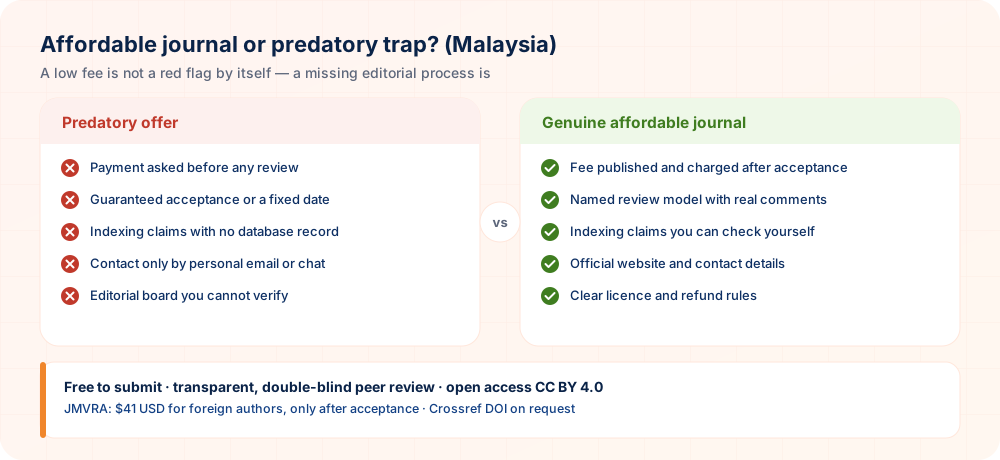
A low price does not make a journal predatory, but predatory journals know authors look for cheap fees. Examine the process: who the editors are, whether you receive real reviewer comments, when payment is requested and whether the databases confirm the indexing claims.
- A request to pay before any review or decision takes place.
- A promise of acceptance, or of acceptance by a fixed date.
- Claims about Scopus, Web of Science or impact factor that the databases do not support.
- A website copying a real journal’s title or ISSN.
- Fees that change after acceptance, or payment requested into a personal account.
Five Things to Check Before Paying a Publication Fee
- Real acceptanceThe decision, with reviewer comments, comes straight from the journal
- Fee was announcedThe amount is the same as stated before submission
- Official payment channelThe journal’s own page, not a personal account
- Know what is coveredNumber of authors, plus certificates, DOI and extras
- Keep the paperworkInvoice, receipt and acceptance letter
Funding and Support Available in Malaysia
Research management centres at universities often run publication incentive schemes and may help with APCs; look at the terms of your grant as well.
Treat the publication budget as part of study design, not an afterthought once the paper is accepted. Add the likely fee to grant applications, ask whether co-authors’ institutions can share the cost, and have a cheaper second journal ready in case the first is unaffordable.
Compare the Full Cost, Not Only the Headline Fee
| Item | What to check |
|---|---|
| Base fee | The published APC or publication charge, and the currency |
| Authors covered | How many authors the fee covers, and the cost of additional authors |
| Extras | Page, colour, DOI, certificate or print-copy charges |
| Payment costs | The extra that banks and currency conversion add to a payment sent abroad |
| Waivers | Whether you qualify for a fee reduction, and how to apply |
| Value | The standard of review, how far the journal reaches readers and the indexing you must have |
How to Pay a Publication Fee Safely From Malaysia
Cross-border payments bring extra costs that are easy to overlook: bank charges, currency conversion and, at times, intermediary fees. Prior to paying, ask the journal which payment methods it takes, whether the amount is stated in ringgit or US dollars, and whether the invoice can carry the name your institution requires for reimbursement.
- Do not pay before genuine acceptance; use only the journal’s official bank account or payment page.
- Do not pay into anyone's personal account or through an agent.
- Keep the acceptance letter, invoice and receipt in one file; audits and reimbursement may require them.
- If the charge differs from the advertised fee, request an explanation in writing before paying.
Affordable Publication From Anywhere in Malaysia
Submission, peer review and payment all take place online, which means authors in Kuching, Malaysia; Kota Kinabalu, Malaysia; Johor Bahru, Malaysia; George Town, Penang, Malaysia; Shah Alam, Malaysia; Bangi, Malaysia; Serdang, Malaysia; Kuala Lumpur, Malaysia and every other place are treated alike. Select a journal for its subject fit and working process; where you live does not alter the fee.
Where JMVRA suits authors in Malaysia
Based in India, JMVRA (ISSN 2984-8911) is an international open access journal covering many disciplines. It is not a Malaysian journal, but it accepts papers from authors in Malaysia. Its fee is modest because it operates on a no-profit, no-loss basis, not because peer review is skipped.
- Fee: Foreign authors, including those in Malaysia, pay $41 USD; it is requested after acceptance, not before, and covers up to 5 authors.
- Review: subject experts conduct a double-blind, transparent review, and similarity must be lower than 15%.
- Access: open access under a CC BY 4.0 licence; a Crossref DOI can be obtained on request.
- Indexing in plain terms: the journal is listed by Google Scholar; Scopus, Web of Science and DOAJ do not list it.
Budgeting for Publication Costs in Malaysian ringgit (MYR)
| Item | What to check |
|---|---|
| Publication fee | Which currency, and when the charge applies; JMVRA’s foreign-author fee of $41 USD is due only after acceptance |
| Payment charges | Bank or card charges on an international payment sent from Malaysia |
| Authors covered | Whether the fee applies to the whole author team (JMVRA: up to five) |
| Optional services | Extras (language editing, DOI, print copies) to be chosen only when you need them |
Sending an International Fee From Malaysia
- Wait until the acceptance email arrives — genuine journals do not ask for payment before review
- Transfer funds only with official payment details — sourced from the journal’s website or its acceptance email
- Confirm the sum in Malaysian ringgit (MYR) — your bank applies its own exchange rate
- Keep a copy of each receipt — for reimbursement and record-keeping
Smart Publishing Habits for Malaysian Researchers
Malaysian universities often set expectations for research output, which can create pressure to publish quickly. These tips help you stay deliberate and protect the quality of your record.
- Read your institution's research policy. Check how your university classifies outlets and which ones count towards its internal requirements. Policies change, so consult the latest document rather than relying on colleagues' recollections.
- Edit for clarity in English. If English is not your first language, ask a proficient reader to review the full manuscript. Clear writing prevents reviewers from misreading your methods or conclusions.
- Match the journal to your postgraduate stage. Doctoral candidates may need a particular kind of publication before the viva. Discuss options with your supervisor so that your timeline and journal choice align.
- Retain ethical approval documents. Keep your approval letters, consent forms and data management plans ready. Journals frequently request evidence, and quick answers prevent delays in the editorial process.
- Avoid splitting findings artificially. Dividing one coherent study into several thin papers to boost output can be treated as poor practice. Publish distinct contributions that each stand on their own.
Follow current institutional policy, polish your English and ethics documentation, and publish whole, meaningful studies instead of fragments.
Questions Researchers Often Ask
Summary and What to Do Next
Affordable publishing in Malaysia is achievable once you know where to search and what to verify. Favour journals with a clear workflow and a stated fee, take advantage of waivers and institutional help, and do not pay until a genuine acceptance arrives. Ask colleagues which journals treated their own submissions fairly.
- Find out exactly what your institution requires.
- Draw up a shortlist of diamond, national and affordable international journals that fit your field of study in Malaysia.
- Complete the five checks before you pay any fee.
- Browse the list of research journals in Malaysia as well as high impact factor journals in Malaysia.
Ready to send in your paper?
Submission to JMVRA is online and free. Review always comes first; the $41 USD publication fee applies only after your paper is accepted.
Related searches
Visitors from Malaysia reading this page frequently look up low cost journal publication, publication charges, APC waivers, free open access journals and secure ways to pay as well. These guides deal with each of those questions:
References and Sources
Checked on 4 October 2026. Fees and policies can change, so confirm them before submitting.
Getting Published From Malaysia With JMVRA
- Submit onlineWherever you live; there is no fee to submit
- Pre-reviewScope assessment and similarity (below 15%)
- Double-blind reviewSubject experts assess the paper and the verdict arrives by email
- Accepted — $41 USDOne charge applies to up to 5 authors
- PublishedPublicly accessible under CC BY 4.0
Details: Publication charges · Peer review · Advice for authors outside India.
Ready to Publish? Submit to JMVRA
JMVRA is aligned with UGC's Suggested Parameters for Choosing Peer-Reviewed Journals.
JMVRA is a Transparent, Peer-Reviewed, Open Access Journal (Refereed Journal). Following the discontinuation of the UGC and UGC-CARE journal listing, and in alignment with the latest UGC-CARE recommendations and guidelines, JMVRA is aligned with UGC’s Suggested Parameters for Choosing Peer-Reviewed Journals.
Where to go next on jmvra.org
Key Terms
Subjects and search phrases this article addresses.
Related Reading
Further guides for Malaysian researchers.
Keep Reading on the JMVRA Blog
Find this guide on the JMVRA journal blog, a collection of practical guidance on publishing, indexing, metrics and research integrity that favours verifiable content over promotion.