
A special issue gathers research on a single theme within a regular journal and is normally led by guest editors. It can suit a timely paper — provided the call is real and the review standards match the journal’s own. This guide covers what a journal special issue is, how guest editors work, how to find and check a call, how to submit, the integrity concerns worth knowing and how to put forward a proposal. Reading all of it before you start saves wasted effort on calls that do not fit.
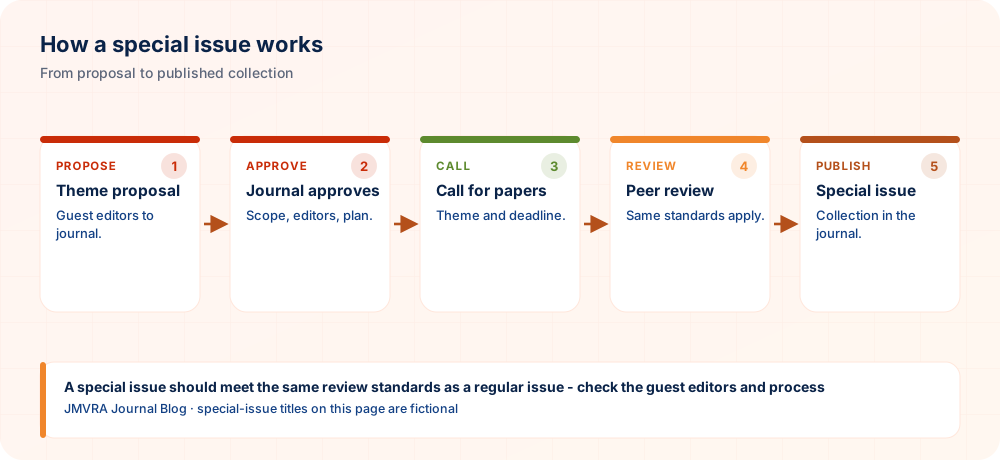
What Is a Journal Special Issue?
A journal special issue (also known as a themed issue or special collection) is a group of papers on one focused subject, published inside a regular journal and usually coordinated by guest editors — specialists in the theme who are invited or approved by the journal. The papers bear the journal’s name and ISSN just like any other article. Special issues pull together work on new or significant topics and can draw attention to a field. Because of that, they often attract readers who follow the theme more than the journal itself.
Special Issue vs Regular Issue
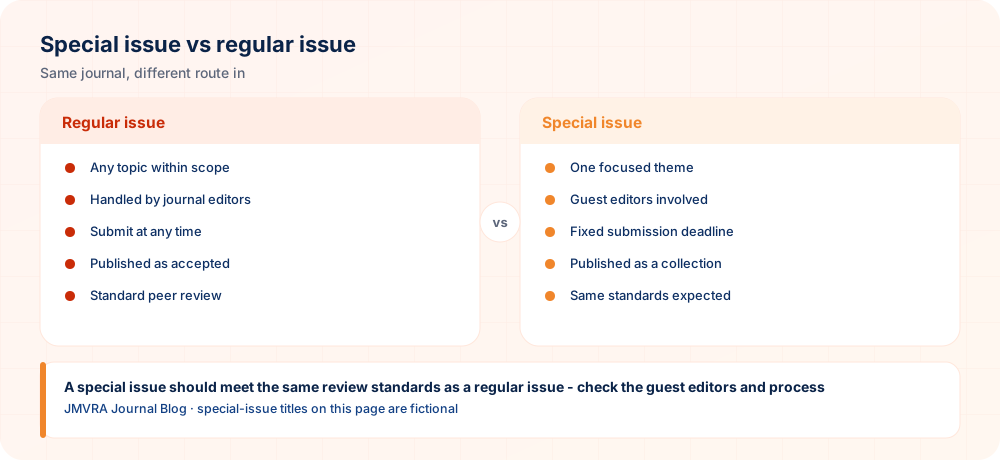
| Aspect | Regular issue | Special issue |
|---|---|---|
| Topic | Any topic within the journal’s scope | A single theme defined in the call |
| Editors | The journal’s editorial board | Guest editors under the journal’s oversight |
| Deadline | Submissions often accepted at any time | Fixed submission window |
| Publication | Added as papers are accepted | Released as a collection, or online as papers are accepted |
| Standards | The journal’s own peer review | Ought to match regular issues |
To see how special issues differ from conference proceedings, read Proceedings Volume or Journal Special Issue?.
The Role of Guest Editors
Guest editors suggest the theme, draft the call, invite and screen submissions, and run peer review according to the journal’s policies; a journal editor usually stays ultimately responsible. Good practice expects guest editors to disclose conflicts of interest and to stay out of decisions on their own papers or those of close colleagues. This separation protects the fairness of the whole collection.
Finding Special Issue Calls
- Journal websites, normally in sections called “Special issues” or “Calls for papers”.
- Notices from societies, conferences and research networks.
- Invitations from colleagues who serve as guest editors.
Verify the Call
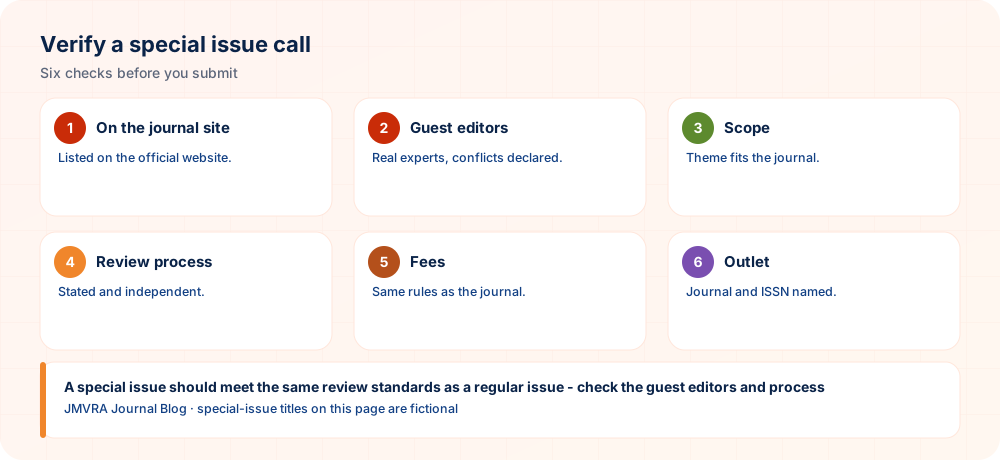
Make sure the call is posted on the journal’s official website, that the guest editors are real specialists whose institutional pages can be verified, that the theme sits within the journal’s scope, that a review process is described and that fees follow the journal’s ordinary rules. Further reading: how to identify predatory journals and how to spot hijacked journals.
How to Submit to a Special Issue
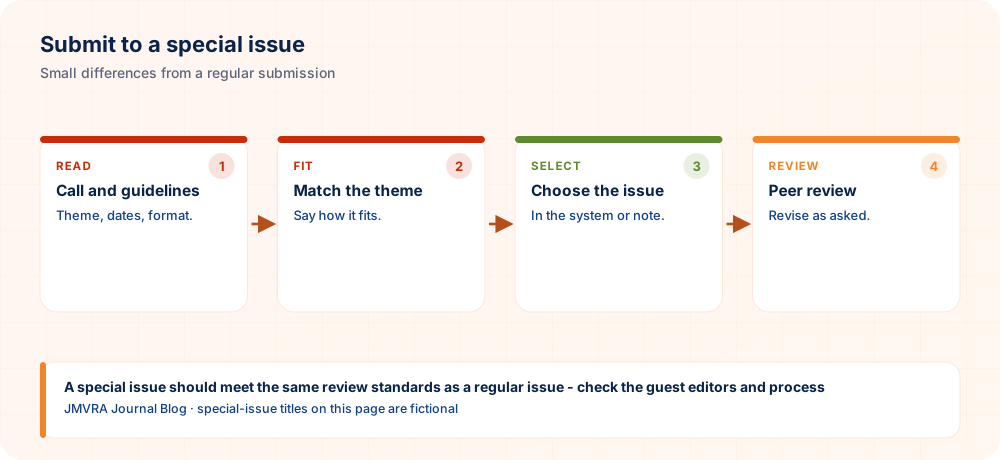
- Go through the call and the journal’s author guidelines, noting theme, deadline, accepted article types and formatting.
- Confirm the fit: describe in your cover letter how the paper speaks to the special-issue theme.
- Pick the special issue in the submission system, or mention it in the cover letter if no option exists.
- Complete peer review and revise as requested; acceptance is never assured.
Look at cover letter examples and the submission checklist.
Deadlines and Timing
Special issues come with submission deadlines, and papers that arrive late may be shifted to a regular issue or declined. Review takes however long it takes, so plan ahead and never count on a special issue for a guaranteed date. Building in time for revisions keeps a deadline from becoming a source of stress.
Integrity Concerns
Special issues have real value, but they have also been abused. A number of publishers have retracted large batches of special-issue papers after uncovering manipulated peer review, paper-mill submissions or compromised guest editing. Journals protect against this by vetting guest editors, supervising decisions and following COPE guidance. As an author, favour special issues where the journal’s oversight is plainly visible, and never pay anyone to obtain a place.
Pros and Cons for Authors
| Advantages | Points to weigh |
|---|---|
| A focused readership interested in the theme | A fixed deadline may clash with your schedule |
| Papers are grouped and often promoted together | Quality rests on the guest editors and oversight |
| Suits timely topics well | The theme can be narrower than your paper |
| Same journal record and ISSN | Some evaluators scrutinise special-issue papers more closely |
Proposing a Special Issue
Researchers and institutions are able to propose special issues. A proposal normally contains the theme and its rationale, guest editors with brief CVs, a draft call, expected contributors, a timeline and a plan for managing review. Select a journal whose scope matches the theme. A clear plan for handling conflicts of interest strengthens a proposal.
Special Issues With JMVRA
Colleges and institutions can ask JMVRA for a special issue using the same secure request form that serves conferences; the editorial team examines the request and passes on the procedure. Details appear on the special issue page, and subject-wise calls on the call for papers page. For a single paper that is not part of a special issue, submit straight to JMVRA whenever you like; issues are published monthly.
JMVRA in brief
- Review: transparent, double-blind peer review, normally by at least two subject experts. Specialist reviewers assess your paper, and you receive the acceptance or rejection decision by email and WhatsApp.
- Fee: Payment of ₹971 INR (Indian authors) or $41 USD (foreign authors) is requested after acceptance alone; there is no cost to submit or to be reviewed.
- Access: free to read under CC BY 4.0; ISSN 2984-8911; a new issue every month; submit whenever you like; ask for a Crossref DOI if you want one.
- Indexing: JMVRA appears in Google Scholar and is registered with Crossref and the ISSN Portal / ROAD; it is not currently indexed in Scopus, Web of Science or DOAJ.
Share Your Research Through JMVRA
Submit your research to JMVRA for publication
JMVRA (ISSN 2984-8911) is a peer-reviewed, open access journal spanning many disciplines. Submission is free. Specialist reviewers assess your paper, and you receive the acceptance or rejection decision by email and WhatsApp.
- 1. Get ready by reading the guidelines
- 2. Submit online
- 3. Peer review
- 4. Decision by email & WhatsApp
- 5. Open-access publication
Your At-a-Glance Checklist
- OfficialCall on the journal’s site
- EditorsVerifiable experts
- FitTheme matches
- SelectSpecial issue picked
- ReviewSame standards
- No payFor a place
Contributing Wisely to a Journal Special Issue Call
Special issues can offer a focused audience, but they also invite shortcuts and sometimes misleading calls. Careful preparation helps you take part without compromising your reputation.
- Match your paper to the theme. Read the call's scope closely and explain in your cover letter how your work contributes. Papers that stretch the theme are usually returned early.
- Verify the guest editors. Look up their profiles through institutional pages and confirm they are linked with the journal. An unverifiable editorial team is a reason to hesitate.
- Expect the same review standards. A themed issue should still involve genuine peer review. Be cautious if the call promises automatic acceptance or skips the usual evaluation.
- Plan around the closing period. Allow time for revisions after reviewer comments, not only for the first submission. Starting early prevents a rushed manuscript that weakens your case.
Check the call, the guest editors and the review process before you submit, and begin early so revisions are not rushed.
Questions Researchers Often Ask
In Summary
A special issue can offer a timely paper a focused readership, as long as the call is genuine and the journal’s standards are applied. Locate the call on the official website, check the guest editors and process, demonstrate how your paper fits, and expect review as for any other paper. When no suitable special issue is open, a regular issue is an equally valid home.
Time to publish: submit your paper to JMVRA
JMVRA (ISSN 2984-8911) is a peer-reviewed, open access journal spanning many disciplines. Submission is free. Specialist reviewers assess your paper, and you receive the acceptance or rejection decision by email and WhatsApp.
- 1. Get ready by reading the guidelines
- 2. Submit online
- 3. Peer review
- 4. Decision by email & WhatsApp
- 5. Open-access publication
References and Further Resources
Special Issues Summary
- ThemeOne focus
- Guest editorsVerified
- CallOn the journal’s site
- SubmitChoose the issue
- ReviewSame standards
Related: JMVRA special issues · Request form · Submit Paper.
Ready to Publish? Submit to JMVRA
JMVRA is aligned with UGC's Suggested Parameters for Choosing Peer-Reviewed Journals.
JMVRA is a Transparent, Peer-Reviewed, Open Access Journal (Refereed Journal). Following the discontinuation of the UGC and UGC-CARE journal listing, and in alignment with the latest UGC-CARE recommendations and guidelines, JMVRA is aligned with UGC’s Suggested Parameters for Choosing Peer-Reviewed Journals.
Handy links within jmvra.org
Key Terms
Subjects and search phrases this article addresses.
Related Reading
Further guides on special issues, proceedings and choosing journals.
Proceedings Volume or Journal Special Issue?
Read the guide RelatedPublishing a Conference Paper From Abstract to Proceedings
Read the guide RelatedSpotting Predatory Journals: Signs & Scenarios
Read the guide RelatedResearch Paper Cover Letters: Template & Examples
Read the guide RelatedChoosing a Journal by Career Stage and Goal
Read the guide RelatedPeer-Reviewed Journals and How Review Works
Read the guideKeep Reading on the JMVRA Blog
The JMVRA journal blog includes this guide, one of many practical pieces on publishing, indexing, metrics and research integrity, prepared so readers can verify them without any sales pitch.