
Type a question or pick a category to find help on technical support, certificates, tracking, DOI & indexing, peer review, payment and submission, written for JMVRA authors.
A journal with peer review, aligned to UGC's 2025 suggestive parameters.
Help Categories
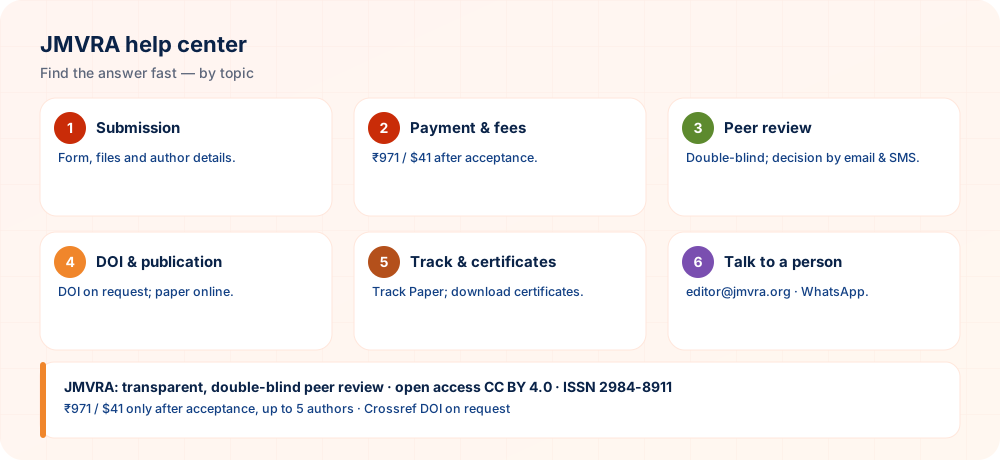
Nine categories that take you from your first submission through to a published, indexed DOI.
Submission Help
Help with manuscript upload, layout mistakes and problems with the submission confirmation.
6 articlesPayment & Fees
What each fee is, which payment options work, plus invoices, GST and transactions that fail.
6 articlesPeer Review
How long review takes, how to handle reviewer feedback and revisions, and how to read the final decision.
5 articlesDOI & Publication
Registering a DOI, links that do not resolve, and the steps between acceptance and the paper going online.
5 articlesIndexing & Visibility
Reasons your paper may not yet appear in Google Scholar or other databases.
5 articlesTrack Your Paper
How to see your submission's status, what each stage is called and the usual time frames.
4 articlesCertificates
Getting your certificate, fixing mistakes on it and asking for printed copies.
4 articlesPolicies & Ethics
Similarity limits, copyright, retractions and the place to find all policy documents.
5 articlesTechnical Support
Failed uploads, browser problems and general fixes for site issues.
4 articlesPopular Resources
Pages that authors open most frequently.
Reach a Real Person
Each contact option listed here connects you to the editorial team itself, never an automated bot.
Response Time
Usual time to first reply
Within 24 hoursSupport Hours
Indian Standard Time (IST)
Mon–Sat, 9 AM–6 PMFrequent Problems & Ways to Resolve Them
For the problems authors meet most, each entry gives the symptom, its cause and a remedy, grouped under the nine categories shown above.
Submission Help
My file upload fails repeatedly
Nearly every time, the cause is a file format or size issue. The JMVRA upload form takes only .doc and .docx files, so a PDF, a scanned image or a Google Docs export link gets rejected. Make sure the file is smaller than 10 MB; embedded high-resolution pictures are what usually inflate a file. When the paper really does contain many images, shrink them inside Word (File Compress Pictures) and save again. Keep a copy of the original file so you can compare quality after compressing.
No submission confirmation email has reached me
Begin by looking in your spam or junk folder, since institutional mail systems often filter automatic confirmations. Should nothing show up after an hour, avoid submitting again. Send your name and paper title to [email protected] instead, and the editorial team will verify receipt by hand and prevent a duplicate entry. Adding the institution's mail domain to your safe-sender list helps future messages arrive.
May one idea be split into two separate submissions?
Only when each paper offers a substantial contribution of its own. Dividing a single dataset or study into several thin papers (“salami slicing”) counts as an ethics problem under the COPE Ethics Policy, and both papers could be sent back. If the studies are truly linked, cite the companion paper and explain the relationship openly.
A co-author's information was typed in wrong
Requests to change the author list or affiliations need to be made in writing, with every listed co-author agreeing, before final acceptance. Once a DOI has been registered, a change calls for a formal metadata update that takes more time. Check each author's name, affiliation and ORCID closely when you receive the proof — see why this matters for indexing.
What should I do when my paper falls short of the 4-page minimum?
Lengthen the discussion, related-work or methodology sections instead of stretching the page count with blank space or oversized figures; reviewers spot this, and it may influence the outcome of the review. When your work truly is a short communication, say so in your cover note, because that is a recognised format (see Documentation).
How can I be sure the editorial team received my submission?
A confirmation email arrives containing your manuscript reference number. Hold on to it, because you need it both to track your paper's status and for any later correspondence.
Payment & Fees
What is included in the fee?
One all-inclusive fee of ₹971 INR for Indian authors or $41 USD for foreign authors covers plagiarism screening, indexing propagation, the publication certificate, a Crossref DOI, ISSN registration and peer review. No separate submission fee exists, and nothing further is invoiced after acceptance apart from this single payment. Compare this list with what other journals include before judging any fee.
Money left my account but the payment shows no confirmation
Typically the gateway did complete the transaction, but its confirmation message to our system arrived late or not at all. Such timing problems on the bank side are common and the money is not lost. Please do not pay again. Write to [email protected] with a screenshot showing the transaction or UTR number along with your manuscript reference; the editorial team will check and confirm by hand, usually within a business day. Keep the bank's debit message until the confirmation is complete.
Which ways of paying are accepted?
| Method | Indian Authors | International Authors |
|---|---|---|
| UPI | Yes | Not applicable |
| Net banking | Yes | Not applicable |
| Debit / Credit card | Yes | Yes |
| International wire / card | — | Yes |
Will I receive a GST invoice?
Yes. For payments made by Indian authors, a GST-compliant invoice is created automatically and sent with your confirmation email. The GST Policy explains how tax is treated in more detail.
Do I pay anything when my paper is rejected?
No. A publication fee is requested solely after editorial acceptance. Because no submission fee exists, a rejected paper costs you only the time spent in review.
Is a refund possible once I have paid?
Whether you qualify for a refund hinges on how far your paper had progressed when you ask. The Refund Policy spells out all details, including the situations that are eligible.
Peer Review
What is the real duration of the review?
Specialist reviewers assess your paper, and you receive the acceptance or rejection decision by email and WhatsApp. Review time depends on reviewer availability and the revision needed, so no fixed turnaround is promised.
What if I do not agree with a reviewer's remark?
Accepting every comment without question is not expected. For any point you decide not to act on, set out your reasons politely and clearly in the response document, backed by evidence or published literature whenever you can. The handling editor considers your justification together with the reviewer's original remark.
After a rejection, may I submit the paper again?
Yes, provided you have revised it substantially to answer the reviewers' concerns. Resubmitting brings no penalty and no extra fee, because publication fees apply only after acceptance.
What is the reason JMVRA follows double-blind review?
Reviewers and authors do not know each other's identities, so institutional reputation, seniority and personal acquaintance play no part, and the judgement rests on the work itself. The complete process is described in About JMVRA.
What number of reviewers evaluate my paper?
At least two independent subject experts, selected from a pool of 3000+ reviewers covering many disciplines.
DOI & Publication
My DOI link gives an error
Start by waiting: a DOI normally becomes active 24–72 hours after publication, so a link tried too soon will not work. When more than 72 hours have gone by and https://doi.org/ followed by your DOI still shows an error, write to the editorial team right away, quoting your DOI and manuscript reference. The publisher has to correct this registration fault; you cannot fix it yourself. Test the link again in a fresh browser window before reporting it.
Is a separate DOI request necessary?
A Crossref DOI is offered on request as an optional extra to the regular publication process. It is not assigned automatically, so tell the editorial team when you submit if you want one.
My name appears misspelled in the published metadata
Get in touch with the editorial office the moment you notice the error. The corrected record can be deposited with CrossRef, yet spreading it to aggregators is slow and duplicate records may linger further along, which is precisely why checking at proof stage (see Documentation) is so important.
What is the correct way to cite my DOI?
Use the complete resolver format, https://doi.org/10.5555/xxxxx, rather than the bare DOI string or the journal page URL. Only this form is certain to keep resolving even when the site is redesigned.
How does "accepted" differ from "published"?
Acceptance means the editors have decided to publish your paper. Publication happens later, when the article goes online with a DOI, usually a few days to a couple of weeks after acceptance, after typesetting, proofing and DOI registration have finished. Until that point, avoid describing the paper as published in applications or CVs.
Indexing & Visibility
My paper does not appear on Google Scholar yet
Such a delay is normal during the first weeks. Google Scholar crawls sites on its own timetable and generally lists a new article 2–6 weeks after publication. Meanwhile, check that your DOI resolves and add the paper by hand to your Google Scholar profile, which also helps the crawler discover it.
How can I verify where my paper is really indexed?
The Indexing & Abstracting page contains a six-step self-check to follow; it guides you through testing your DOI, examining the CrossRef record and searching Google Scholar, OpenAlex, Scilit and OpenAIRE yourself.
Why do Google Scholar and CrossRef report different citation counts?
Their sources and coverage are not the same. Google Scholar crawls widely, taking in theses and preprints, whereas CrossRef counts only citations from publishers who deposit reference lists. A mismatch between the two is to be expected and is not a fault. Quote the source and date alongside any citation figure you report.
My co-author appears under two profiles with one name
The cause is a name written in different ways across papers (e.g. “R. Kumar” vs “Rajesh Kumar”). To solve it, use one ORCID iD consistently from now on; earlier records will not merge by themselves, but the duplication will stop increasing.
Is it possible to ask JMVRA to send my paper to a particular database?
Records reach Google Scholar, OpenAIRE, OpenAlex, Scilit, ResearchGate and Zenodo automatically through the CrossRef deposit. No manual submission is made for each article, so nothing can be requested. Should a particular record still be absent after two months, ask the editorial office to inspect the underlying CrossRef deposit.
Track Your Paper
Where can I see my paper's present status?
Enter your manuscript reference number in the Track Your Paper portal, or ask [email protected] by email for a status update done by hand.
What is the meaning of each status stage?
| Status | Meaning |
|---|---|
| Submitted | Received and waiting for first screening |
| Under Screening | Checks of scope, format and completeness underway |
| Under Review | Being assessed by reviewers under double-blind conditions |
| Revision Requested | Reviewer feedback delivered; your reply is awaited |
| Accepted | Decision taken by the editors; payment and typesetting follow |
| In Production | Stage of typesetting and proofing |
| Published | Live with a DOI |
Is it normal that my status has stayed the same for several days?
Yes, certain stages, "Under Review" above all, naturally last longer than the rest. Contact the editorial team with your reference number if the paper has not moved for over two weeks past the expected period.
I no longer have my manuscript reference number
Look through your inbox for the first submission confirmation email. Otherwise, send the editorial team your paper title, author name and roughly when you submitted, and they can find it for you.
Certificates
Where can I get my publication certificate?
As soon as your article is published, the certificate can be downloaded using the link in your publication confirmation email. The Tutorials section has the step-by-step instructions.
There is a spelling mistake on my certificate
Write to [email protected] giving the correct spelling plus your DOI or manuscript reference. A corrected certificate is issued after the change is checked against the published metadata.
Does every co-author receive an individual certificate?
Yes. Each listed author of an accepted paper is issued a certificate, and not only the corresponding author.
How can I obtain a printed copy of the journal?
Printed copies can be supplied if you ask; postage is charged and the amount is told to you when you make the request. To arrange one, email the editorial office.
Policies & Ethics
Is there one page where all JMVRA policies can be read?
Looking for a policy? The All Policies page collects all 23 documents, among them publication charges, peer review, ethics, refunds, copyright and AI-generated content.
What similarity or plagiarism limit applies?
Before reaching reviewers, every manuscript is screened and has to stay within the permitted similarity level; a paper above it is sent back for revision. The complete policy is in Publication Ethics.
How should I raise a copyright issue concerning a published article?
The Copyright Infringement Policy sets out the procedure, which includes investigation and, if the concern is confirmed, retraction.
Is JMVRA genuinely peer-reviewed, and how can I check this on my own?
Look up the journal name or ISSN 2984-8911 on the official UGC CARE portal itself, and never accept a journal's own badge at face value. About JMVRA's FAQ describes the whole verification approach.
What rights do I keep over my published work?
Copyright stays with you under the CC BY 4.0 licence. Author Rights & Open Access Licence explains this fully.
Technical Support
The submission form does not open or keeps hanging
Switch to another browser such as Chrome or Firefox in its latest version, empty the browser cache, or use another network, since some institutional networks block particular form submissions. When the trouble continues, attach your manuscript to an email sent straight to [email protected] to avoid wasting time.
A page on the site will not open for me
Make sure you are using the correct, current URL and not an old bookmark or forwarded link, then reload the page. If it stays broken, report it to the editorial team along with the exact URL.
Messages sent to [email protected] are returned
Look for typing mistakes in the address, and make sure your institution's server is not blocking your outgoing mail, which happens with some university email systems. WhatsApp works as a backup: +91 91063 65667.
No reply comes from the WhatsApp number
Support is available Mon–Sat, 9 AM–6 PM IST. Any message sent outside those hours gets a reply on the next business day. Email is watched a little more widely, which helps in urgent cases.
Is Your Paper Ready for Submission?
Starting at ₹971 INR · UGC Status & Parameters · Crossref DOI available on request · International publishing practice.
At-a-Glance Checklist
- Topic foundIn the help categories
- Paper ID readyFor any query
- Spam folder checkedFor emails
- One channel usedAvoid duplicates
- Payment proof keptFor billing queries
Try to Fix It Yourself First
| Problem | Try |
|---|---|
| Did not receive an email | Look in the spam and promotions folders |
| Upload fails | Verify the file's size and format, then try a different browser |
| Wrong details submitted | Send your paper ID in an email to the editorial office |
| Unsure of fee | Visit the publication charges page |
When You Should Contact Support
- Send one clear message — including your paper ID
- Include screenshots — when the issue is technical
- Stick to a single channel — either email or WhatsApp
- Save the response — as your own record
Contacting Support Efficiently About Submission, Payment or Certificates
Clear, well-organised enquiries are resolved sooner than vague ones. A few minutes of preparation lets support staff understand your situation at once and respond with the right solution.
- Choose the correct category. Sort your question into submission, payment, review, identifier or certificate matters before writing. Directing it to the right topic avoids being passed between people.
- Write a useful subject line. Include the type of problem and your paper identifier in the subject. Staff can then locate your record immediately without reading the whole message first.
- Attach proof in one message. Send screenshots, receipts or file names together with a short chronological explanation. Splitting evidence across many emails makes the case harder to follow.
- State the outcome you need. Say plainly whether you want a correction, a copy, a status update or an explanation. A defined request leads to a defined answer.
- Protect sensitive information. Hide card numbers and passwords in any screenshot you send. Support teams should never require them to investigate a technical fault.
Pick the right topic, identify your paper in the subject line and send one organised message with evidence and a clear request.
Questions Researchers Often Ask
How can I follow my paper's progress?
Open Track Paper on jmvra.org and enter your Registration ID. Email and WhatsApp messages also deliver decisions.
At what point is the publication fee paid?
Payment comes only once the paper is accepted: ₹971 INR from Indian authors or $41 USD from foreign authors, which covers up to 5 authors.
I have paid, yet the status still reads unpaid. What now?
Send your paper ID and the transaction ID or receipt to [email protected] by email. Do not make the payment again.
What is the quickest way of getting help?
Send your paper ID by email to [email protected], or message +91 91063 65667 on WhatsApp.
What should I do if my upload continues to fail?
Verify the file's format and size, switch to a different browser, and then reach support with a screenshot.
Your Paper's Journey at JMVRA, From Submission to Publication
- SubmitReceive your paper ID
- ScreenScope & similarity
- ReviewDouble-blind
- DecideEmail & SMS
- RevisionComment by comment
- AcceptCopyright & fee
- ProduceDOI at the author's request
- PublishMonthly issue
How long review takes depends on the reviewers and on any revision required, so no set turnaround is promised; you are told of acceptance or rejection by email and WhatsApp.
Ready to Publish? Submit to JMVRA
JMVRA is aligned with UGC's Suggested Parameters for Choosing Peer-Reviewed Journals.
JMVRA is a Transparent, Peer-Reviewed, Open Access Journal (Refereed Journal). Following the discontinuation of the UGC and UGC-CARE journal listing, and in alignment with the latest UGC-CARE recommendations and guidelines, JMVRA is aligned with UGC’s Suggested Parameters for Choosing Peer-Reviewed Journals.
Quick links across jmvra.org
Key Terms
Subjects and search phrases this article addresses.
Related Reading
Further reading on the same theme from the JMVRA blog.
Keep Reading on the JMVRA Blog
Our JMVRA journal blog carries this guide along with other practical advice on publishing, indexing, metrics and research integrity, all written so that claims can be verified and nothing is promotional.