
Colleges, institutes and universities can team up with JMVRA (ISSN 2984-8911) to publish conference proceedings and special issues that are peer-reviewed and citable, at a fraction of what special-issue publishing normally costs.
A JMVRA special issue of its own is created for your conference, bringing every accepted paper together under the event's name.
Each paper is screened and reviewed prior to publication, so the editorial standard matches that of regular issues.
For an extra ₹500, each conference paper can have a lasting, citable digital identifier.
Proceedings go live after review ends and all documents have arrived, and the organiser is kept informed at every stage.
The price is only ₹500 + GST for each paper, far below what conference proceedings usually cost to publish.
Once published, proceedings are open access and can be found through Google Scholar and other academic databases.
What Does JMVRA's Conference / Special Issue Partnership Involve?
Colleges, institutes and universities frequently host national and international conferences, seminars and symposiums, and each one asks the same thing afterwards: where do we publish the proceedings? That is precisely what JMVRA's Conference & Special Issue Partnership answers.
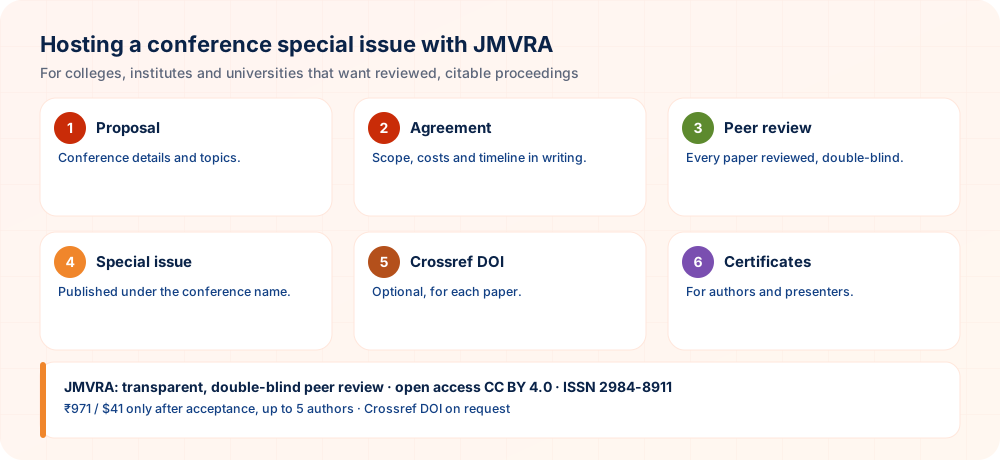
Rather than self-publishing a proceedings PDF that lacks an ISSN, a DOI and long-term discoverability, organising institutions can issue their conference papers as a dedicated Special Issue of JMVRA (ISSN 2984-8911), which is peer-reviewed, citable and permanently archived.
Reasons Colleges, Institutes & Universities Pick JMVRA
- No publishing setup required — peer review, formatting, ISSN association, hosting and indexing are all taken care of by JMVRA.
- Low price per paper — ₹500 + GST, far less than the expense of producing a separate proceedings volume.
- Real peer review — papers are screened and not merely compiled, which gives delegates a credible publication.
- Lasting digital archive — once published, proceedings stay available for good, whereas a PDF on a conference site may vanish after the event page is removed.
- Optional Crossref DOI — for optional add-on per paper, delegates get a permanent, citable identifier for their conference paper.
The Conference Special Issue Process, Step by Step
- Send a Conference / Special Issue Request — the host institution provides the conference details (brochure, conference website, a short description, the conference name, organising body, institution and contact person) through the online request form.
- Editorial Review — Before confirming anything, JMVRA's editors examine the request and then reach out to the institution through the contact details it supplied.
- Paper Collection — after confirmation, the institution gathers the accepted conference papers from delegates, making sure they follow the required format.
- Peer Review — every paper receives the identical plagiarism check and peer review that an ordinary JMVRA submission gets.
- Payment & Documents — authors send the required documents together with the fee charged per paper (₹500 + GST, with an extra ₹500 when a Crossref DOI is needed).
- Special Issue Publication — the accepted papers appear together in a separate special issue carrying the conference's name.
Conference Publication Charges
Conference proposals invited by JMVRA come with straightforward, open pricing charged per paper, with no bundled fees and no unexpected charges.
| Item | Amount |
|---|---|
| Paper Publication for Conferences / Special Issues | ₹500 |
| GST (18%) | ₹90 |
| Subtotal (without DOI) | ₹590 |
| Crossref DOI (optional extra) | +Optional |
| Total (with DOI) | ₹1,090 |
What the ₹500 + GST Fee Covers
- Editorial screening plus peer review for each conference paper
- Typesetting and placement within the conference's own special issue
- Publication carrying JMVRA's ISSN (2984-8911)
- Open access hosting, readable free of charge anywhere
- An electronic publication certificate issued to the author
- Exposure through indexing on Google Scholar and further academic discovery platforms
Crossref DOI for Papers from Conferences
A Crossref DOI (Digital Object Identifier) assigns every conference paper a unique, lasting identifier that does not break, which helps with citation tracking, institutional recognition and building a delegate's academic profile. In conference special issues the DOI is an optional add-on priced at ₹500 per paper, because registering it and maintaining its metadata carries a cost of its own. Check that author names and the title are final before requesting one, as metadata errors are tedious to fix later.
Advantages for Organising Institutions
- Adds academic credibility to your conference through a genuine, indexed publication result
- Spares you from running a proceedings publication process on your own
- Builds the standing of later editions, since delegates are confident their work will be published properly
- The institution does not need its own infrastructure, editorial panel or ISSN registration
Advantages for Individual Authors & Presenters
- A peer-reviewed journal article rather than merely a conference certificate
- A publication certificate that can go into academic records
- Crossref DOI available as an option for lasting citation
- Open access exposure for the work presented at the conference
Conference Partnership: Eligibility & Requirements
To get started, the organising institution provides these details through the Conference / Special Issue Request form:
- Full conference name
- Organising body / institution
- Name and location of the college / institution
- Full name, mobile number and email address of the contact person
- Conference website, if there is one
- A short summary of the conference
- Brochure for the conference (optional; PDF, Word, JPG or PNG)
At-a-Glance Checklist
- Proposal sentWith organising committee
- Costs confirmedPer paper, in writing
- Review agreedSame standard as regular issues
- DOI decidedOptional per paper
- Schedule sharedWith all authors
Getting Conference Papers Ready for the Special Issue
- Distribute the JMVRA template — to every conference author at an early stage
- Gather papers in a single format — editable files that include author details
- Verify similarity — keep it under 15% before passing papers on
- Obtain declarations — confirming originality and authorship consent
Communicating With Authors
Clear timeline
Let authors know what follows once the conference ends.
Review expectations
Certain papers will require revisions.
DOI option
A Crossref DOI is an optional extra.
Certificates
Certificates reach authors once the paper is published.
Preparing Conference Papers Before Joining a Special Issue
A special issue gathers papers from one event, which means one weak batch can slow everyone down. These tips help organisers and presenters bring the papers into good shape together.
- Circulate one template to all authors. Send the same formatting file and instructions to every presenter. Papers in a uniform layout need far less editing and move through checks faster.
- Ask for expanded versions. A short abstract is not a full paper. Encourage presenters to develop their talk into a complete manuscript with methods, results and references.
- Run a plagiarism check internally. Before forwarding papers, scan them using a tool available at your institution and ask authors to fix overlapping text, so problems are handled early.
- Appoint one point of contact. Nominate a single coordinator to talk to the journal and to authors. Mixed messages from several organisers create errors in names and payment details.
- Confirm details of every author. Collect correct spellings of names, affiliations and email addresses in a spreadsheet, and ask each author to verify their own row before the list is sent.
Give all authors the same template and instructions, and keep one coordinator and one verified author list.
Questions Researchers Often Ask
Q1. What does JMVRA's Conference / Special Issue Partnership involve?
It is a scheme through which colleges, institutes and universities can publish their conference proceedings as their own Special Issue of JMVRA, with peer review, citability and permanent archiving under JMVRA's ISSN. Institutions benefit most when they agree on the format and schedule with authors before the event.
Q2. What is the cost of publishing a conference paper?
Each paper costs ₹500 + 18% GST (₹90) = ₹590. A Crossref DOI can be added as an optional extra for ₹500, which makes the total ₹1,090 per paper when a DOI is included.
Q3. How can our conference be submitted for a special issue?
Fill in the online request form as a Conference / Special Issue Request, giving the conference details, a contact person and, if you wish, a brochure. Afterwards the editorial team reviews it and contacts you.
Q4. Who pays: the institution or the individual authors?
The fee is charged for each paper, and organising institutions frequently handle bulk submission and payment for their conference delegates. Agree internally on who pays before submission so that receipts and invoices carry the right name.
Q5. Can conference papers get a Crossref DOI?
Yes. It is an optional extra at ₹500 per paper and gives every conference paper a lasting, citable digital identifier.
Q6. How much time does publication need?
The schedule usually depends on how readily reviewers are available once peer review begins and the required documents have been submitted.
Q7. Does our conference receive a separate special issue, or do papers appear within regular issues?
Your conference's papers are kept together in a dedicated special issue bearing the conference name, separate from JMVRA's regular monthly issues.
Q8. Must a conference brochure be attached to the request?
No. The brochure is optional, whereas the conference name, organising body, institution and contact details must be supplied.
Q9. What follows once we send in the request form?
The editorial team goes through your request prior to its public appearance, and you will be contacted on the email address or mobile number you entered in it.
Q10. Are international conferences eligible as well?
Yes. National as well as international conferences held by academic institutions can join the partnership.
Q11. Does every paper presented at the conference get published?
No. A paper is published only if it clears peer review and satisfies JMVRA’s standards, which include similarity under 15%.
Q12. Who is in touch with the conference authors?
Typically the organisers of the conference take care of it, in coordination with the editorial office of JMVRA at [email protected].
Looking to publish your conference proceedings? Submit your Conference / Special Issue Request, after which JMVRA's editors will examine what you sent and contact you.
JMVRA Welcomes Your Conference Proposal
₹500 + GST per paper · +₹500 for Crossref DOI · Total ₹1,090 with DOI
Conference Proceedings vs Journal Special Issue
| Aspect | Conference proceedings | Journal special issue |
|---|---|---|
| Format | Volume compiling the presented papers, edited | Articles picked for inclusion in an issue of the journal |
| Review | Conference committee review | The journal's complete review process |
| Length | Shorter, fewer references | Whole article; extended papers normally bring ~30% fresh material |
| Timing | Usually in hand at the event itself | When review and acceptance are complete |
| Best for | Capturing what was presented | The strongest papers become journal articles that can be cited |
Are you the organiser of an event? JMVRA accepts a conference or special issue proposal from you.
Ready to Publish? Submit to JMVRA
JMVRA is aligned with UGC's Suggested Parameters for Choosing Peer-Reviewed Journals.
JMVRA is a Transparent, Peer-Reviewed, Open Access Journal (Refereed Journal). Following the discontinuation of the UGC and UGC-CARE journal listing, and in alignment with the latest UGC-CARE recommendations and guidelines, JMVRA is aligned with UGC’s Suggested Parameters for Choosing Peer-Reviewed Journals.
Quick links across jmvra.org
Key Terms
Subjects and search phrases this article addresses.
Related Reading
Further reading on the same theme from the JMVRA blog.
SEO for Journals Without Tricks
Read the guide RelatedConference Management Systems Explained
Read the guide RelatedOpenAlex Explained for Researchers and Publishers
Read the guide RelatedTutorials
Read the guide RelatedJW Book: Self-Publish With ISBN and Global Reach
Read the guide RelatedHow to Become a JMVRA Reviewer: Eligibility, Registration & Benefits
Read the guideKeep Reading on the JMVRA Blog
Our JMVRA journal blog carries this guide along with other practical advice on publishing, indexing, metrics and research integrity, all written so that claims can be verified and nothing is promotional.