
Submit your research paper to JMVRA — UGC Status & Parameters, Transparent Peer-Reviewed, Open Access Journal
Aligned with UGC's 2025 suggestive parameters, this is a peer-reviewed journal.
Submission Deadline Countdown
Publish Your Research Paper Today in a Low-Cost, UGC CARE Approved Journal
Publish your research paper with JMVRA, an open access journal with transparent peer review that follows UGC Status & Parameters and international publishing practice. The package includes double-blind review, a Crossref DOI on request, and indexing across Google Scholar, ROAD and major academic databases. Researchers from India and around the world publish with it.
Onwards · incl. GST · $41 USD international
Crossref DOI on Request Submit Paper- UGC Status & Parameters
- International publishing practice
- Crossref DOI (On Request)
- Official ISSN Number
- Decision by Email & SMS
No hidden charges · Decision by email & WhatsApp
Publishing a Book as Well? JMVRA Publication Can Assist
Some manuscripts are not journal papers. For a full-length book, whether a monograph, textbook, edited volume, poetry or fiction, JMVRA's parent publisher, JMVRA Publication, handles everything from manuscript to a saleable, ISBN-registered title, with professional editing, cover design and distribution via Amazon, Flipkart, Google Books, Kindle and Apple Books.
Onwards · per title · custom quote for your manuscript
DOI, Certificate & Hard Copy — On Request Get a Book Quote- Official ISBN Registration
- Professional Editing & Design
- Global Online Distribution
- Author Proof Approval
- Royalty Tracking Dashboard
No hidden charges · Custom quote for your manuscript
Important Dates & Deadlines
New issues of JMVRA appear every month. To have your paper in the current issue, send it in ahead of the deadline.
Topics & Subject Areas
JMVRA is a multidisciplinary journal that welcomes original research papers from every field of study.
Easy 6-Step Submission Process
Submitting a manuscript takes only minutes, and our team supports you throughout.
Submission Guidelines
Keep to these guidelines so that your paper meets JMVRA standards and is processed quickly.
- Format: MS Word (.doc / .docx)
- Minimum 4 pages, no maximum limit
- Font: Times New Roman, 12pt body, 14pt heading
- Abstract: 150–250 words
- Keywords: 5–8 relevant keywords
- References: IEEE / APA / MLA style
- Plagiarism: Below 15% similarity
- Language: English or regional languages accepted
- Full name of all co-authors
- Affiliation: Department, Institution, City, Country
- Corresponding author email address
- Mobile number for SMS notification
- ORCID ID (optional but recommended)
- Author undertaking form (provided after acceptance; authors retain copyright, CC BY 4.0)
- Declaration of original and unpublished work
- No simultaneous submission to other journals
- Title (concise, informative)
- Author(s) and Affiliation
- Abstract and Keywords
- Introduction & Literature Review
- Methodology / Research Design
- Results & Discussion
- Conclusion & Future Scope
- References
- Indian Authors: ₹971 INR only
- International: $41 USD
- Payment via UPI, NEFT, PayPal, Card
- Fee paid only after acceptance
- Official receipt provided
- No hidden charges
- Print copy available at extra cost
- Crossref DOI available on request
Author Benefits
Choosing JMVRA brings your research the widest visibility and strong academic recognition.
Ten Years of Published Research
JMVRA has been publishing continuously, monthly, since June 2023 — here's the record so far.
Indexed & Recognised On
Reasons to Send Your Research to JMVRA
On the surface, every call for paper looks alike: a deadline, a fee and a pledge of quick review. What counts is what follows once you press submit: who reads the manuscript, how thoroughly it is judged, and whether the end result is a publication you can cite and depend on for years. These are the points that truly distinguish JMVRA's process.
The Criteria Reviewers Apply
Four matters outweigh the rest for reviewers: how original the contribution is, how sound the methodology is, how clear the results and discussion are, and whether the data presented really supports the conclusion. A neatly formatted paper that is weak on these points is still sent back for revision, because correct formatting only speeds up screening and cannot replace the substance of the research.
Typical Reasons for Returning Papers for Revision
- An abstract that falls outside 150–250 words, or that outlines the subject without reporting what was actually found
- Co-author details that are incomplete, such as a missing affiliation, designation or email for any named author
- Citation styles that are mixed (some references in IEEE, others in APA) in a single manuscript
- A similarity score over the accepted threshold, most often caused by background sections that are not paraphrased enough
- Figures or tables lacking captions, or never mentioned at least once in the body text
Getting the Most from Your Submission
The most effective step before you submit is to work through the 12-point Submission Checklist. It takes roughly five minutes and catches most of the problems that would otherwise hold your paper up at screening. Also, write your abstract at the end, once the paper is complete, so that it reflects your actual results and not what you first planned for the study.
The Journey of Your Paper After Publication
Publication is not where the story ends; it is the moment your work becomes discoverable for good. Each accepted paper is registered with Crossref (DOI available on request), spreads on its own to Google Scholar, OpenAlex and ResearchGate in the following weeks, and stays hosted permanently under open access, free for anyone to read, cite or build upon.
Preparing Your Paper for This Call
- Pick your strongest result — a single clear contribution
- Work in the JMVRA template — right from the beginning
- Verify similarity — under 15%
- Get author details and declarations ready — full and correct
- Meet the monthly deadline — late papers move to the following issue
Article Types Welcome
Original research
New data and analysis.
Review articles
Synthesis of existing work.
Case studies
Detailed analysis of a case.
Short communications
Focused, timely findings.
Preparing a Strong Response to a Call for Papers
A call for papers invites many submissions at once, so careful preparation helps your manuscript stand out for the right reasons. These suggestions apply before you press the submit button.
- Match your topic to the scope. Read the listed subject areas and article types, then state in your cover note why your work belongs in this journal rather than elsewhere.
- Start formatting early. Download the template at the outset and write inside it. Reformatting a finished draft at the last minute is where citation and heading errors usually creep in.
- Prepare an anonymised file. For blind review, remove names, acknowledgements and self-identifying phrases from the main file, and keep a separate title page with author details ready.
- Have co-authors approve the draft. Share the final version with every listed author and record their agreement before submission. Disputes over authorship are much harder to settle afterwards.
- Keep your source files safely. Store the manuscript, figures, data and correspondence together in one folder so revision requests can be answered promptly and accurately.
Read the scope and instructions fully, prepare an anonymised, correctly formatted file, and confirm co-author approval before submitting.
Call for Paper — FAQ
Brief answers on this call for paper. Visit the full FAQ hub for anything else.
What is the deadline for submission?
Send your paper before the 25th of each month for that month's issue; anything later moves automatically to the next month.
What is the review duration?
Review time depends on reviewer availability and the revision needed, so no fixed turnaround is promised. Specialist reviewers assess your paper, and you receive the acceptance or rejection decision by email and WhatsApp.
How much is the publication fee?
The fee is ₹971 INR for Indian authors and $41 USD for foreign authors, and it is collected only after acceptance, never when you submit.
Can I submit if my subject is missing from the Topics list?
Yes. JMVRA is fully multidisciplinary, and the topics shown are examples and not limits.
Are authors from other countries accepted?
Yes, authors from any country can submit. Foreign authors pay $41 USD, and everything is handled online.
What happens if my paper is not accepted?
You pay nothing, because the fee applies only after acceptance. You get feedback and can revise and resubmit.
Is submission itself charged?
No. A fee is charged only once the paper is accepted.
Is a language other than English allowed?
JMVRA publishes in English as well as in Indian and foreign languages.
Ready to Publish?
Send in your research paper now — a transparent, double-blind review, and the acceptance or rejection reaches you by email and WhatsApp.
A Full Guide to Answering JMVRA's Call for Paper — Timelines, Requirements & What Follows Your Submission
Most "call for paper" notices give you three items: a deadline, a fee and a pledge of review. What they seldom explain is everything between pressing submit and seeing your paper live with a DOI, and that is the gap that leaves many first-time authors unsure. This guide covers JMVRA's call for paper from start to finish so that nothing is left to guesswork.
Key Fact
JMVRA's call for paper carries no fixed annual deadline. Submissions are welcome on every day of the year, and each accepted paper goes into the next monthly issue that is available. You need not wait for an announcement or for a special "window" to open.
The Real Meaning of "Call for Paper" at JMVRA
Many journals treat a call for paper as a one-off event linked to a special issue or a conference partnership, with a hard cutoff after which nothing is accepted until the next cycle. JMVRA works differently, because its call is a standing, rolling invitation. As JMVRA publishes monthly (12 issues a year), authors can prepare and submit a manuscript when their research is ready, with no need to race an artificial deadline or lose months waiting for another call.
This is more significant than it first seems. With a fixed annual call, authors must either hurry a manuscript to meet the cutoff or hold finished research back for months until the next window. A rolling call eliminates that dilemma completely, and the only deadline that matters is the moment your own manuscript is truly ready.
Who Can Respond to This Call for Paper
Many kinds of contributors may respond, and JMVRA places no limit on submissions based on career stage or institutional affiliation:
- PhD scholars needing a peer-reviewed publication before they submit the thesis or sit the viva
- Faculty and professors strengthening their publication record for API scoring and promotion rounds
- Master's and bachelor's students who want to showcase their own project work that is original, plus case studies or brief communications
- Industry researchers and practitioners who record applied findings beyond a purely academic setting
- Foreign authors from any country — the process and the pricing ($41 USD) are the same wherever you are
- Conference organisers who propose a peer-reviewed special issue for the accepted papers of their event
Manuscript Preparation — What Is Actually Checked
A manuscript first goes through an initial screening that looks at format and completeness, and not at scientific merit, before any reviewer sees it. Most delays at this point can be avoided:
| Requirement | What Screening Checks |
|---|---|
| Abstract | 150–250 words that summarise the real findings and do not merely restate the topic |
| Key Terms | 5–8 terms that someone searching would realistically type to find your paper |
| Author details | Each listed co-author's full name, designation, institutional affiliation and email |
| Citation style | A single consistent style from start to finish (IEEE, APA or MLA), never mixed inside one manuscript |
| Similarity score | Under the accepted threshold, as verified with Turnitin/iThenticate before a reviewer receives the paper |
| Figures & tables | Captioned and numbered, and mentioned at least once in the body text |
| Length | At least 4 pages in the JMVRA format, with no upper limit |
None of these involve academic judgement; they are mechanical checks. A manuscript that fails one is just returned for a quick fix and is not rejected on merit.
From Submission to Publication, Stage by Stage
- Submission. You send the paper online, with no submission fee and no charge should it be rejected later.
- Initial screening. Format, completeness and scope are examined, and any problems are reported to you straight away and not after a full review.
- Plagiarism screening. The manuscript is tested for similarity, and papers over the threshold are sent back before a reviewer sees them.
- Double-blind peer review. At least two subject-matter reviewers, drawn from a 3,000+ expert panel, judge originality, methodology and clarity.
- Decision communicated. The decision, whether accept, minor revision, major revision or reject, reaches you with the reviewer comments attached.
- After acceptance — Payment. Only at this stage, and never before it, is the ₹971 INR / $41 USD fee requested.
- Publication. Final steps include approval of the proof, typesetting, registration of the Crossref DOI (on request) and the issue of the certificate.
Pro Tip
The quickest way to prevent delay at any stage is to answer reviewer or editorial feedback within 24–48 hours. Papers left unanswered for weeks are not rejected; they just slip to the back of that month's queue and move into the next issue.
When Your Paper Needs Revision and Is Not Accepted Outright
A request for revision does not mean rejection; it shows the review process doing its job. Reviewers typically want one of three things: a clearer methodology, more discussion of the results, or conclusions that are better supported. Answer every comment point by point in a brief response document submitted with the revised manuscript. Handling editors look for this when judging whether the revision resolves the concern, and it is much quicker to assess than a revised paper that offers no account of what changed and why.
Included in the Publication Fee, and Available on Request
Payable solely after acceptance, the ₹971 INR (Indian authors) / $41 USD (foreign authors) fee funds the complete editorial and production process. That means screening, organising double-blind peer review, plagiarism checks, copy-editing, typesetting, ISSN listing, lasting open-access hosting and a digital publication certificate.
| Item | Status |
|---|---|
| Peer review, editorial handling, hosting, certificate | Included in the base fee |
| Crossref DOI | On request, optional add-on |
| Printed hard copy of the journal | On request, optional add-on |
| Turnitin/iThenticate plagiarism report | On request |
| Transparent peer review certificate | On request |
| Best Paper Award nomination | On request, for outstanding submissions |
Handling DOI, hard copy and report requests apart from the base fee is a conscious choice for transparency, so authors who want only the core publication do not pay for extras they never requested. The full breakdown is on the Publication Charges policy page.
After Publication — The Next Stops for Your Paper
Publication is not the final point; it is when your paper becomes discoverable for good. When it goes live, metadata is deposited with Crossref and spreads over the next weeks to Google Scholar, OpenAIRE, OpenAlex, ResearchGate, Scilit and Zenodo, and it can also be found through Semantic Scholar, Mendeley, BASE and WorldCat. A DOI that you requested resolves permanently at doi.org, whatever changes JMVRA's own website may undergo later. The Indexing & Abstracting page has the complete indexing breakdown.
Answering This Call for Paper from Any Location
Everything described above happens online, including submission, review communication, payment, DOI registration (on request) and certificate download. Authors in any Indian city, or in any of the Global countries JMVRA serves, follow an identical process, and no stage requires attendance in person. When you cannot tell whether your manuscript is ready for this call for paper, contact the editorial team before submitting. That advice costs nothing, and a manuscript shaped properly beforehand clears screening and review noticeably faster.
What This Guide Covers
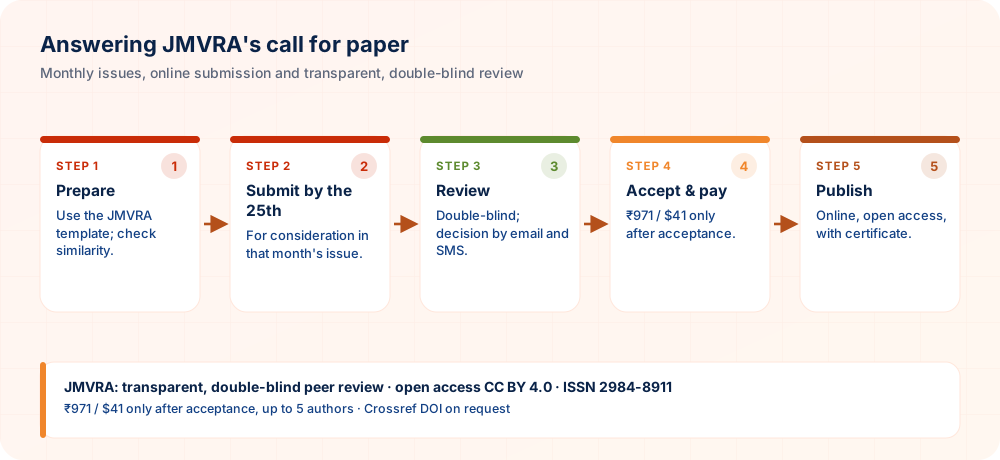
At-a-Glance Checklist
- Template usedJMVRA manuscript template
- Similarity below 15%Checked before review
- Submitted by the 25thFor that month's issue
- Contact details checkedEmail and mobile you use
- Fee after acceptanceNever at submission
Your Paper's Journey at JMVRA, From Submission to Publication
- SubmissionPaper ID assigned
- ScreenScope & similarity
- ReviewDouble-blind
- DecideEmail & SMS
- AmendItem by item
- AcceptCopyright & fee
- ProduceDOI provided when requested
- PublishMonthly issue
How long review takes depends on the reviewers and on any revision required, so no set turnaround is promised; you are told of acceptance or rejection by email and WhatsApp.
Ready to Publish? Submit to JMVRA
JMVRA is aligned with UGC's Suggested Parameters for Choosing Peer-Reviewed Journals.
JMVRA is a Transparent, Peer-Reviewed, Open Access Journal (Refereed Journal). Following the discontinuation of the UGC and UGC-CARE journal listing, and in alignment with the latest UGC-CARE recommendations and guidelines, JMVRA is aligned with UGC’s Suggested Parameters for Choosing Peer-Reviewed Journals.
Handy links within jmvra.org
Key Terms
Subjects and search phrases this article addresses.
Related Reading
Further reading on the same theme from the JMVRA blog.
JMVRA Help Center for Authors, Reviewers & Organisers
Read the guide RelatedLiterature Reviews That Synthesise, Not List
Read the guide RelatedPublishing a Thesis With JMVRA: Archive or Book
Read the guide RelatedJournal Fees Decoded: APC, Taxes & Add-Ons
Read the guide RelatedSubmitting Your Paper to JMVRA: Step-by-Step
Read the guide RelatedConverting a PhD Thesis to a Journal Article, Step by Step
Read the guideKeep Reading on the JMVRA Blog
The JMVRA journal blog includes this guide, one of many practical pieces on publishing, indexing, metrics and research integrity, prepared so readers can verify them without any sales pitch.