
No Application Needed; Metadata Simply Arrives
Unlike with DOAJ or Scopus, a journal does not "apply" to OpenAlex. Its articles usually show up because their metadata, most often a registered DOI with title, authors, affiliations and references, has already been deposited with an open data source such as Crossref, and OpenAlex ingests that source on a regular basis. Get the metadata right where it originates, and OpenAlex coverage will generally follow on its own update cycle.
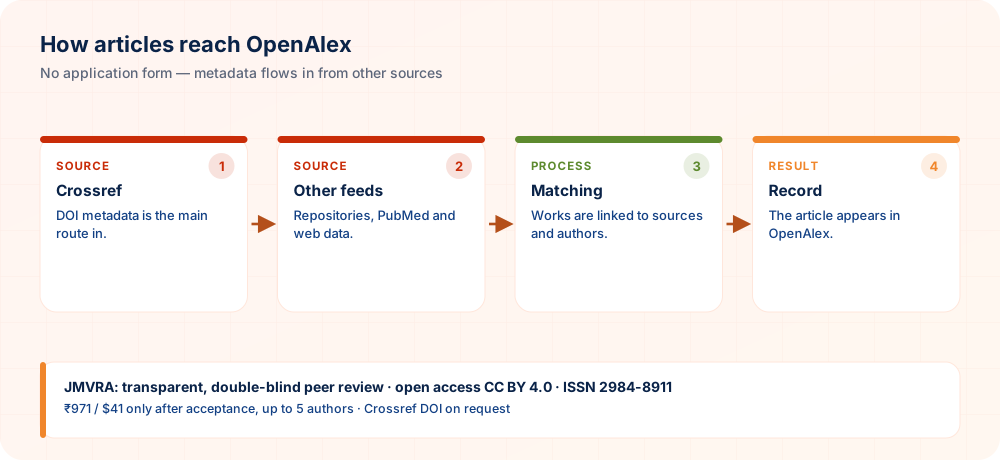
The Route Metadata Takes into OpenAlex
Reasons an Article May Not Be Visible Yet
- Lag in data ingestion, since OpenAlex updates on its own timetable and not the moment something is published
- DOI metadata that is incomplete at the source (authors, affiliations or references missing)
- No DOI has been registered for the article at all
- A metadata correction made recently that has not spread through yet
- The article appeared on a platform that OpenAlex's present data sources do not cover yet
Should your article be absent from OpenAlex or show incorrect details, fix the metadata at the true registration source (usually the DOI record) instead of hunting for a way to edit OpenAlex itself; the fix should then flow through at the next ingestion cycle. Keep a note of what you changed and when, so you can confirm later that it arrived.
Why "Indexed in OpenAlex" Can Be Misleading
Describing OpenAlex presence as "indexing" takes over wording from Scopus and Web of Science, where indexing means a journal passed a selective editorial evaluation. OpenAlex performs no such evaluation and simply aggregates open data widely. Using one word for two different processes blurs a distinction that matters a great deal. Saying that a journal's articles "appear in OpenAlex's data" is more accurate than saying the journal "is indexed by OpenAlex."
When Your Article Is Missing from OpenAlex
Open catalogues rely on metadata that arrives from other sources, so gaps and delays are normal. These steps help authors and editors investigate a missing or incorrect record calmly.
- Allow reasonable time first. Newly published articles do not appear everywhere at once. Wait a sensible period after publication before raising a concern, and check again rather than assuming something has failed.
- Check the registered metadata. Confirm that the article's identifier is registered and that title, authors and journal details are correct at the source. Errors there are copied downstream and explain many missing or mismatched records.
- Use correct author identifiers. Add your ORCID iD to your accepted paper and keep affiliations consistent across publications. Consistent details help automated systems attach your work to the right author profile.
- Contact the journal about errors. If the underlying metadata is wrong, ask the journal to correct it at the source. Fixing the original record is usually more effective than trying to edit copies elsewhere.
- Do not read presence as praise. Appearing in a large open catalogue shows that metadata exists, not that a paper is excellent. Judge quality by the work itself, its review process and its reception among peers.
Be patient, repair metadata at its source, keep your author details consistent, and remember that being listed is not the same as being recommended.
How to Check an Article in OpenAlex
- Search for the title — on the OpenAlex website
- Inspect the source — journal name and ISSN
- Inspect authors and institutions — are they linked properly?
- Record the DOI — it ties in the Crossref data
Fixing Errors
| Error | Fix |
|---|---|
| Wrong metadata | Fix it where it originates (publisher or Crossref) |
| Missing article | Check DOI registration |
| Author mixed up | Use ORCID consistently |
OpenAlex Coverage FAQs
Must I apply to OpenAlex to have my journal included?
There is no formal application; articles usually appear through metadata taken from sources such as Crossref.
What does "source record" mean in OpenAlex?
The journal or venue has its own entry in OpenAlex, kept apart from the records for single articles (works).
Is OpenAlex inclusion assured once a DOI is registered?
It raises the likelihood considerably because Crossref metadata is a main input, but it is not a firm guarantee.
Why has my published article not shown up yet?
The commonest causes are ingestion lag, metadata that is incomplete, or no DOI being registered.
Is it possible to fix wrong details in OpenAlex?
Fix the metadata at its source (for instance the DOI record), and the change should flow through at the next update.
Does inclusion in OpenAlex equal being indexed?
Not as Scopus or WoS use the term, because OpenAlex aggregates data and does not do selective editorial indexing.
Does a small, new journal stand a realistic chance of being covered?
Yes. OpenAlex sets no selective quality bar, and all that is needed is for metadata to reach its data sources.
Will being covered by OpenAlex help citations?
It can aid discoverability, but it does not directly bring about citations or ensure them.
Is it sensible to list OpenAlex coverage on a CV?
It is reasonable as one signal of discoverability, though it does not equal a listing in Scopus or Web of Science.
Is it possible to submit a journal to OpenAlex?
No application exists; metadata comes in from sources such as Crossref.
Does OpenAlex serve as a basis for rankings?
Certain analyses draw on it, but being present is not a mark of quality.
Related Searches
Good Metadata Begins with a Complete Manuscript
When the title, authors, affiliations and references are accurate, each later discovery step, whether DOI, OpenAlex or Google Scholar, works properly at the first attempt.
Submit Paper OnlineAt-a-Glance Checklist
- DOI metadata filled inAuthors, abstract, references
- ISSN accurateIn each deposit
- Be patientNew records need time
- Report errorsVia OpenAlex support
- No claim of quality"In OpenAlex" shows presence alone
Where JMVRA Appears — With Current Figures
Quickly test Google Scholar coverage, in one minute
- Begin with the titlePaste or type the exact title of the article into Google Scholar.
- Use the source filter:Key in
source:"Journal Name"and Google Scholar will show that journal’s papers. - Inspect the profilePull up the citation profile of the journal if one has been set up.
Visit the Indexing & Discovery page for a link to each record listed here (figures as of 30 Sep 2026).
Ready to Publish? Submit to JMVRA
JMVRA is aligned with UGC's Suggested Parameters for Choosing Peer-Reviewed Journals.
JMVRA is a Transparent, Peer-Reviewed, Open Access Journal (Refereed Journal). Following the discontinuation of the UGC and UGC-CARE journal listing, and in alignment with the latest UGC-CARE recommendations and guidelines, JMVRA is aligned with UGC’s Suggested Parameters for Choosing Peer-Reviewed Journals.
Related pages on jmvra.org
Key Terms
Subjects and search phrases this article addresses.
Related Reading
Further reading on the same theme from the JMVRA blog.
Refund Policy
Read the guide RelatedMendeley, Zotero or EndNote? Pick a Reference Manager
Read the guide RelatedPublish Conference Proceedings as a JMVRA Special Issue
Read the guide RelatedPublish With JMVRA From Any City or Country
Read the guide RelatedBecoming a JMVRA Reviewer: Eligibility, Registration & Benefits
Read the guide RelatedGoogle Scholar vs Academia.edu vs ResearchGate: Which One to Use?
Read the guideKeep Reading on the JMVRA Blog
Published on the JMVRA journal blog, this guide gives practical direction on publishing, indexing, metrics and research integrity, with a focus on what can be verified instead of on promotion.