
An email titled “Decision on your manuscript” can be hard to read calmly, and harder to interpret. Editors use standard phrases, yet the same words can carry different weight at different journals, and a major revision is not a disguised rejection. This guide explains each common decision — desk reject, reject, reject and resubmit, major revision, minor revision and accept — what it signals, what to do next, how long you typically have, and how to appeal if a decision rests on a clear mistake.
Who makes the decision, and how
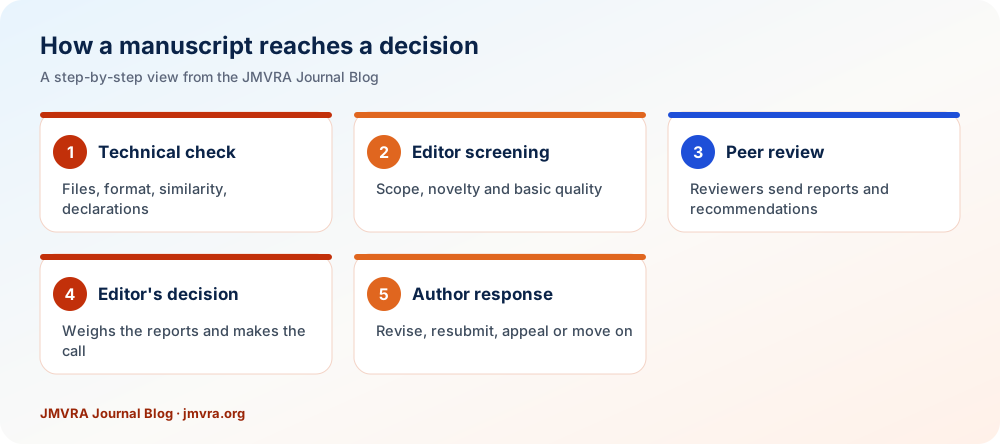
Reviewers advise; editors decide. Most journals follow a similar sequence. An editorial assistant runs a technical check: files complete, formatting, similarity report, declarations. A handling editor screens the paper for scope and basic quality. Suitable papers go to two or more reviewers, and the editor then reads their reports and issues a decision. In larger journals an associate editor may recommend and the editor-in-chief signs off.
Two consequences follow. First, reviewers often disagree, and the editor is not bound by a majority vote: one well-argued concern about the methods can outweigh two favourable reports. Second, the editor's own summary at the top of the letter is the most important part, because it tells you which reviewer comments are essential and which are optional.
Read the whole letter twice before reacting, ideally a day apart. Then list every request in a table before deciding what to do. Our overview of peer-reviewed journals and how review works covers the process in more depth.
The six decisions at a glance
Journal systems use slightly different labels, but almost every decision falls into one of these categories.
| Decision | What it means | Typical next step | Usual response window |
|---|---|---|---|
| Desk reject | Declined without external review | Improve and submit elsewhere | None |
| Reject | Reviewed; not acceptable to this journal | Use the reports, then choose another journal | None |
| Reject and resubmit | Not acceptable now; a substantially new version may be considered | New submission with a response document | Often open; months rather than weeks |
| Major revision | Potentially publishable after substantial changes | Point-by-point revision, usually re-reviewed | Commonly 30–60 days |
| Minor revision | Close to acceptable; small changes needed | Quick revision, often checked by the editor | Commonly 7–21 days |
| Accept | Approved for publication | Licence, fee if any, proofs | Production steps follow |
The windows shown are typical, not fixed; the deadline in your letter or submission system always takes precedence. Some journals add “accept with minor revisions” or “conditional acceptance”, which sit between minor revision and accept.
Desk rejection: declined before review
A desk rejection means the editor decided not to send the paper to reviewers. It usually comes quickly, often within one or two weeks, and the letter is short. Common reasons include:
- the topic falls outside the journal's scope or readership;
- the manuscript ignores the author guidelines on structure, length, reference style or required declarations;
- the similarity report shows substantial overlap with published text;
- the contribution is too small, or the design cannot answer the research question;
- essential reporting is missing, such as ethics approval for human participants or a reporting guideline checklist.
A desk rejection is not a verdict on your ability, and because no reviewer has read the paper you may submit it elsewhere immediately. Still, treat it as information. If the letter mentions scope, read the aims of your next target closely and use a structured journal-selection method. If it mentions formatting or similarity, fix those first. Appeals against desk rejections rarely succeed unless the editor plainly misread the scope.
Rejection after peer review
A rejection after review means at least one expert read the paper in detail and the editor concluded that, even with revision, it would not meet the journal's bar. Letters often say “we are unable to accept your manuscript for publication” or “the reviewers raised concerns that cannot be addressed through revision”.
The decision is final at that journal unless you have strong grounds for an appeal. The value now lies in the reports. Before sending the paper elsewhere:
- sort comments into fundamental issues (design, data, analysis), fixable issues (clarity, missing literature, presentation) and matters of preference;
- fix everything fixable, even though nobody will check — the next journal may invite the same reviewer;
- rethink the framing if reviewers misunderstood the contribution, which usually means the introduction did not make it clear.
Never send an unchanged paper to a new journal the same week. If several journals have rejected the same manuscript, look for a pattern using our guide to common rejection reasons.
Reject and resubmit: a door left open
“Reject and resubmit”, also worded as “decline with encouragement to resubmit” or “we would consider a new submission”, means the editor sees potential but the changes needed are so large that the paper must be treated as new. Typical triggers are a missing analysis, a further dataset, a changed design or a different framing.
How it differs from a major revision:
- the resubmission usually receives a new manuscript number and may go to new reviewers;
- there is often no fixed deadline, though waiting many months risks the field moving on;
- acceptance is not implied: you start again, but with an advantage.
When you resubmit, say so in the cover letter, quote the original manuscript number and attach a response document summarising how each major concern was addressed. If the requested work is not feasible, you may take the paper elsewhere instead. What you should not do is resubmit to the same journal without the changes.
Major revision: substantial work, real chance
A major revision means the paper could be publishable but needs significant changes: further analyses, a clearer methods section, a reworked discussion, robustness checks or a stronger link to the literature. Many published papers pass through this stage, so it is encouraging news rather than a polite rejection.
- The revised paper normally returns to the same reviewers, who will check every point.
- Acceptance is not guaranteed, and a second round of revision is common.
- You may disagree with a comment, but you must answer it with evidence and courtesy.
- The deadline matters. If you need more time, ask early and give a reason.
Work through the comments in a response table with three columns: the comment, your reply, and where the change appears by page and line. Practical workflows are set out in revising a paper after peer review, and wording you can adapt is in the response letter templates.
Minor revision and conditional acceptance
A minor revision means the paper is close to acceptable. Requests are typically small: clarifying sentences, correcting a figure label, adding a few references, fixing reference formatting, shortening the abstract or completing a declaration. Often the editor checks the revision without sending it back to reviewers.
Respond promptly, usually within one to three weeks, and avoid making changes nobody asked for. Rewriting sections or adding new results at this stage can trigger another round of review. If you must change something unrequested, for instance because you found an error in a table, flag it clearly in the response letter.
Some journals send “accept subject to minor revisions” or “conditional acceptance”. This normally means the editor will accept once the listed conditions are met, without further review. Read the conditions carefully; they may include technical items such as a signed licence form, high-resolution figures or a completed data availability statement.
Acceptance: what happens next
Acceptance means the editor has approved the scientific content. The paper now enters production, and several practical steps follow:
- Licence or copyright form. Open access journals usually apply a Creative Commons licence; read what you are agreeing to.
- Article processing charge, if any. Reputable journals invoice only after acceptance. At JMVRA, for example, the fee of ₹971 INR for Indian authors or $41 USD for international authors is payable only after acceptance, with an optional Crossref DOI add-on; see the publication charge page.
- Copyediting and typesetting. The text is edited for style and laid out in the journal format.
- Proofs. You check the typeset version, usually against a short deadline.
- Publication. The article goes online and, where the journal uses them, DOIs are registered.
Scientific changes are no longer possible after acceptance except to correct genuine errors. Keep the acceptance letter: universities and funders sometimes ask for it before the paper appears online.
Decoding common phrases in decision letters
Editors write in a careful, standard register. The phrases below usually carry these meanings, but the decision category shown in the letter or submission system always overrides any interpretation of tone.
| Phrase | Usual meaning |
|---|---|
| “We are unable to consider your manuscript further” | Final rejection at this journal |
| “Outside the scope of the journal” | Desk rejection on fit; try a better-matched journal |
| “Not suitable for publication in its current form” | Usually rejection; check whether a new version is invited |
| “We would consider a substantially revised version” | Reject and resubmit, or major revision |
| “Please address the remaining minor issues” | Minor revision; quick turnaround expected |
| “We are pleased to inform you…” | Acceptance, or conditional acceptance; read on |
Responding on time and appealing politely
Whatever the decision, reply within the window given. If you need longer, write before the deadline, give a reason and propose a date; editors seldom refuse an early, reasonable request, but they do close files that go silent. If you decide not to revise a paper that was invited back, withdraw it in writing before submitting elsewhere, so it is never under consideration at two journals at once.
An appeal is appropriate only when you can show a clear error: a reviewer misread the data, a report concerns a different paper, or a factual statement in the decision is demonstrably wrong. Disagreeing about importance or novelty is not enough. COPE guidance expects journals to offer an appeals route, often handled by a different editor.
Keep it short and courteous, appeal once and accept the outcome. If you submit to JMVRA, decisions arrive by email and WhatsApp and questions can go to [email protected]; the peer review page explains the process.
Quick Checklist
- Read it twiceLetter and reports, ideally a day apart
- Identify the categoryTrust the system label, not your reading of tone
- List every requestComment, action and page or line in one table
- Note the deadlineAsk early, with a reason, if you need more time
- Choose your pathRevise, resubmit, appeal or move to another journal
- Reply courteouslyThank the editor, whatever the outcome
Handling any decision professionally
How you respond to a decision affects your relationship with editors as much as the paper itself. These habits help.
- Wait before replying. Draft your reaction privately, then send a calm, factual message the next day.
- Follow the editor's priorities. When reviewers disagree, the editor's summary shows which requests are essential.
- Diary the deadline. Put the revision due date in your calendar the day the decision arrives, with a reminder a week earlier.
- One journal at a time. Withdraw formally before taking a revision-invited paper elsewhere.
- Keep every letter. Decision letters, reports and responses form a record you may need for appeals, theses or promotion files.
Every decision, including a rejection, gives you information that makes the next submission stronger.
Questions Researchers Often Ask
In Summary
Editorial decisions fall into a small set of categories, and each points to a clear next step. Desk and post-review rejections free you to improve the paper and move on; reject and resubmit invites a fresh submission; major and minor revisions ask for focused changes within a deadline; and acceptance starts production. Read the letter carefully, identify the category, list every request, respond on time and keep your tone professional. When your paper is ready for its next journal, the JMVRA online submission form is free to use.
Ready to send in your paper?
Online submission to JMVRA is free of charge. Papers are screened first and then go through transparent, double-blind peer review; ₹971 INR (Indian authors) or $41 USD (foreign authors) is due only after acceptance. Retain every confirmation email for your records.
References and Sources
Taking a Draft Through to a Published Paper
- PrepareStick to the template and author guidelines
- Submit onlineCosts nothing; write down your paper ID
- ScreeningSubject scope, declarations and similarity below 15%
- Double-blind reviewDecision by email and WhatsApp
- AcceptedThe ₹971 INR / $41 USD fee becomes due, and the paper is then published in open access
Details are available under Publication guidelines · Peer review · Publication charges.
Ready to Publish? Submit to JMVRA
JMVRA is aligned with UGC's Suggested Parameters for Choosing Peer-Reviewed Journals.
JMVRA is a Transparent, Peer-Reviewed, Open Access Journal (Refereed Journal). Following the discontinuation of the UGC and UGC-CARE journal listing, and in alignment with the latest UGC-CARE recommendations and guidelines, JMVRA is aligned with UGC’s Suggested Parameters for Choosing Peer-Reviewed Journals.
More useful pages at jmvra.org
Key Terms
Subjects and search phrases this article addresses.
Related Reading
More JMVRA guides that pair well with this one.
Keep Reading on the JMVRA Blog
You are reading part of the JMVRA journal blog, a source of hands-on guidance about publishing, indexing, metrics and research integrity that aims to be verifiable, not promotional.