
Most authors know that copying someone else's words is plagiarism. Fewer realise that reusing their own work can cause just as much trouble. Sending one manuscript to two journals at once, republishing the same results under a new title, or cutting a single study into thin papers can each end in rejection, a submission ban or a retraction. The rules are not arbitrary: they protect the accuracy of the published record and the time of unpaid reviewers. This guide defines each practice, shows where the honest boundaries lie and explains exactly what to disclose to an editor.
Three practices, three definitions
The terms are often used loosely, but editors distinguish between them because each one is detected and handled differently.
- Duplicate (simultaneous) submission means sending the same or a substantially similar manuscript to two or more journals at the same time. It is a problem even if neither journal has published it yet, because two sets of editors and reviewers are working on one paper.
- Redundant (duplicate) publication means publishing results that have already appeared elsewhere, in whole or in large part, without clear cross-reference. A common form is a second paper with the same data, a different title and a slightly reworded discussion.
- Salami slicing (sometimes called the "least publishable unit") means dividing one study that answers one question into several smaller papers, each reporting a fragment, so that the author's publication count rises while each paper becomes less useful.
| Practice | What overlaps | When it is usually caught |
|---|---|---|
| Duplicate submission | The whole manuscript, at the same time | Shared reviewers, similarity checks across submission systems |
| Redundant publication | Data, results and conclusions already in print | Similarity reports, readers, meta-analysts |
| Salami slicing | One sample and design split across papers | Reviewers who notice identical methods and samples |
A related issue, text recycling, is covered later.
Why editors treat overlap as misconduct
Authors sometimes argue that reusing their own results harms nobody. Editors and research integrity bodies disagree, for practical reasons.
- It distorts the evidence. When the same patients, students or samples appear in two papers that do not cite each other, a later systematic review may count them twice. A frequently cited 1990s analysis of anaesthesia trials found that hidden duplicate reports made an anti-nausea drug look more effective than it really was.
- It wastes peer review. Reviewers are mostly unpaid volunteers. Two journals reviewing one manuscript doubles that burden for no gain.
- It misleads evaluators. Hiring panels, promotion committees and funders count papers. Three slices of one study presented as three contributions overstate an author's output.
- It creates rights conflicts. If you transferred copyright or granted an exclusive licence to the first journal, republishing the same work may breach that agreement.
Consequences range from desk rejection to a notice of redundant publication, retraction, a submission ban and, in serious cases, a letter to the author's institution. A retraction notice is far more damaging than one fewer paper on the CV.
What COPE and ICMJE guidance says
Two sets of guidance shape how most editors respond. The Committee on Publication Ethics (COPE) publishes flowcharts for suspected redundant publication, both in a manuscript under review and in an article already published. The editor typically compares the two works, judges how much overlaps (data, figures, conclusions), then writes to the corresponding author asking for an explanation before deciding anything. A minor overlap with a reasonable explanation may lead only to a request to add citations. A major overlap usually leads to rejection or, after publication, a notice or retraction, and the editor may contact the other journal.
The ICMJE Recommendations, widely adopted outside medicine as well, contain a section on overlapping publications. In summary, authors should not submit the same manuscript, in the same or a different language, to more than one journal at a time; they should tell the editor about related manuscripts and supply copies when asked; and secondary publication (for example, in another language for a different readership) is acceptable only with the agreement of both editors and a clear citation of the original.
Most journals, including JMVRA, state in their ethics policies that they follow COPE guidance, so these flowcharts are a reliable guide to what will happen if overlap is found.
Salami slicing: where splitting goes wrong
Splitting a project into several papers is not wrong in itself; the problem is splitting that removes meaning. Reviewers tend to spot salami slicing through a recognisable pattern:
- the same sample size, setting and data collection period appear in each paper;
- the research questions differ only in which outcome variable is reported;
- methods sections are nearly identical, but none of the papers cites the others;
- each paper's discussion would be stronger if the results were read together.
Consider a survey of 400 college teachers measuring workload, burnout and job satisfaction in one questionnaire, analysed with one model. Publishing "workload and burnout", "workload and satisfaction" and "burnout and satisfaction" as three separate articles fragments a single story. A reader of any one paper cannot see the full relationships, and a reviewer who finds the other two will question the author's intent.
Ask yourself one test question: would a reader of paper A need the results of paper B to interpret paper A correctly? If yes, the two belong together. If each paper answers a distinct question with its own analysis and stands on its own, separate publication may be justified, provided it is declared openly.
Several papers from one dataset, done correctly
Large cohort studies, national surveys, field trials and doctoral projects legitimately produce several papers. What makes them acceptable is the way they are planned and reported.
- Give each paper a distinct question. A primary outcome paper, a methods or validation paper and a secondary analysis on a different hypothesis are clearly different contributions.
- Describe the parent study once and cite it. Name the project, its registration or protocol if any, and refer readers to the first paper for full details instead of repeating them word for word.
- Cross-reference every related output. Each paper should list its siblings, including those still under review ("submitted" or "under review" is acceptable in many reference styles).
- Report the same numbers the same way. If the baseline sample is 1,214 in one paper, it should not quietly become 1,190 in another without explanation.
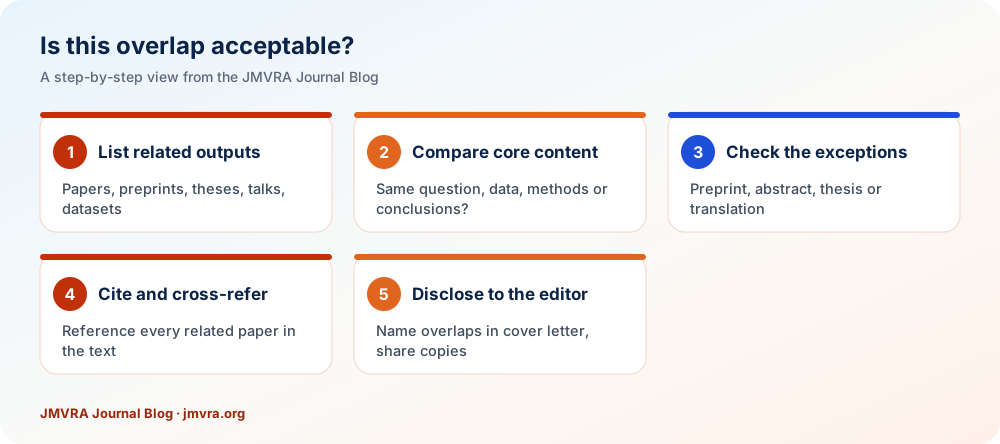
- Tell each editor. Mention the other papers in the cover letter and offer to share them.
A PhD thesis converted into articles follows the same logic; see turning a PhD thesis into journal articles for planning the split.
Preprints, conference papers and other exceptions
Not every earlier appearance counts as prior publication. The table below summarises how most journals treat common cases, but the target journal's own policy always takes precedence.
| Earlier version | Usually treated as | What to do |
|---|---|---|
| Preprint on a public server | Not prior publication at most journals | Check the preprint policy; give the preprint DOI at submission |
| Conference abstract or poster | Not prior publication | Mention it in the cover letter or acknowledgements |
| Full paper in conference proceedings | Prior publication unless substantially extended | Add new data or analysis; cite the proceedings paper; disclose |
| Thesis or dissertation in a repository | Generally acceptable | Cite or mention the thesis; rewrite for a journal audience |
| Translation in another language | Secondary publication | Only with both editors' consent and a citation of the original |
| Results in a trial registry or funder report | Usually acceptable | Disclose and cite the registry entry or report |
For the preprint route in more detail, read preprints: where to post and when. If you are turning a conference paper into a journal article, publishing a conference paper explains what reviewers expect from the extended version. Some fields, especially computer science, expect a clearly stated proportion of new material; when in doubt, ask the editor before submitting.
Reusing your own text in methods and background
Text recycling, sometimes called self-plagiarism, is the reuse of passages you have already published. Expectations differ by section of the paper:
- Methods: reusing a standard description of an established protocol, instrument or model is widely tolerated, because rewording a precise method can introduce errors. Cite the earlier paper where the wording first appeared.
- Introduction and literature review: write afresh. Recycled background suggests the new paper adds little.
- Results and discussion: should be new. Reused results are redundant publication, not text recycling.
Two practical points are often missed. First, similarity software compares your manuscript with published work, including your own, so recycled text raises your score like any other match. If you submit to JMVRA, for example, the overall similarity should be below 15%, and self-overlap counts toward that figure. Second, if your earlier paper was published under a restrictive copyright transfer, the first publisher may own the wording; papers published under CC BY are easier to quote with attribution. See plagiarism rules every author should know and the Text Recycling Research Project for detailed guidance.
Disclosing related papers in your cover letter
Disclosure is the simplest protection you have. An editor who learns about overlap from you will judge it on its merits; an editor who discovers it from a similarity report will assume the worst. Include a short paragraph in the cover letter whenever any of the following exist:
- another paper, published or under review, that uses the same data or participants;
- a preprint, thesis, conference paper or report containing part of the manuscript;
- a translation or earlier version in another language;
- a previous submission of this manuscript to another journal that has been formally withdrawn or rejected (only if the journal asks, or if it explains overlap).
State what overlaps, what is new and where the related work can be found. Attach unpublished related manuscripts as "files for editor only" if the submission system allows it.
Many submission forms also ask you to confirm that the work is not under consideration elsewhere. Tick that box only when it is literally true.
Withdrawing, correcting and recovering
Mistakes happen, often through misunderstanding rather than intent. What you do next matters most.
- You want to move a manuscript to another journal. Write to the first journal requesting withdrawal, wait for written confirmation and keep it. Only then submit elsewhere. Silence from a journal is not a withdrawal.
- A co-author submitted the paper elsewhere without telling you. Inform both editors immediately and withdraw one submission. Agree within the team who handles submissions in future.
- The same results are already published twice. Contact both editors, explain how it happened and accept their decision. Usually the later article receives a notice of redundant publication or is retracted. Acting first reflects better on you than being discovered.
The mechanics of notices and retractions are covered in corrections, retractions and expressions of concern. For journal-level expectations, read the JMVRA policies or any target journal's ethics statement before submission, not after a query arrives.
Quick Checklist
- Withdraw before movingGet written confirmation before a new submission
- Map related outputsList every paper, preprint and thesis from the data
- Cite your own workReference overlapping papers inside the manuscript
- Write fresh textNew background and discussion for each paper
- Tell the editorName overlaps in the cover letter, share copies
- Keep recordsSave submission dates and withdrawal emails
Habits that keep your publication record clean
Most overlap problems start with poor record-keeping or unclear team roles, not deliberate deception. These habits prevent them.
- Plan the papers at the start. When a project begins, write down which questions each future paper will answer. A plan made before results exist looks very different from slicing decided afterwards.
- Name one submission lead. One co-author should track where every manuscript is under review. Duplicate submissions often happen when two co-authors act independently.
- Keep a related-work register. A simple spreadsheet of titles, journals, status and datasets makes cover-letter disclosure quick and accurate.
- Run your own similarity check. Check the draft against your earlier papers before submission and rewrite recycled background passages.
- Ask before, not after. If you are unsure whether a conference paper or report counts as prior publication, email the editor a two-line question before submitting.
Overlap that is planned, cited and disclosed is normal research practice; overlap that is hidden is misconduct.
Questions Researchers Often Ask
In Summary
Duplicate submission, redundant publication and salami slicing all inflate the record while reducing its value. The safeguards are straightforward: submit to one journal at a time, withdraw formally before moving, give each paper a distinct question, write fresh introductions and discussions, cite your own related work and tell the editor about every overlap in the cover letter. Preprints, abstracts, theses and agreed translations are recognised exceptions when they are declared. Treat transparency as the default, keep a record of where each manuscript has been, and an honest set of papers from one project will never be mistaken for misconduct.
Ready to send in your paper?
Online submission to JMVRA is free of charge. Papers are screened first and then go through transparent, double-blind peer review; ₹971 INR (Indian authors) or $41 USD (foreign authors) is due only after acceptance. Retain every confirmation email for your records.
References and Sources
Taking a Draft Through to a Published Paper
- PrepareStick to the template and author guidelines
- Submit onlineCosts nothing; write down your paper ID
- ScreeningSubject scope, declarations and similarity below 15%
- Double-blind reviewDecision by email and WhatsApp
- AcceptedThe ₹971 INR / $41 USD fee becomes due, and the paper is then published in open access
Details are available under Publication guidelines · Peer review · Publication charges.
Ready to Publish? Submit to JMVRA
JMVRA is aligned with UGC's Suggested Parameters for Choosing Peer-Reviewed Journals.
JMVRA is a Transparent, Peer-Reviewed, Open Access Journal (Refereed Journal). Following the discontinuation of the UGC and UGC-CARE journal listing, and in alignment with the latest UGC-CARE recommendations and guidelines, JMVRA is aligned with UGC’s Suggested Parameters for Choosing Peer-Reviewed Journals.
More useful pages at jmvra.org
Key Terms
Subjects and search phrases this article addresses.
Related Reading
More JMVRA guides that pair well with this one.
Keep Reading on the JMVRA Blog
You are reading part of the JMVRA journal blog, a source of hands-on guidance about publishing, indexing, metrics and research integrity that aims to be verifiable, not promotional.