

Authors in computer science are asking more and more for two things: a DOI that makes the paper permanently citable, and fast publication so that results stay current. Both requests are reasonable, yet both are also turned into marketing slogans. This guide covers what a DOI really provides, how software and datasets obtain DOIs of their own, and how to assess a promise of speed.
What a DOI Does for a Computer Science Paper
A DOI (Digital Object Identifier) is a lasting link, for instance https://doi.org/10.5555/…. When it is registered via an agency like Crossref, it continues to point to your article even after the journal changes its website, and it passes metadata — authors, title, references — on to citation databases and reference managers. Check that the DOI you print on your CV opens the right page.
- Years afterwards, citations still resolve.
- A DOI by itself lets reference managers pull in the complete citation.
- Linking of citations ties your paper to the sources it cites.
- A DOI that resolves is separate evidence that the article really exists as published.
Code, Models and Datasets Need DOIs Too
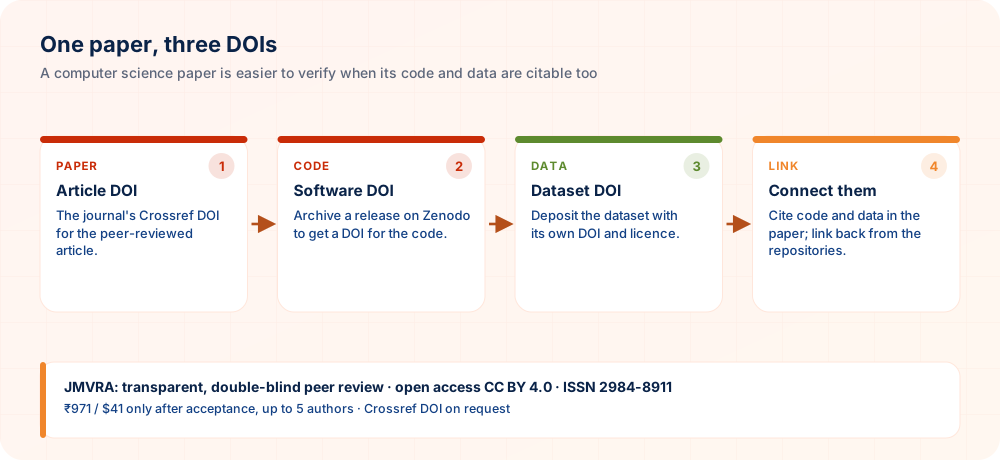
A paper is just one part of what computing research produces. Assign your software and data persistent identifiers of their own as well:
- Archive a release. Link your GitHub repository with Zenodo and publish a release, and Zenodo will create a DOI for precisely that version.
- Cite it in the paper. Put the software and dataset DOIs in your reference list and in your code-availability statement.
- Be honest about versions. When you fix a bug after publication, issue a fresh release with its own version DOI instead of quietly altering the old one.
The Honest Meaning of “Fast Publication”
Real speed is the result of efficient administration — prompt screening, a large reviewer pool, rapid formatting — and not of skipping review. A journal can work efficiently, but it cannot promise that two independent experts will read your paper carefully within a set number of hours.
A Realistic Timeline
| Stage | What happens | What you control |
|---|---|---|
| Screening | Checks on scope, format and similarity | Template followed; similarity report clean |
| Peer review | The paper is read by independent experts | Lucid writing; thorough experiments |
| Revision | You answer the reviewers | Prompt, detailed replies to each point |
| Production | Proof stage, issue allocation, DOI deposit | Quick proof checking |
Confirming That a Journal’s DOIs Are Genuine
- Open the DOI of a published article. It ought to begin with 10. and lead, via https://doi.org/, to the article page.
- Search Crossref. Enter the DOI or the title in Crossref Search, and the record should name the journal and carry accurate metadata.
- Look at the prefix. The articles of a given journal normally have the same prefix, meaning the portion ahead of the slash.
Example in Practice: A Single Paper with Three DOIs
Suppose a paper puts forward a lightweight intrusion-detection model. Its full, citable research record could be arranged as follows:
| Output | Where it lives | Identifier |
|---|---|---|
| Journal article | The journal’s website | Journal-registered article DOI (Crossref) |
| Source code v1.0 | GitHub, archived on Zenodo | Software DOI (DataCite) |
| Pre-processed dataset | Zenodo or Figshare | Dataset DOI (DataCite) |
In its references and availability statement, the article cites the DOIs of the code and dataset. A reader can then fetch the very version that was used — and that is what reviewers are after when they ask for reproducibility.
The 10 Most-Searched Questions on This Topic
Here are the ten questions researchers search for most on this subject, each with a direct answer.
computer science journal with DOI
A journal that obtains a DOI for every article from an agency like Crossref, so its papers stay citable permanently.
fast publication computer science journal
A journal whose screening and review run efficiently. Measure any speed claim against the review process the journal has published.
how to get DOI for research paper
Registration is done by the publisher at the time of publication; authors are unable to register a Crossref DOI for a journal article on their own.
DOI for GitHub code
Connect GitHub with Zenodo and issue a release, and Zenodo gives that version of the code a DOI.
DOI for dataset
Place the dataset in a repository like Zenodo, Figshare or Dryad, which will issue a DOI.
Crossref DOI check
Enter the DOI into the search box at search.crossref.org, or put it straight after https://doi.org/ in your browser’s address bar.
DOI vs URL
A URL shows where a file is located now, whereas a DOI identifies the work itself and is updated if the location moves.
when is DOI assigned to article
As a rule at the time of publication, once the journal submits the article’s metadata to the registration agency.
rapid publication journal computer science
Seek processes that are quick yet open: a stated review model and timelines given as ranges rather than guarantees.
is DOI mandatory for journal publication
It is not compulsory, yet a DOI makes a paper much simpler to cite, locate and verify, which is why most reputable journals supply one.
How JMVRA Fits In
JMVRA is a Transparent, Peer-Reviewed, Open Access Journal (Refereed Journal). Following the discontinuation of the UGC and UGC-CARE journal listing, and in alignment with the latest UGC-CARE recommendations and guidelines, JMVRA is aligned with UGC’s Suggested Parameters for Choosing Peer-Reviewed Journals. UGC public notice (PDF)
JMVRA registers DOIs through Crossref under the Crossref DOI on request. DOI registration is an optional add-on, assigned when the article is published in an issue.
- ISSN
- 2984-8911 (online) · publishing since June 2023
- Issues
- Monthly issues across many disciplines
- Review
- Two-way anonymous review by specialists
- Access
- Free to read, CC BY 4.0 licence
- Fee
- ₹971 INR for Indian and $41 USD for foreign authors, due only after acceptance
- DOI
- Crossref — available as an optional extra
- Indexing
- Google Scholar returns it in searches, while Scopus, Web of Science and DOAJ do not
- Impact factor
- 11.25, derived from Google Scholar data
Screening begins the moment a paper arrives and each decision is sent as soon as it is reached, yet JMVRA never promises a set number of days: actual review time depends on the reviewers and on how much revision the paper needs.
At-a-Glance Checklist
- Paper DOI asked forA Crossref DOI is available on request at JMVRA
- Code archivedUse a tagged release rather than a branch that keeps changing
- Data depositedAccompanied by a licence and a README
- Everything citedListed in the paper's references
- Links testedEach DOI resolves through doi.org
Citing Software Properly
| Element | Example |
|---|---|
| Authors | Developers or project team |
| Title and version | ToolName v2.1 |
| Year | Release year |
| Identifier | DOI from Zenodo or similar |
Connecting the Paper, Code and Data
- Start by archiving code and data — obtain their DOIs
- Refer to them in the paper — in the references or the availability statement
- Put the paper DOI into the repositories — once it is published
- Keep versions aligned — use the version that the paper relied on
Making Computer Science Outputs Easy to Cite With DOIs
A persistent identifier only helps if the information behind it is complete and consistent. These steps make your computer science work easier to find, cite and trust.
- Test your DOI link after release. Once the paper is online, click its DOI and confirm it lands on the correct article page. Report mismatches to the journal promptly so they can be repaired.
- Use the same author name everywhere. Write your name and affiliation identically on the paper, repository and profile pages. Consistency lets indexing tools connect your outputs correctly.
- Tag releases of your code. Create a clearly labelled release of the code behind the paper and archive it with a persistent identifier. Readers can then rerun exactly what you describe.
- Describe data with a short README. Include file formats, variable meanings, licence and how the data were collected. A good readme turns a dump of files into a reusable resource.
- Cite your own artefacts in the text. Reference the dataset and software in your bibliography just as you would a paper. This creates a visible trail and gives credit where it belongs.
Verify identifiers after publication and give code and data tidy, citable homes so others can build on your work.
Questions Researchers Often Ask
Anatomy of a JMVRA DOI
Resolver → prefix 10.5555 (an example Crossref prefix) → suffix: journal, volume 14, issue 9, article identifier. A format example: doi.org/10.5555/12345678
Not sure a JMVRA DOI is real? Search it via Crossref Search or the Crossref journal record.
Ready to Publish? Submit to JMVRA
JMVRA is aligned with UGC's Suggested Parameters for Choosing Peer-Reviewed Journals.
JMVRA is a Transparent, Peer-Reviewed, Open Access Journal (Refereed Journal). Following the discontinuation of the UGC and UGC-CARE journal listing, and in alignment with the latest UGC-CARE recommendations and guidelines, JMVRA is aligned with UGC’s Suggested Parameters for Choosing Peer-Reviewed Journals.
Pages worth visiting on jmvra.org
Key Terms
Subjects and search phrases this article addresses.
Related Reading
Further reading on the same theme from the JMVRA blog.
Structuring a CS Paper for an International Journal
Read the guide RelatedHow Peer Review Works for Computer Science Papers
Read the guide RelatedMatch Your CS Paper to a Journal by Subfield
Read the guide RelatedGetting a Crossref DOI for Your Published Paper
Read the guide RelatedDoes This DOI Work? Resolution & Metadata Checks
Read the guide RelatedZenodo DOI or Journal Crossref DOI? Choosing Right
Read the guideKeep Reading on the JMVRA Blog
As part of the JMVRA journal blog, this guide shares practical help on publishing, indexing, metrics and research integrity, and is written to be verifiable rather than promotional.