
What sets a journal article apart from a blog post is peer review. Reviewers of computer science papers are typically researchers who build, measure and benchmark systems on their own, so they know where results tend to be brittle. Knowing what they look at, and how to reply, can decide whether you get a quick acceptance or a lengthy round of revisions.
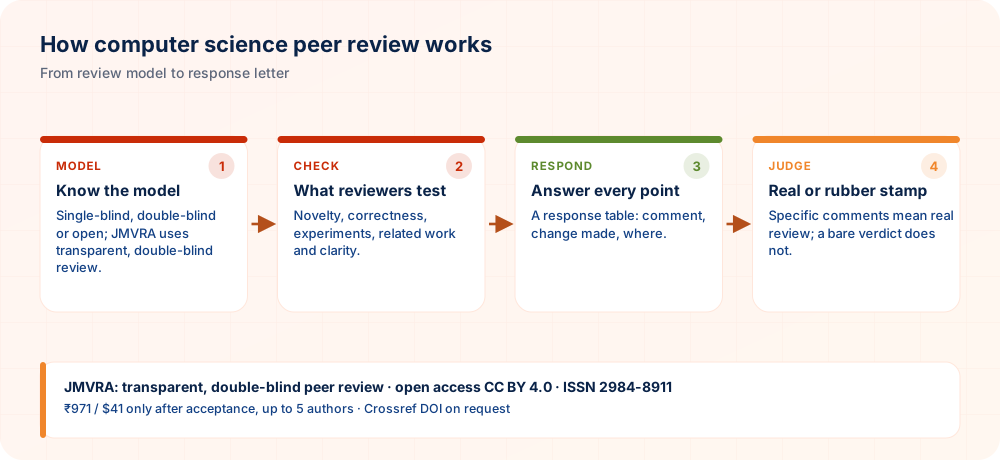
Review Models You Are Likely to Encounter
| Model | Who knows whom | Where common |
|---|---|---|
| Single-blind | Reviewers are aware of the authors, but authors are unaware of the reviewers | Many journals |
| Double-blind | Neither party knows who the other is | Numerous CS conferences and journals, JMVRA among them |
| Open review | Names are public, and sometimes the reports are too | Certain venues and platforms |
What Reviewers Look for in Computer Science Papers
Novelty
Is the idea original, or merely a familiar method used without fresh insight?
Soundness
Do the proofs hold, are the experiments fair, and does the data back the conclusions?
Baselines
Does it compare against strong, up-to-date methods on standard benchmarks?
Reproducibility
Can the experiments be repeated by others using the paper and the released code?
Clarity
Is the paper well organised and understandable to a reviewer outside the specialty?
Relevance
Is it a good match for the journal and relevant to its readership?
Answering Reviewer Comments
- Begin with thanks, then answer each point. Paste every comment, write your reply underneath, and note the change together with section and line numbers.
- Where possible, add rather than argue. Running one more experiment or giving a clarification generally settles a concern sooner than a debate does.
- Disagree courteously and with evidence. Should a reviewer be mistaken, explain calmly why, using data or references.
- Show changes in the manuscript. Highlight the text or supply a tracked-changes copy so the editor can spot them easily.
Genuine Review Versus a Rubber Stamp
A real review report makes specific remarks about your paper, pointing to a certain table, an experiment or a missing reference. If a report could fit any paper (“good work, minor formatting changes”), or an acceptance comes before any reviewer could have read the paper, the review is probably not doing its job.
A Response-to-Reviewers Table That Editors Appreciate
| Reviewer comment | Our response | Change in manuscript |
|---|---|---|
| R1.1 Comparison with method M is missing. | We agree and have added M as a baseline. | Section 5.2, Table 4, lines 312–330 |
| R1.2 The dataset split is unclear. | We now specify an 80/10/10 split with fixed seeds. | Section 4.1, lines 221–226 |
| R2.1 The novelty over [ref] is not clear. | We clarify three differences and add a comparison. | Section 2, lines 98–120 |
Give each comment a number, reply to all of them, and indicate precisely where the change was made. That allows the editor to check revisions within minutes and frequently spares you another round.
The 10 Most-Searched Questions on This Topic
Here are the ten questions researchers search for most on this subject, each with a direct answer.
computer science peer review publication
Publishing where independent experts assess a paper before it is accepted, typically by single- or double-blind review.
double blind peer review meaning
Neither authors nor reviewers know who the other is, which helps reduce bias.
how to respond to reviewer comments
Answer every point in turn, state each change along with where it is, and back any disagreement with evidence.
what do reviewers look for in a paper
Originality, technical soundness, fair comparison, reproducibility, clarity and suitability for the journal.
how long does peer review take
The time differs greatly, from days up to months, depending on the field, the journal and how available reviewers are.
major revision vs minor revision
A major revision calls for considerable new work or rewriting, while a minor revision needs only small corrections. In both cases the paper can still be accepted.
peer reviewed journal meaning
A journal that passes submissions to independent experts for assessment before it decides to publish.
how many reviewers for a journal paper
Usually two or three, though some journals involve more for complicated papers.
rebuttal letter example
“We thank the reviewer… We have added experiment X (Section 5.2, Table 4), which shows…”
fake peer review signs
Vague reports, assured acceptance, or acceptance arriving before reviewers could have read the paper.
How JMVRA Fits In
JMVRA is a Transparent, Peer-Reviewed, Open Access Journal (Refereed Journal). Following the discontinuation of the UGC and UGC-CARE journal listing, and in alignment with the latest UGC-CARE recommendations and guidelines, JMVRA is aligned with UGC’s Suggested Parameters for Choosing Peer-Reviewed Journals. UGC public notice (PDF)
Subject experts review each JMVRA submission double-blind prior to acceptance, and authors get the decision and comments as soon as they reach the editor. Read every comment carefully before you begin revising.
- ISSN
- 2984-8911 (online) · publishing since June 2023
- Issues
- Monthly issues across many disciplines
- Review
- Two-way anonymous review by specialists
- Access
- Open access with a CC BY 4.0 licence
- Fee
- ₹971 INR for Indian and $41 USD for foreign authors, due only after acceptance
- DOI
- Crossref — available as an optional extra
- Indexing
- Google Scholar users can reach it; not so for Scopus, Web of Science or DOAJ
- Impact factor
- 11.25, derived from Google Scholar data
Screening begins the moment a paper arrives and each decision is sent as soon as it is reached, yet JMVRA never promises a set number of days: actual review time depends on the reviewers and on how much revision the paper needs.
At-a-Glance Checklist
- Model understoodDouble-blind requires an anonymised file
- Baselines includedEven-handed comparison with recent work
- Response table preparedComment, change and location
- Courteous toneEven if you disagree
- Genuine review confirmedRemarks specific to your paper
How to Write a Persuasive Rebuttal
Thank and summarise
Demonstrate that you grasped the main concerns.
Evidence first
Fresh experiments or clarifications.
Respectful disagreement
Justify with data rather than opinion.
Point to changes
Section numbers and line numbers.
When You Review CS Papers Yourself
- Test claims against the evidence — are the experiments enough?
- Examine reproducibility — code, data and parameters
- Examine novelty — set against recent literature
- Stay constructive — propose concrete improvements
Responding Professionally to Computer Science Reviewers
Reviewer reports in computing can be blunt and technical. A calm, organised reply often decides whether an editor sees your revision as ready, so treat the response as seriously as the paper.
- Thank reviewers briefly. Open with a sincere sentence of appreciation, then move to the points. Gratitude costs nothing and sets a constructive tone for the whole document.
- Quote each comment exactly. Reproduce every remark and place your answer beneath it, with the location of the change in the revised file. Editors can then verify your work quickly.
- Run new experiments when asked. If a reviewer requests an extra baseline or ablation, perform it rather than arguing that it is unnecessary. Evidence usually persuades better than explanation.
- Disagree with respect. When you believe a comment is mistaken, explain your reasoning politely with a reference or result, and consider whether the paper was unclear. Often both are true.
- Proofread the final package. Check that every promised change appears in the manuscript and that marked-up and clean versions match. Inconsistencies erode confidence at the last step.
Answer every comment precisely, support disagreements with evidence and keep a courteous tone from the first line to the last.
Questions Researchers Often Ask
How Transparent Peer Review Works, Stage by Stage
- SubmissionBefore anything else, plagiarism, formatting and scope are verified.
- Reviewer matchingScholar9 portal assigns experts in the relevant subject.
- Double-blind reviewEvaluators weigh the originality of the work, its method, its significance and its clarity.
- DecisionWhether accepted, sent back for revision or rejected, you hear by email and WhatsApp.
- RevisionAuthors reply individually to each comment raised.
- TransparencyYou can see the review record on Scholar9 and request the report.
Open reports, open participation and optional reviewer identity make up the three transparency models; how JMVRA applies them is described separately.
Ready to Publish? Submit to JMVRA
JMVRA is aligned with UGC's Suggested Parameters for Choosing Peer-Reviewed Journals.
JMVRA is a Transparent, Peer-Reviewed, Open Access Journal (Refereed Journal). Following the discontinuation of the UGC and UGC-CARE journal listing, and in alignment with the latest UGC-CARE recommendations and guidelines, JMVRA is aligned with UGC’s Suggested Parameters for Choosing Peer-Reviewed Journals.
Related pages on jmvra.org
Key Terms
Subjects and search phrases this article addresses.
Related Reading
Further reading on the same theme from the JMVRA blog.
Match Your CS Paper to a Journal by Subfield
Read the guide RelatedWhat an SSRN Listing Means for a CS Paper
Read the guide RelatedSpeeding Up Publication of a CS Paper Honestly
Read the guide RelatedOpen Access, Peer Review, Impact Factor & UGC Parameters Norms — A Complete Guide
Read the guide RelatedRecognising a Predatory Journal
Read the guide RelatedUnderstanding Plagiarism in Research Papers: Types, Detection Methods and Threshold Control
Read the guideKeep Reading on the JMVRA Blog
Published on the JMVRA journal blog, this guide gives practical direction on publishing, indexing, metrics and research integrity, with a focus on what can be verified instead of on promotion.