

What counts as “best” is not the same for a PhD scholar at a state university, an assistant professor preparing for CAS promotion and an M.Tech student working on a first paper. For computer science researchers in India, the right journal satisfies your institution’s rules, offers your work real peer review and visibility, and suits your budget and schedule. Weigh these factors together rather than chasing a single headline metric.
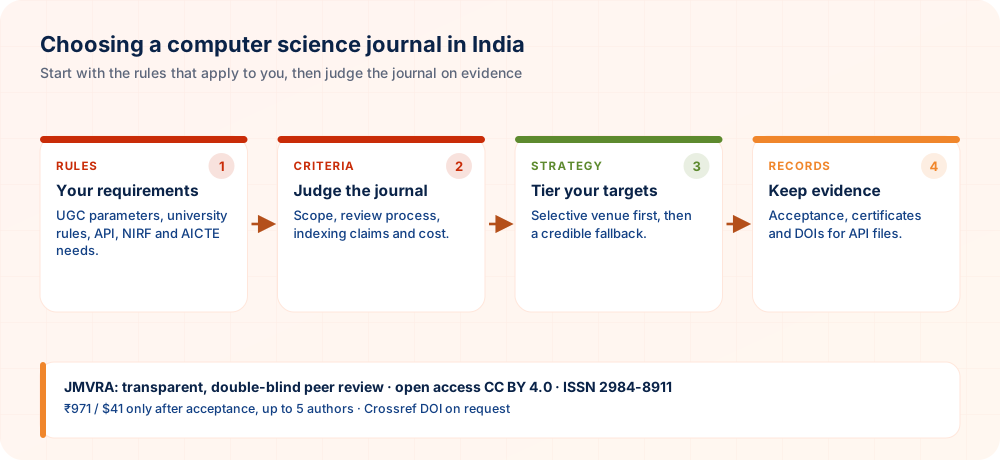
First Check the Rules That Govern You
| Your goal | What typically determines the choice of venue |
|---|---|
| PhD thesis submission | The PhD ordinance and research committee of your university |
| CAS promotion / API | UGC regulations as your institution’s IQAC applies them |
| AICTE / NBA / NAAC records | Publication records of faculty in verifiable, peer-reviewed venues |
| NIRF research score | Chiefly papers in venues indexed by Scopus and Web of Science |
| A student’s first paper | Real review, a genuine DOI and a venue that your supervisor accepts |
Life Beyond the UGC-CARE List
The CARE list has been discontinued by UGC, which means no single national list remains to consult. Institutions now evaluate journals on evidence such as peer review, indexing, transparency and UGC’s suggested parameters for choosing peer-reviewed journals. Read our guide on where the UGC CARE list stands in 2026 and which databases replace it.
Key Criteria When Choosing a CS Journal
Real peer review
A stated review model, visible reviewer reports and decisions that reflect them.
Verifiable indexing
Statements you are able to check in Scopus, in the Master Journal List, in DOAJ or on Google Scholar.
Board members with CS know-how
Editors and referees with a computing background rather than only people from distant disciplines.
Transparent cost
An openly stated charge, due once the paper is accepted, with no concealed costs.
Permanent identifiers
Working Crossref DOI links and permanent article pages.
Recent CS papers
Papers in your own subfield that you would be glad to appear alongside.
A Tiered Plan That Works in Practice
- Aim high first. Send your best results to Scopus/SCIE-indexed venues that cover your subfield.
- Reliable indexed choice. Respected journals whose acceptance rates are realistic for sound, finished studies.
- Recognised and affordable open access. Multidisciplinary peer-reviewed journals suited to student projects, applied research and first papers.
Common Errors Made by Indian Authors
- Relying on a “UGC approved” label without looking up where UGC stands today.
- Picking a journal purely for its cost or turnaround.
- Sending one manuscript to multiple journals simultaneously.
- Allowing a “publication agent” to do the submitting for you.
- Leaving the similarity report unread until the paper is rejected.
Keeping Records for API and Accreditation
Reviewers look at faculty publication records during CAS promotions and NAAC and NBA visits, frequently long after the paper appeared. Start assembling that record the moment the paper is published:
- One folder for each paper holding the acceptance letter, invoice, final PDF and reviewer comments
- Each article’s link and DOI logged in a spreadsheet
- A screenshot, with the date visible, of the journal’s ISSN entry and any indexing you depended on
- Whichever edition of your institution’s rule was in force when the paper came out
- Up-to-date Google Scholar and ORCID profiles
Should evaluation rules shift later, these papers prove the journal satisfied the criteria in force at the time you published.
The 10 Most-Searched Questions on This Topic
Here are the ten questions researchers search for most on this subject, each with a direct answer.
best peer reviewed computer science journal in India
The journal that meets your institution’s requirements, offers real review and exposure, and suits both your subfield and your budget.
computer science journals India list
Draw up a shortlist by subject from Scopus and Web of Science, add recognised multidisciplinary journals, then check every one.
UGC approved computer science journals 2026
There is no longer any UGC-maintained approved or CARE list; instead, journals are assessed on evidence against UGC’s suggested parameters.
API score journal publication
Faculty earn points for publications under UGC and institutional rules, so consult your IQAC for the scheme currently in use.
NIRF research publications
Research scoring in NIRF relies chiefly on papers listed in the large indexed databases.
PhD publication requirement computer science
Your university decides this, as UGC’s 2022 PhD regulations leave the matter to institutions; consult your ordinance.
Scopus indexed computer science journals India
Confirm any Scopus claim through the Scopus Sources page and make sure the journal is still active.
AICTE faculty publication
Faculty papers should be peer-reviewed and checkable, as AICTE and accreditation bodies expect.
peer reviewed journal for M.Tech students
An authentic peer-reviewed journal that your supervisor accepts, offering a working DOI and open fee details.
how to check journal is genuine India
Check the ISSN on the ISSN Portal, indexing in the database itself, the DOI through Crossref, and look up editorial board members yourself.
How JMVRA Fits In
JMVRA is a Transparent, Peer-Reviewed, Open Access Journal (Refereed Journal). Following the discontinuation of the UGC and UGC-CARE journal listing, and in alignment with the latest UGC-CARE recommendations and guidelines, JMVRA is aligned with UGC’s Suggested Parameters for Choosing Peer-Reviewed Journals. UGC public notice (PDF)
JMVRA is based in India and has published since June 2023; computer science authors get double-blind peer review, open access and a clear fee of ₹971 INR that is payable only after acceptance.
- ISSN
- 2984-8911 (online) · publishing since June 2023
- Issues
- Monthly issues across many disciplines
- Review
- Two-way anonymous review by specialists
- Access
- CC BY 4.0, open to all readers
- Fee
- ₹971 INR for Indian and $41 USD for foreign authors, due only after acceptance
- DOI
- Crossref — available as an optional extra
- Indexing
- Computer science readers: indexed by Google Scholar and not by Scopus, Web of Science or DOAJ
- Impact factor
- 11.25, derived from Google Scholar data
Screening begins the moment a paper arrives and each decision is sent as soon as it is reached, yet JMVRA never promises a set number of days: actual review time depends on the reviewers and on how much revision the paper needs.
At-a-Glance Checklist
- Rules verifiedObtained in writing from your institution
- Claims checkedEvery index confirmed at the source
- Backup selectedPrior to your first submission
- Agents avoidedUse the journal's own website to submit
- Records savedProof for API and accreditation
Publishing Projects Tied to Industry
Confidentiality
Find out which company data you are allowed to publish.
Anonymisation
Strip out identifying information when necessary.
Acknowledgement
Acknowledge industry partners properly.
Conflicts of interest
Disclose any funding or employment ties.
A Publication Roadmap for CS Faculty
| Goal | Example |
|---|---|
| Main research paper | Drawn from a funded or extended project |
| Student-led papers | Based on outstanding final-year or master’s projects |
| Review or survey | Covering a new area that you teach |
| Dataset or software | Shared with a DOI |
Documenting Computer Science Publications for Faculty Evaluation
Faculty and scholars in computer science are regularly asked to show their publications to promotion panels and accreditation teams. Good documentation habits make those requests easy to meet.
- Maintain a publication register. Keep a spreadsheet listing title, authors, journal, volume details, link and the date you saved a copy. Updating it after each acceptance takes minutes and saves hours during audits.
- Store the final PDF and metadata. Download the published version, the acceptance email and the web page showing journal details. Pages can change or disappear, and your stored copies remain your evidence.
- Separate journals from conferences. Label each entry clearly as a journal article, conference paper or book chapter. Committees treat these categories differently, and mixing them can cause misunderstandings.
- Record your own contribution. For multi-author papers, write a line describing your specific role, such as design, coding or writing. This helps when panels ask about individual effort.
- Link code and datasets where allowed. Where sharing is appropriate, point to a repository so reviewers and readers can inspect your implementation. Open artefacts strengthen a paper's credibility.
Keep an organised, evidence-backed record of every computer science output so evaluations never catch you unprepared.
Questions Researchers Often Ask
How Transparent Peer Review Works, Stage by Stage
- SubmissionChecks on plagiarism, formatting and scope happen up front.
- Reviewers assignedThe Scholar9 portal is the route by which subject experts receive the paper.
- Double-blind reviewExperts examine how original, significant and clear the work is, and how sound its method is.
- DecisionA result of accept, revise or reject is notified by email as well as WhatsApp.
- RevisionAuthors work through all the comments and answer each one.
- TransparencyThe record of review sits on Scholar9; reports are given upon request.
To see how JMVRA applies them, note that the three transparency models are open reports, optional reviewer identity and open participation.
Ready to Publish? Submit to JMVRA
JMVRA is aligned with UGC's Suggested Parameters for Choosing Peer-Reviewed Journals.
JMVRA is a Transparent, Peer-Reviewed, Open Access Journal (Refereed Journal). Following the discontinuation of the UGC and UGC-CARE journal listing, and in alignment with the latest UGC-CARE recommendations and guidelines, JMVRA is aligned with UGC’s Suggested Parameters for Choosing Peer-Reviewed Journals.
Where to go next on jmvra.org
Key Terms
Subjects and search phrases this article addresses.
Related Reading
Further reading on the same theme from the JMVRA blog.
10 Signs of a Good Computer Science Journal
Read the guide RelatedSubmitting to Computer Science Journals: Checklist
Read the guide RelatedCS Publishing: Journals or Conferences?
Read the guide RelatedThe End of UGC-CARE: What Researchers Should Know
Read the guide RelatedJMVRA and Scopus & Web of Science Standards — The Honest Answer
Read the guide RelatedVerifying UGC-CARE, Scopus & Web of Science Claims
Read the guideKeep Reading on the JMVRA Blog
Find this guide on the JMVRA journal blog, a collection of practical guidance on publishing, indexing, metrics and research integrity that favours verifiable content over promotion.