
A good number of journal and publisher sites continue to promote “UGC CARE approved” or “UGC approved journal” status, frequently beside a price. Because UGC ended CARE listing, no journal can appear on a current CARE list; such claims are therefore unverifiable and increasingly work against a journal instead of for it. UGC’s substitute for the list is a set of recommendation points, meaning suggestive parameters for choosing peer-reviewed journals. This guide explains how to phrase a UGC claim correctly in 2026 and sets out the 35 points a journal ought to be able to back with evidence.
Why “UGC CARE Approved” Can No Longer Be Claimed
UGC-CARE existed as a list. When the list ended, the claim lost its only source of meaning: a place where anybody could confirm it. A journal advertising “UGC CARE approved 2026” refers to a list that is not there; one saying “was UGC-CARE listed” might be true as history, yet it reveals nothing about how the journal operates now.
What Changed and the Timing
| Date | Step |
|---|---|
| 2017 – 2019 | UGC-Approved List of Journals (large re-evaluation in May 2018) |
| 2019 | UGC-CARE replaces the approved list |
| 3 Oct 2024 | UGC decides to discontinue CARE listing (584th Commission meeting) |
| Feb 2025 | Public notice; final archived CARE list (1,474 journals as on 10 Feb 2025) |
| 16 Jul 2025 | Discontinuation confirmed; Annexure-I sets out 35 suggestive parameters in 8 groups |
| 2026 | No CARE list; journals are judged on evidence against the parameters |
Wrong vs Right: Wording the Claim Properly
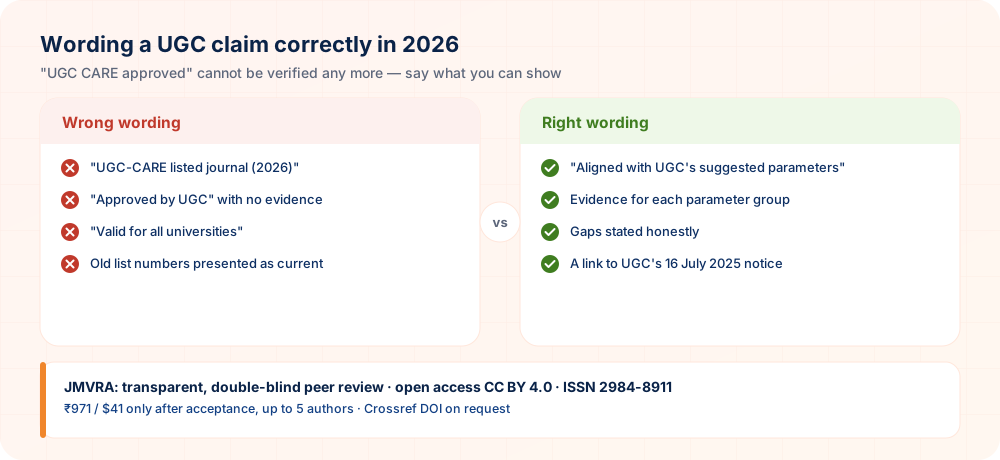
| Avoid (unverifiable) | Use instead (verifiable) |
|---|---|
| “UGC CARE approved journal” | “Aligned with UGC’s Suggested Parameters for Choosing Peer-Reviewed Journals” |
| “UGC approved journal 2026” | “Following the discontinuation of UGC-CARE listing, we meet UGC’s suggested parameters — see our parameter-by-parameter statement” |
| “UGC CARE journal from ₹599” | “Peer-reviewed journal, fee ₹___ payable after acceptance; UGC parameters met: see [link]” |
| “UGC recognised publication” | “Institutions evaluate journals against UGC’s suggested parameters; our evidence is published here” |
| “Was UGC-CARE listed” (with no date) | “Listed in UGC-CARE Group __ from [year] to [year]” — only if true, with dates |
A good model is the statement JMVRA uses: “JMVRA is a Transparent, Peer-Reviewed, Open Access Journal (Refereed Journal). Following the discontinuation of the UGC and UGC-CARE journal listing, and in alignment with the latest UGC-CARE recommendations and guidelines, JMVRA is aligned with UGC’s Suggested Parameters for Choosing Peer-Reviewed Journals.” It links to the UGC public notice (PDF) and to a page showing how each parameter is met.
UGC’s New Recommendation Points: 35 Parameters in 8 Groups
| Group | Parameters |
|---|---|
| 1. Journal preliminary criteria (9) | Journal title · ISSN · Periodicity and continuity · Contact and publication details · Transparent review policy · Website on a certified domain · Open access or subscription policy · Integration with national/international repositories · Archival policy |
| 2. Editorial board criteria (3) | Editorial board details · Board composition · Efficient editorial and review process |
| 3. Journal editorial policy (5) | Aims, objectives and scope · Subject areas · Article processing charges · Publishing timeline · Acceptance rate |
| 4. Content quality (2) | Academic contribution · Conformity to journal scope |
| 5. Journal standards (7) | Bibliographic data and citation · Font and design · Infographics and exhibits · Citation record · Print continuum · Quality of website · Multilingual availability (the February 2025 draft also listed “Online availability”, dropped from the final list) |
| 6. Research ethics (4) | Ethical guidelines for authors · Plagiarism prevention · Conflict-of-interest disclosure · AI-generated content policy |
| 7. Journal visibility (2) | Impact factor or similar factor (if applicable) · Indexation in reputed databases |
| 8. Journal impact criteria (3) | Self-citation score · Total citation rate · CiteScore |
The parameters are suggestive: UGC does not certify any journal against them. Institutions and authors treat them as a checklist, and that is the reason a journal ought to publish proof for each one instead of a badge.
Supporting Every Group With Evidence
Preliminary criteria
An ISSN Portal record, an archive of all issues, the official domain and contact, and published review and archival policies.
Editorial board
Editors and reviewers listed by name with affiliations that can be verified, plus a described review workflow.
Editorial policy
Scope and subjects, the APC stated at the outset, timelines given as ranges, and the acceptance rate — or a plain note that it is not published.
Content and standards
An author template, a referencing style, full text available online, and a website kept up to date on schedule.
Research ethics
Policies aligned with COPE, similarity screening ahead of review, and policies on conflict of interest and AI use.
Visibility and impact
Indexing that can be confirmed at the source, with metrics credited to their source — never a bought “impact factor”.
Be Open About What You Do Not Meet
Hardly any journal satisfies all 35 points. Group 8 (self-citation score, total citation rate, CiteScore) relies on databases that many journals are absent from. An honest statement marks each parameter as met, partly met or not published, and a journal that boasts a perfect score should be asked to show its evidence. Such openness is a better sign of quality than any badge.
The self-assessment sits on the JMVRA & UGC CARE page, where each shortfall is explained. The result: 28 of 35 met, 2 partly met, 3 not published, 2 not applicable.
Is Any of This Relevant to Books?
No. UGC-CARE listed journals and never books, and the suggestive parameters were written for journals. A book or a book chapter cannot be “UGC CARE approved”. What can be checked for books is the ISBN, the publisher’s identity, any peer or editorial review, and a DOI where one is registered — see our JW Book publication guide.
Testing a Journal’s UGC Claim in Six Steps
- Read precisely what is said. Is it claiming a current list, or alignment with the parameters?
- Look at the UGC notice. Confirm the discontinuation on your own in UGC’s public notice.
- Request the parameter statement. A reliable journal presents evidence for every group.
- Confirm the fundamentals. An ISSN record, DOIs that work, a named board, and fees payable after acceptance.
- Verify indexing where it originates. Scopus, Web of Science, DOAJ or Google Scholar — and not badges.
- Follow your institution’s rule. Your IQAC or university determines what is valid for you.
The 10 Most-Searched Questions on This Topic
Here are the ten questions researchers search for most on this subject, each with a direct answer.
UGC CARE approved journal 2026
As no current UGC-CARE list exists, the claim cannot be confirmed; journals are measured against UGC’s suggested parameters.
UGC new recommendation for journals
For picking peer-reviewed journals, the 16 July 2025 notice offers 35 suggestive parameters, arranged in 8 groups, in its Annexure-I.
UGC suggestive parameters list
Preliminary criteria, editorial board, editorial policy, content quality, standards, ethics, visibility and impact.
UGC CARE discontinued notice
UGC’s public notice on CARE journals declared the end of the listing and the shift to parameters.
how to write UGC claim on journal website
“Aligned with UGC’s Suggested Parameters for Choosing Peer-Reviewed Journals”, linked to evidence for each parameter.
UGC 35 parameters journal
The 35 suggestive parameters against which journals are assessed now that CARE listing has ended.
is UGC approved journal list available
Just archived lists kept for reference; UGC maintains no current approved or CARE list.
UGC CARE for books
UGC-CARE never included books; assess books by ISBN, publisher, review and DOI.
fake UGC approved journal
A journal that asserts current UGC approval is making a claim that cannot be verified.
JMVRA UGC status
JMVRA describes itself as aligned with UGC’s suggested parameters. Of 35, it counts 28 as met, 2 as partial, 3 as not published and 2 as not applicable.
How JMVRA Fits In
JMVRA is a Transparent, Peer-Reviewed, Open Access Journal (Refereed Journal). Following the discontinuation of the UGC and UGC-CARE journal listing, and in alignment with the latest UGC-CARE recommendations and guidelines, JMVRA is aligned with UGC’s Suggested Parameters for Choosing Peer-Reviewed Journals. UGC public notice (PDF)
JMVRA states its UGC position exactly as recommended here: aligned with UGC’s Suggested Parameters for Choosing Peer-Reviewed Journals, with a published parameter-by-parameter statement (28 met, 2 partial, 3 not published, 2 not applicable).
- ISSN
- 2984-8911 (online) · publishing since June 2023
- Issues
- Monthly issues across many disciplines
- Review
- Two-way anonymous review by specialists
- Access
- Open access, licensed CC BY 4.0
- Fee
- ₹971 INR for Indian and $41 USD for foreign authors, due only after acceptance
- DOI
- Crossref — available as an optional extra
- Indexing
- Google Scholar indexes it, while Scopus, Web of Science and DOAJ do not
- Impact factor
- 11.25, derived from Google Scholar data
Screening begins the moment a paper arrives and each decision is sent as soon as it is reached, yet JMVRA never promises a set number of days: actual review time depends on the reviewers and on how much revision the paper needs.
At-a-Glance Checklist
- Claim rewordedParameters, not listing
- Evidence linkedPer group
- Gaps admittedOpenly
- Notice linkedUGC public notice
- Books consideredSeparate rules
How Authors Should Handle Journal Claims
- Be cautious with “UGC CARE approved” claims — the list no longer exists
- Request evidence for the parameters — policies, review and identity
- Look up your institution’s criteria — they settle what counts
- Keep notes — on what you verified and on which date
How JMVRA Expresses Its Position
Reading and Wording Journal Recognition Claims Carefully
Whether you are an author judging a journal or an editor describing one, precise language matters. Careless wording about recognition can mislead readers and damage trust in otherwise sound research work.
- Prefer verbs you can prove. Say what a journal does, such as publishing a review policy or stating its ethics rules, instead of using grand adjectives. Every sentence on a status page should point to something checkable.
- Watch for outdated phrases. Words that described a retired arrangement still circulate on old websites and templates. If a claim sounds like it belongs to an earlier system, ask the journal to explain its current basis.
- Separate approval from alignment. Being approved by an authority and following its suggested guidance are different statements. When you read or write a claim, make sure the verb matches what actually happened.
- State limitations openly. If a journal does not meet some expectation yet, say so plainly. Authors usually trust a transparent statement of gaps more than a flawless-sounding claim they cannot test.
- Screenshot claims before they change. When a journal makes a recognition claim that matters to your decision, save the page with its address and the day you viewed it. This helps if the wording is quietly altered later.
Treat every recognition statement as a claim to be tested, and word your own statements so that each part can be backed by evidence.
Questions Researchers Often Ask
How JMVRA Measures Up to UGC’s 35 Suggested Parameters
The final Annexure-I attached to UGC’s notice of 16 July 2025 groups 35 parameters into 8 categories; the February 2025 draft had 36. JMVRA’s own tally is 28 met, 2 partly met, 3 not published and 2 not applicable, each with a stated reason.
Source: UGC public notice on CARE journals (PDF) · the full breakdown can be read on JMVRA & UGC parameters.
Ready to Publish? Submit to JMVRA
JMVRA is aligned with UGC's Suggested Parameters for Choosing Peer-Reviewed Journals.
JMVRA is a Transparent, Peer-Reviewed, Open Access Journal (Refereed Journal). Following the discontinuation of the UGC and UGC-CARE journal listing, and in alignment with the latest UGC-CARE recommendations and guidelines, JMVRA is aligned with UGC’s Suggested Parameters for Choosing Peer-Reviewed Journals.
Helpful pages on jmvra.org
Key Terms
Subjects and search phrases this article addresses.
Related Reading
Further reading on the same theme from the JMVRA blog.
Keep Reading on the JMVRA Blog
This guide belongs to the JMVRA journal blog, which offers practical advice on publishing, indexing, metrics and research integrity, written to be checkable instead of promotional.