
Most problems reviewers find in a manuscript start long before the results: a question too broad to answer, a hypothesis that cannot be tested, or methods that do not match what was asked. Getting the research questions and hypotheses right makes every later section easier to write and to defend. This guide explains the types of research questions, how qualitative and quantitative questions differ, how to use the PICO and FINER frameworks, how to write null, alternative, directional and non-directional hypotheses, and how to align all of them with your objectives and analysis.
Why Research Questions and Hypotheses Matter
A research question states what the study is trying to find out. A hypothesis, where one is used, states what the researcher expects to find and in a form that data can support or contradict. Together they set the boundaries of the project: which population, which variables, which comparison and which outcome.
For journal publication they do three practical jobs:
- They justify the design. Reviewers check whether the chosen sample, instruments and tests can actually answer the question asked.
- They organise the paper. The introduction ends with them, the results report against them, and the conclusion answers them in the same order.
- They limit scope creep. A precise question tells you which interesting side analyses to leave for another paper.
Not every study needs a hypothesis. Exploratory, descriptive and most qualitative studies are driven by research questions alone. Hypotheses belong in studies that test a prediction, usually with statistical inference. If you are still choosing an overall approach, our overview of research methodology explains how design follows from purpose.
From Topic to Problem to Question
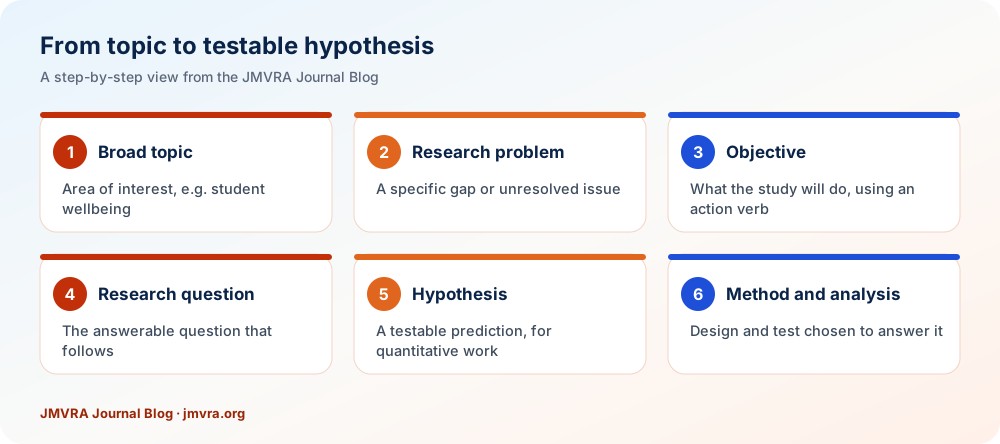
A topic is not a question. “Online banking in rural India” is a topic; it could lead to dozens of studies. Narrowing it takes three moves.
- Find the problem. Read recent studies and identify what is unknown, disputed or untested in your context. The problem is the gap: for example, adoption studies mostly sample urban, salaried users.
- Set the objective. State what the study will do with an action verb: to examine, to compare, to estimate, to explore. Example: “To examine the factors associated with online banking use among small farmers in two districts.”
- Write the question. Turn the objective into an answerable question: “Which demographic and attitudinal factors are associated with online banking use among small farmers?”
A good research question is specific about population and setting, names the main concepts or variables, and can be answered with data you can realistically collect.
A careful literature review is the most reliable way to find a real gap rather than a gap that only exists because the search was thin.
Types of Research Questions
Research questions are often grouped by what they ask about. The type determines the design and the analysis.
| Type | Asks about | Example | Typical design |
|---|---|---|---|
| Descriptive | Level, frequency or pattern | What proportion of nursing students report sleeping under six hours on exam nights? | Cross-sectional survey |
| Comparative | Differences between groups | Do government and private school teachers differ in digital teaching confidence? | Group comparison (t-test, ANOVA) |
| Relational | Association between variables | Is working capital ratio associated with profitability in listed textile firms? | Correlation or regression |
| Causal | Effect of one variable on another | Does a peer-tutoring programme raise mathematics scores in Class 8? | Experiment or quasi-experiment |
| Exploratory | Experiences, meanings, processes | How do first-generation college students describe their transition to university? | Interviews, focus groups, case study |
A paper can combine types. Two to four research questions are typical for an empirical article; more than six usually signals that the material should be split or tightened.
Qualitative and Quantitative Questions Are Written Differently
Quantitative questions name variables and a relationship between them. They use words such as difference, relationship, effect, predict or proportion, and they are usually followed by hypotheses. Example: “Is there a relationship between weekly hours of part-time work and grade point average among undergraduate commerce students?”
Qualitative questions are open and exploratory. They usually begin with how or what, focus on a central phenomenon, and avoid directional or causal words such as affect, influence or determine, because the study is not designed to test them. A common structure is one central question supported by a few sub-questions.
Qualitative questions may also be refined as data collection proceeds, which is acceptable as long as the paper reports how and why they changed. Mixed-methods studies add a third question on how the two strands will be integrated.
Using PICO, SPIDER and FINER
Frameworks help you check that a question contains the parts a reviewer will look for.
PICO for intervention and comparison questions
Population, Intervention or exposure, Comparison and Outcome. A time element is sometimes added (PICOT). Common in health research, it also suits education or management studies that compare interventions. Example: “In adults with type 2 diabetes (P), does a pharmacist-led counselling programme (I), compared with usual care (C), lower HbA1c after six months (O, T)?”
SPIDER for qualitative and mixed questions
Sample, Phenomenon of Interest, Design, Evaluation and Research type. It suits questions about experiences and perceptions, where PICO’s “intervention” and “comparison” do not fit.
FINER for judging whether a question is worth asking
- Feasible — enough participants, time, money and skills.
- Interesting — to you and to the journal’s readers.
- Novel — confirms, extends or challenges earlier findings rather than repeating them.
- Ethical — can be approved and conducted without undue risk.
- Relevant — to science, practice or policy.
Use PICO or SPIDER to make the question precise, then FINER to decide whether to pursue it.
What Makes a Good Hypothesis
A hypothesis is a tentative, testable statement about the relationship between two or more variables in a defined population. Strong hypotheses share five features:
- Testable. Data that you can collect could, in principle, contradict it.
- Specific. It names the variables, the population and the expected relationship.
- Grounded. It follows from theory or earlier findings, which the introduction should cite.
- Measurable. Each variable has an operational definition — how it will be observed or scored.
- Single. It tests one relationship. “Job satisfaction and pay affect turnover and absenteeism” is really four hypotheses.
Operational definitions turn abstract concepts into measurements. “Academic stress” might be operationalised as the total score on a named, validated scale. State these in the methods and keep the hypothesis wording consistent with them.
Avoid value judgements (“online learning is better”), vague terms (“some effect”) and hypotheses that cannot fail (“attitudes may or may not influence behaviour”). A prediction that every possible result would support is not a hypothesis. The methods section guide covers how to report variables and measures so reviewers can see that each hypothesis was actually tested.
Null and Alternative Hypotheses
In statistical hypothesis testing, each research hypothesis is usually expressed as a pair:
- Null hypothesis (H0) — no difference, no association or no effect in the population.
- Alternative hypothesis (H1 or Ha) — there is a difference, association or effect.
The test assesses how compatible the data are with H0. If the p-value falls below the significance level set in advance (often 0.05), you reject the null hypothesis; otherwise you fail to reject it. Do not write that the null was “accepted” or “proved”: a non-significant result may reflect a real absence of effect or simply too little data to detect one. Likewise, rejecting H0 does not prove H1 or show the effect is large; report effect sizes and confidence intervals alongside p-values.
Directional and Non-Directional Hypotheses
An alternative hypothesis can predict a direction or simply a difference.
- Non-directional (two-tailed): “Job satisfaction differs between permanent and contract nurses.” Either group could score higher.
- Directional (one-tailed): “Permanent nurses report higher job satisfaction than contract nurses.” Only one direction is predicted.
Choose a directional hypothesis only when theory or consistent earlier evidence clearly predicts the direction, and decide this before seeing the data. A one-tailed test has more power to detect an effect in the predicted direction but cannot detect one in the opposite direction. Switching from a two-tailed to a one-tailed test after the results come in, to push a p-value under 0.05, is a questionable research practice that reviewers watch for.
Relational hypotheses follow the same logic: “Hours of sleep are positively associated with exam performance” is directional; “Hours of sleep are associated with exam performance” is not.
State hypotheses in the present tense as predictions about the population, not about your sample, and number them (H1, H2, H3) so the results and conclusion can refer back to each one.
Aligning Objectives, Questions, Hypotheses and Methods
A frequent structural weakness is misalignment: an objective with no matching question, a hypothesis never tested, or an analysis that answers something else. An alignment matrix in your planning notes prevents this.
| Objective | Research question | Hypothesis | Measure | Analysis |
|---|---|---|---|---|
| Describe usage | RQ1: How often do small farmers use online banking? | None (descriptive) | Self-reported monthly transactions | Frequencies, percentages |
| Compare groups | RQ2: Does usage differ by education level? | H1: Usage differs across education levels | Education category; transactions | ANOVA or Kruskal–Wallis |
| Test predictors | RQ3: Does perceived risk predict usage? | H2: Higher perceived risk predicts lower usage | Validated risk scale | Multiple regression |
Read across each row: if any cell is empty or does not follow from the one before it, fix the plan before collecting data. The same matrix makes the results section easy to organise and helps you write a conclusion that answers every question in order.
Common Mistakes and How to Avoid Them
- Too broad. “What is the impact of technology on education?” cannot be answered in one study. Name the technology, learners, setting and outcome.
- Double-barrelled. “Do training and mentoring improve performance and retention?” Split it so each question has one predictor and one outcome.
- Hypotheses in a purely qualitative study. Use open research questions instead.
- Too many hypotheses. Testing twenty predictions raises the chance of false positives; prioritise and consider corrections for multiple comparisons.
- HARKing. Hypothesising After the Results are Known means presenting a pattern discovered in the data as if it had been predicted. Label unexpected findings as exploratory.
- Mismatched wording. The hypothesis says “effect”, but the design is cross-sectional. Use “association” unless the design supports causal inference.
Pre-registering hypotheses and analysis plans on a public registry, which is standard for clinical trials and increasingly common elsewhere, is the strongest protection against these problems. Many of them also appear among the common reasons papers are rejected. If you submit to JMVRA or any peer-reviewed journal, double-blind reviewers will read your questions first and judge everything else against them.
Quick Checklist
- Narrow the topicName population, setting and main variables
- Check with PICO/SPIDERAll key components present in the question
- Test with FINERFeasible, interesting, novel, ethical, relevant
- Write H0 and H1Only where a prediction is being tested
- Fix direction earlyChoose one- or two-tailed before data collection
- Build an alignment matrixObjective, question, hypothesis, measure, test
Practical Tips for Sharper Questions and Hypotheses
Small wording changes often decide whether a reviewer sees a study as focused or vague.
- Start with the objective verb. If you cannot write the objective with one clear verb such as compare, estimate or explore, the question is not ready.
- Read it to a non-specialist. If they cannot say who is being studied and what is measured, add those details.
- Draft the results table first. Sketch the empty table that would answer each question; if you cannot, the question is too vague to analyse.
- Use the same labels everywhere. Keep RQ1 or H2 identical in the introduction, results, discussion and conclusion so reviewers can track them.
- Separate confirmatory and exploratory. Predictions made in advance and patterns found later should be reported under different headings.
A precise question and a falsifiable hypothesis are the foundation every other section of the paper rests on.
Questions Researchers Often Ask
In Summary
Clear research questions and testable hypotheses make a paper easier to write and easier to review. Narrow the topic to a specific problem, state the objective with a precise verb, check the question with PICO or SPIDER and FINER, and add null and alternative hypotheses only where you are testing a prediction. Decide on direction before seeing the data, keep each hypothesis to one relationship, and use an alignment matrix to link every question to a measure and an analysis. When your manuscript is ready, run through the pre-submission checklist before you submit.
Ready to send in your paper?
Online submission to JMVRA is free of charge. Papers are screened first and then go through transparent, double-blind peer review; ₹971 INR (Indian authors) or $41 USD (foreign authors) is due only after acceptance. Retain every confirmation email for your records.
References and Sources
Taking a Draft Through to a Published Paper
- PrepareStick to the template and author guidelines
- Submit onlineCosts nothing; write down your paper ID
- ScreeningSubject scope, declarations and similarity below 15%
- Double-blind reviewDecision by email and WhatsApp
- AcceptedThe ₹971 INR / $41 USD fee becomes due, and the paper is then published in open access
Details are available under Publication guidelines · Peer review · Publication charges.
Ready to Publish? Submit to JMVRA
JMVRA is aligned with UGC's Suggested Parameters for Choosing Peer-Reviewed Journals.
JMVRA is a Transparent, Peer-Reviewed, Open Access Journal (Refereed Journal). Following the discontinuation of the UGC and UGC-CARE journal listing, and in alignment with the latest UGC-CARE recommendations and guidelines, JMVRA is aligned with UGC’s Suggested Parameters for Choosing Peer-Reviewed Journals.
More useful pages at jmvra.org
Key Terms
Subjects and search phrases this article addresses.
Related Reading
More JMVRA guides that pair well with this one.
Keep Reading on the JMVRA Blog
You are reading part of the JMVRA journal blog, a source of hands-on guidance about publishing, indexing, metrics and research integrity that aims to be verifiable, not promotional.