
GST Applicability
- Indian authors who pay Article Processing Charges (APC) are liable to GST
- The GST rate in force at present is 18% for publication services
- Any Indian author can request a GST invoice
- Indian GST does not apply to international authors
GST Invoice
Authors who need a GST invoice for reimbursement by their institution or for personal tax reasons should give their GSTIN (GST Identification Number) when paying. GST invoices are issued within 48 hours of confirmed payment. It helps to verify the registration number against your own records before you pay.
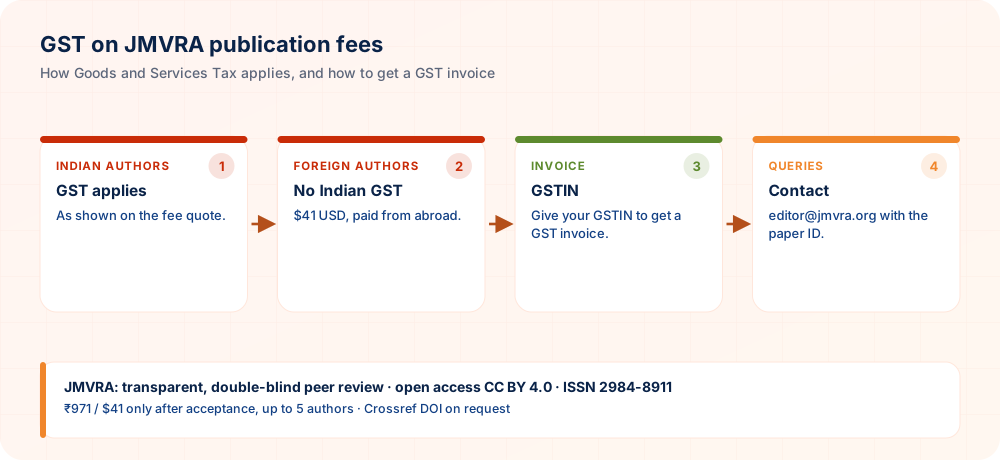
GST Rates Summary
| Author Type | Base Fee | GST Rate | Total |
|---|---|---|---|
| Indian Author | ₹971 INR | 18% | Subject to the prevailing notification |
| Foreign Author | $41 USD | Exempt | $41 USD |
Contact for GST
For a GST invoice or any tax-related questions, write to [email protected] and include your GSTIN and payment details.
Obtaining an Invoice Suitable for Reimbursement
- Enquire before you pay — decide if the invoice should be personal or in your institution's name
- Give precise details — your name, address and tax registration number exactly as they must be printed
- Verify the amount — compare it with the listed fee and the acceptance email
- Store invoice and receipt side by side — along with the paper ID
Some General Remarks on Taxation of Services
As for the publication fee itself, the publication charges page lists ₹971 INR for Indian authors and $41 USD for foreign authors per accepted article, charged only after acceptance. Compare the amount on your invoice with that page before you pay.
Practical Tips for GST Invoices on Publication Fees
Tax paperwork matters most when your institution or funder reimburses the fee. A little preparation before payment avoids rejected claims, rewritten invoices and delays in your own accounts office.
- Ask your accounts office first. Find out which details your finance department needs on a service invoice, such as exact institution name, address and tax registration, before you make any payment on the manuscript.
- Keep names consistent everywhere. The billing name, payer name and name on the bank record should agree. Mismatches between an invoice and a payment proof are a frequent reason reimbursement officers return a claim.
- Supply billing details at the right time. Send tax registration details and the billing address when the payment request arrives, not afterwards. Changing a document once it is issued usually needs extra steps and explanation.
- File the invoice with the paper trail. Store the invoice together with the acceptance email, payment proof and manuscript identifier in one folder. Auditors and grant managers often ask for the complete chain, not a single page.
- Confirm tax questions with a professional. Rules differ between institutions and sponsors and can change, so ask your finance officer or tax adviser rather than relying on a general blog explanation.
Agree the invoice details with your accounts office before paying, keep names consistent, and store every related document together.
Questions Researchers Often Ask
At-a-Glance Checklist
- Fee category identifiedIndian or foreign
- GSTIN suppliedIf a GST invoice is needed
- Invoice verifiedName, GSTIN, amount
- Receipt savedWith transaction ID
- Queries submittedWith paper ID
Your Paper's Journey at JMVRA, From Submission to Publication
- UploadPaper ID issued
- ScreenScope & similarity
- ReviewDouble-blind
- DecideEmail & SMS
- ReviseRespond point by point
- AcceptCopyright & fee
- ProduceObtainable DOI, on request
- PublishMonthly issue
How long review takes depends on the reviewers and on any revision required, so no set turnaround is promised; you are told of acceptance or rejection by email and WhatsApp.
Ready to Publish? Submit to JMVRA
JMVRA is aligned with UGC's Suggested Parameters for Choosing Peer-Reviewed Journals.
JMVRA is a Transparent, Peer-Reviewed, Open Access Journal (Refereed Journal). Following the discontinuation of the UGC and UGC-CARE journal listing, and in alignment with the latest UGC-CARE recommendations and guidelines, JMVRA is aligned with UGC’s Suggested Parameters for Choosing Peer-Reviewed Journals.
Further reading on jmvra.org
Key Terms
Subjects and search phrases this article addresses.
Related Reading
Further reading on the same theme from the JMVRA blog.
Keep Reading on the JMVRA Blog
This article sits on the JMVRA journal blog, where practical guidance covering publishing, indexing, metrics and research integrity is written to be verifiable, not promotional.