
Publishing research is essential in academia today, yet it frequently brings high costs and lengthy delays. Students, faculty members and researchers in India face the real challenge of finding a trusted, UGC CARE-aligned journal that is affordable, quick and truly reputable, instead of one that merely claims to be. Reading a journal's published policies before submitting is the quickest way to tell the difference.
The Importance of Low-Cost Journal Publishing
Publication charges of ₹3,000 to ₹10,000 or more are simply out of reach for many researchers in India, particularly students and early-career academics. Genuinely low-cost, transparent journals fill that gap by offering affordable publication with no compromise on peer review or academic integrity.
Advantages of Low-Cost Publishing
- Open to students, PhD scholars and faculty whatever their institutional funding
- Motivates scholarly contributions from rural and underfunded institutions
- Supports quicker and wider sharing of research
- Takes away money-related barriers for able researchers who just cannot justify a fee of ₹5,000+
Peer Review That Is Efficient and Transparent
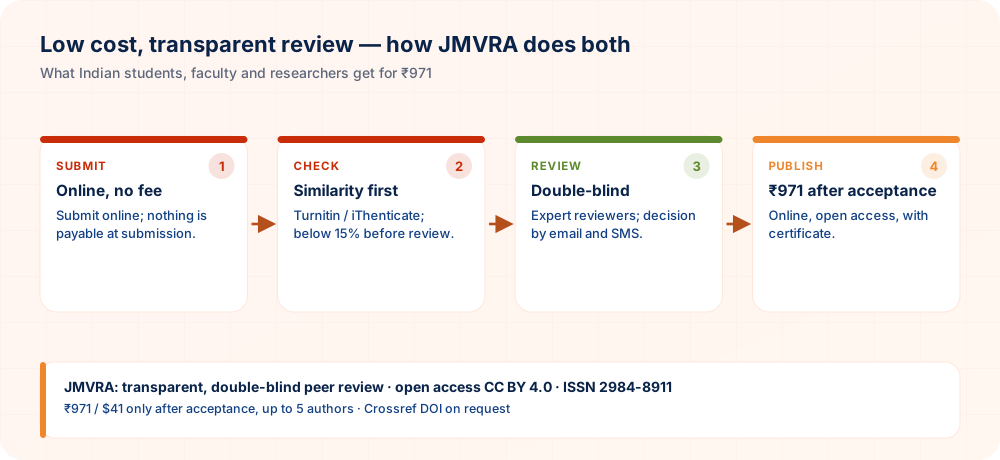
Low cost should not have to mean slow. At JMVRA, expert reviewers evaluate your paper, and acceptance or rejection notices arrive by email and WhatsApp. A double-blind peer review process and a panel of 3,000+ subject-matter reviewers support it, so speed comes from how the process is designed and not from skipping review.
- Every submission gets transparent double-blind peer review
- Acceptance or rejection sent via email and WhatsApp
- Before any reviewer sees the paper, it is screened for plagiarism (Turnitin/iThenticate, below 15% similarity)
- A digital publication certificate is issued right after publication
Keeping to UGC CARE Norms
UGC's guidance for peer-reviewed journals centres on openness. It looks for a real, documented review process, a named editorial board, ethical publishing conduct and accurate indexing. Journals aligned with these expectations hold up well when used for Ph.D. submission, faculty promotion and academic evaluation. Match your choice of journal to what your own institution's rules ask for.
JMVRA is UGC Status & Parameters and operates Open-Process Peer Review, aligned with UGC's suggestive parameters for peer-reviewed journals. That means:
- Each submission is peer-reviewed and refereed, not just a chosen few
- Editorial and ethical policies that are transparent and openly published on this site
- Crossref DOI registration (on request) together with proper indexing
- Open-access publishing for the widest visibility, with no extra charge
JMVRA's Actual, Published Fees — From ₹971 INR
We would rather not direct you to outside journals whose charges and standards we cannot vouch for, so below is the complete fee schedule that JMVRA itself publishes:
| Tier | Fee | What You Get |
|---|---|---|
| Standard (JMVRA) | ₹971 INR / $41 USD | Double-blind peer review, UGC Status & Parameters, ISSN, a certificate, plagiarism screening, and the decision sent by email & WhatsApp |
| Network (TIJER / JNRID) | ₹970 / $50 USD | Our network journals, handled through Research Wave: multidisciplinary, monthly, peer-reviewed and open access |
| Comparing (all three) | ₹970–₹971 INR / $41 USD–$50 USD | Indian authors pay within ₹1 of each other across JMVRA, TIJER and JNRID, while international authors save $9 by choosing JMVRA at $41 USD. Before paying, check each ISSN (2984-8911, 2349-9249, 2984-8687) on portal.issn.org |
Two services are intentionally held apart from the base fee, not folded in without notice: you can request a Crossref DOI for a small optional charge (ask the editorial office), and a printed hard copy of the journal issue for ₹500. The full breakdown is on the Publication Charges policy page, and the Cost Calculator gives an itemised total.
Who This Is Really Meant For
If you are preparing for a Ph.D. viva, seeking promotion under API scoring, or researching independently without institutional funding, an affordable and transparent journal gives you:
- A fee stated openly so you can plan, and no surprise invoice once accepted
- Peer review quick enough to count for degree and deadline schedules
- UGC CARE alignment that institutions genuinely recognise
- A permanent record you can verify, rather than merely a PDF on a personal site
Do Your Checks Before Paying Anyone
Affordability and academic credibility can coexist, but only if the journal is open about its price and its process. Publish your research with confidence and speed, backed by a verifiable record, and do not let the fee alone settle where you submit. Keep copies of correspondence and receipts so you can demonstrate your publication history later.
At-a-Glance Checklist
- Fee verified₹971 INR Indian / $41 USD foreign, due once accepted
- Similarity under 15%Screened ahead of review
- How decisions arriveEmail and SMS
- Rules of your institutionCheck what your institution accepts
- Check before payingUse only the official site and payment page
What the Fee Gets You
| Item | Detail |
|---|---|
| Peer review | Review that is transparent and double-blind |
| Open access publication | Free to read under CC BY 4.0 |
| Publication certificate | After publication |
| Indexing | Google Scholar |
| DOI | A Crossref DOI upon request |
A Fair Way to Compare Affordable Journals
- Weigh the total cost — extra authors and optional services included
- Look at when payment is due — paying after acceptance is safer
- Look for proof of review — comments and decisions
- Judge recognition — against the criteria of your institution
Practical Tips for Indian Scholars Choosing Affordable Journals
Scholars in India often balance tight budgets with strict institutional expectations. These suggestions help you choose carefully, document your choice and avoid problems at evaluation time.
- Check your institution's rules first. Universities and promotion committees have their own requirements for acceptable journals. Obtain the current circular from your research office and compare it with the journal before paying anything.
- Prepare for similarity screening. Run your draft through an approved similarity tool available at your institution, and rewrite borrowed phrasing in your own words. Clean originality reports make the review stage smoother.
- Keep receipts in an organised folder. Store payment proofs, acceptance emails and the final article link together. Viva boards, annual reports and promotion files frequently ask for exactly these documents.
- Use bank-traceable payment methods. Prefer methods that leave a clear record, and avoid cash arrangements or transfers requested through chat. A traceable payment is easier to explain and to dispute if needed.
- Share costs with co-authors fairly. Agree in advance, preferably by email, how the charge and credit will be shared among authors. Early clarity prevents friction between supervisors and students.
Confirm your institution's expectations, keep every document, and choose payment methods that leave a clear trail.
Questions Researchers Often Ask
How Transparent Peer Review Works, Stage by Stage
- SubmissionPlagiarism, formatting and scope are checked at the outset.
- Reviewers assignedSubject experts are given the paper through the Scholar9 portal.
- Double-blind reviewExperts judge the originality, significance and clarity of the work as well as the soundness of its method.
- DecisionYou are told by email and WhatsApp whether the outcome is accept, revise or reject.
- RevisionAuthors go through each comment and reply to it.
- TransparencyScholar9 holds the review record; reports can be had on request.
Transparency can take three forms (open reports, optional reviewer identity, open participation), and how JMVRA applies them is explained elsewhere.
Ready to Publish? Submit to JMVRA
JMVRA is aligned with UGC's Suggested Parameters for Choosing Peer-Reviewed Journals.
JMVRA is a Transparent, Peer-Reviewed, Open Access Journal (Refereed Journal). Following the discontinuation of the UGC and UGC-CARE journal listing, and in alignment with the latest UGC-CARE recommendations and guidelines, JMVRA is aligned with UGC’s Suggested Parameters for Choosing Peer-Reviewed Journals.
Where to go next on jmvra.org
Key Terms
Subjects and search phrases this article addresses.
Related Reading
Further reading on the same theme from the JMVRA blog.
Fee Paid? Final Steps Before Your JMVRA Paper Goes Live
Read the guide RelatedWhy JMVRA Charges Just ₹971 INR / $41 USD Without Lowering Standards
Read the guide RelatedLow-Cost Journal Publication: A Full Guide (From ₹971 INR)
Read the guide RelatedPublication Charges
Read the guide RelatedJMVRA Publication Cost Calculator
Read the guide RelatedAffordable Journal Publication in India, Done Safely
Read the guideKeep Reading on the JMVRA Blog
Find this guide on the JMVRA journal blog, a collection of practical guidance on publishing, indexing, metrics and research integrity that favours verifiable content over promotion.