
Journals now ask every author three questions: who paid for the work, who else helped, and whether anything could be seen as influencing the findings. The answers go into short competing interests, funding and acknowledgement statements. They take minutes to write well, yet missing or vague versions are a frequent reason a manuscript is sent back before review. This guide explains what counts as an interest, how to word each statement, where it belongs under blind review, and what happens if something is missed.
What a conflict of interest actually is
A conflict of interest, often called a competing interest, exists when an author has a relationship or circumstance that a reasonable reader could think might affect how the research was designed, carried out, interpreted or reported. You need not believe the interest changed your results; the test is whether a reader judging the paper would want to know about it.
Declaring an interest is not an admission of wrongdoing. Most declared interests are ordinary: a consultancy, a company grant, a patent application. Trouble starts only when an interest is hidden and surfaces later.
Three distinctions help you decide what to report:
- Actual or perceived. Declare both. A perceived conflict that is disclosed rarely causes problems; an undisclosed one almost always does.
- Personal or institutional. Payments to your department or university linked to this work count, not only money paid to you.
- Current or recent. Journals set a look-back period, commonly the past 36 months, plus anything connected to the present manuscript since the work was first planned.
Financial and non-financial interests
Financial interests are easy to recognise because money, or something of monetary value, changes hands. Non-financial interests are equally relevant but are the ones authors most often forget. The table gives typical examples and the point at which each is usually declared.
| Type | Examples | Declare when |
|---|---|---|
| Grants and contracts | Research funding from a company, foundation or government body | Linked to this work, or to the topic within the look-back period |
| Personal payments | Consultancy, honoraria, speaker fees, expert testimony, travel support | The payer has an interest in the subject of the paper |
| Ownership and IP | Shares, stock options, patents held or pending, royalties | The product, method or a competitor is discussed |
| Employment and roles | Employer, board seat, advisory role, unpaid office in a society or advocacy group | The organisation is connected to the topic |
| Personal relationships | Close family member at an interested company; close rivalry with authors whose work you assess | It could influence interpretation |
| Beliefs and affiliations | A strong public position or membership that bears directly on the question studied | Directly relevant; many journals leave this to author judgement |
Apply the same reader test to non-financial interests: a member of a policy committee who evaluates that committee's own scheme should say so, even if the role is unpaid.
The ICMJE disclosure form in brief
Many health and medical journals, and a growing number in other fields, use the ICMJE Disclosure of Interest form or an adapted version. Even if your target journal has its own form, the ICMJE structure is a sensible way to organise your answers.
- Each author completes it separately. The corresponding author cannot answer for co-authors; every author is responsible for their own declarations.
- Two time frames. Support for the present manuscript is reported for the whole life of the work, from initial planning onwards. Other relevant relationships are reported for the past 36 months.
- Itemised categories. Grants, royalties, consulting fees, lecture payments, travel support, patents, board and leadership roles, stock, equipment or writing help: for each, tick “None” or name the entity and describe the relationship.
- Broad relevance. “Relevant” covers any entity with an interest in the general area of the manuscript, not just the exact product or programme studied.
Wording a “no conflict” statement
If no author has anything to declare, say so plainly and in words that clearly cover all authors. Avoid a bare “Nil” or “Not applicable”, which some editors read as a field left unanswered. Any of the following is acceptable:
“The authors declare no financial or non-financial interests that could be perceived as influencing the work reported in this paper.”
“All authors have completed the disclosure form and report no relevant financial or non-financial relationships in the past 36 months.”
Before you use a blanket statement, ask every co-author directly. A typical gap is a senior co-author who gave a paid talk for a company in the field, and nobody thought to mention it. One short email prevents most problems: “In the last three years, have you had any grants, fees, patents, shares or roles connected to this topic?”
Then check that the statement agrees with the funding section. If a manufacturer funded the study while the competing interests line says “none”, expect the editor to ask why.
Declaring an interest clearly
When an interest exists, a good statement names the author (initials are enough), the organisation, the nature of the relationship and, where useful, its dates. It should be specific enough that a reader can judge its importance without searching elsewhere.
Points to watch when wording it:
- Cover every author, including those with nothing to declare, so no one is left ambiguous.
- Use neutral verbs: “has received”, “holds”, “is employed by”, “serves on”. Leave out defensive add-ons such as “this did not influence the results in any way”; readers can make that judgement.
- Do not give amounts unless the journal asks for them.
- If an interest ended recently, give the end date rather than omitting it.
When unsure whether something counts, disclose it. An editor can dismiss an irrelevant item but cannot assess one never shown.
Writing the funding statement
The funding statement tells readers who paid for the research and lets funders trace their grants. Check your award letter first: many funders prescribe exact wording.
- Use the full official name, with the abbreviation if you like: “Indian Council of Social Science Research (ICSSR)”, not “ICSSR” alone. If a funder has been renamed or merged, follow the wording your award letter requires.
- Give every grant number exactly as it appears on the award, and link each grant to the author who holds it when there are several.
- Pick the funder from the list if the submission system offers one. These lists draw on the Crossref Funder Registry, now being folded into the Research Organization Registry (ROR), and add a persistent funder identifier to the metadata.
- Include institutional and in-kind support: seed grants, free instrument time, donated materials, fellowships.
- Say so when there was no funding, rather than leaving the heading empty.
“This research received no specific grant from any funding agency in the public, commercial or not-for-profit sectors.”
Stating the role of the funder
Many journals also want a sentence on what the funder actually did, which tells readers whether the sponsor could shape the questions, data or conclusions. Cover each stage: study design; data collection; analysis and interpretation; writing; and the decision to submit. If the funder had no role, say so in one sentence; if it had one, describe it factually:
- “The funder had no role in study design, data collection and analysis, interpretation, writing of the manuscript or the decision to submit it for publication.”
- “[Company] supplied the test kits free of charge and checked the final manuscript for the accuracy of product specifications; all decisions on content and submission rested with the authors.”
If a sponsor had any right to review, approve or delay the manuscript, disclose it. Agreements that let a funder block publication are a recognised integrity risk, so before signing a sponsored-research contract, check that you keep the freedom to publish whatever the results show.
Acknowledgements versus authorship
Acknowledgements credit people who helped but do not qualify as authors. The ICMJE criteria remain the most widely used test: an author makes a substantial contribution to the work, drafts or critically revises it, approves the final version and agrees to be accountable for it. Contributors who do not meet all four are acknowledged instead. Our guide to authorship order, roles and ethics covers the byline side in detail.
Typical acknowledgement entries include:
- technical help from laboratory staff, field investigators or a statistician who ran analyses but did not shape the interpretation;
- heads of department who provided facilities only;
- language editing or writing support, naming the provider and who paid;
- participating schools, hospitals or communities, without identifying individuals.
Two rules matter. Obtain permission from everyone you name, because an acknowledgement can imply endorsement. And never use this section to hide a real author or add an honorary one. Many journals also ask for a contribution statement based on the CRediT taxonomy; keep it consistent with the acknowledgements. If you used AI tools for drafting or editing, follow the journal's policy on where to declare it, as explained in using AI ethically in research writing.
Where the statements go, especially under blind review
Most journals group these items in a “Declarations” section after the main text, but the exact location depends on the review model. Under double-blind review, funder names, grant numbers, institutions and acknowledged colleagues can all reveal who you are.
| Item | Usual location | Under double-blind review |
|---|---|---|
| Competing interests | Declarations section, plus any online form | Title page or separate declarations file |
| Funding and funder role | Declarations section, before the references | Title page; remove identifying grant details from the main file |
| Acknowledgements | Before the reference list | Title page only; restored at proof stage |
| Data availability | Before the reference list | Main file, worded so it does not reveal identity |
JMVRA uses double-blind peer review, so if you submit there, keep identifying statements out of the anonymised manuscript and place them with your author details; the publication guidelines describe the files expected, and a Data Availability Statement is expected before the reference list. Whatever the journal, the wording in the online form, the title page and the final article must match exactly.
When a disclosure is missed
Undisclosed interests usually come to light through a reader, a later paper by the same author, a funder's public grant database or a company's published payment register. Journals that follow COPE guidance then contact the authors, ask for an explanation and, if the omission is confirmed, publish a correction adding the missing disclosure. If the hidden interest casts doubt on the reliability of the findings, an expression of concern or, in serious cases, a retraction can follow. The differences are explained in corrections, retractions and expressions of concern.
If you realise after submission that something was left out, tell the editor at once. Before acceptance the fix is a simple update to the declarations; after publication it becomes a formal correction. A correction volunteered by the authors is viewed very differently from one prompted by a complaint.
Editors and reviewers have interests too and should decline manuscripts where they have a stake; if you suspect a reviewer conflict, raise it politely with the editor. JMVRA's approach is set out in its publication ethics and malpractice statement.
Quick Checklist
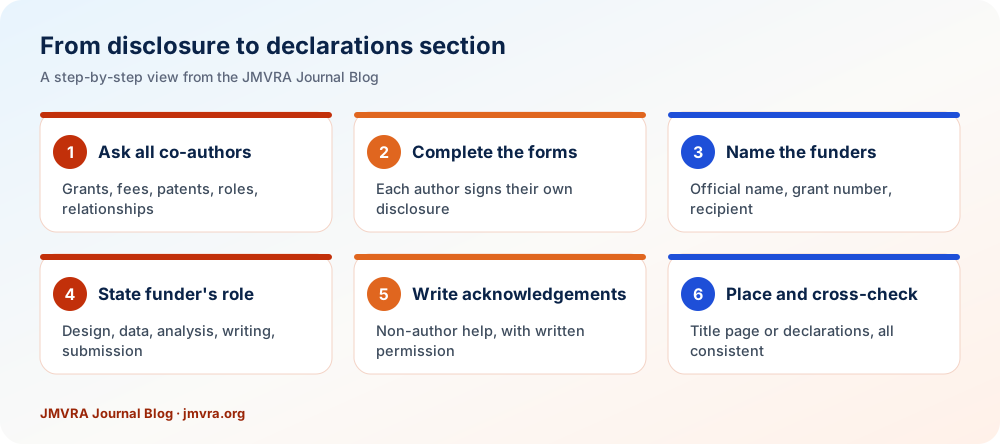
- Ask every co-authorOne email on grants, fees, patents, shares and roles
- Complete each formEvery author signs their own disclosure
- Name funders fullyOfficial name, grant number, recipient initials
- State the funder's roleDesign, data, analysis, writing, decision to submit
- Get permissionWritten consent from everyone you acknowledge
- Cross-checkForms, title page and article must say the same
Practical tips for clean, consistent disclosures
Most disclosure problems come from haste rather than bad intent. These habits remove nearly all of them.
- Keep a disclosure log. A simple spreadsheet of grants, talks, consultancies and roles with dates makes every new form quick and keeps your answers consistent across papers.
- Disclose when in doubt. An unnecessary declaration costs one line; an omitted one can cost a published correction.
- Copy the funder's wording. Paste the required acknowledgement text and grant number straight from the award letter to avoid typing errors.
- Keep headings separate. Put competing interests, funding and acknowledgements under their own headings instead of merging them into one paragraph.
- Recheck at proof stage. Restore any acknowledgements removed for blind review and confirm that grant numbers and funder names survived typesetting.
Specific, complete and consistent declarations protect both your paper and your reputation.
Questions Researchers Often Ask
In Summary
Competing interests, funding and acknowledgement statements are short, but they carry real weight: they let editors, reviewers and readers judge your work fairly and show that you have nothing to hide. Ask every co-author directly, record funders and grant numbers exactly, explain what the funder did, and credit non-author help with permission. Place each item where the journal's review model requires and check that every version matches. If you are preparing a manuscript for JMVRA, the online submission form is free to use, and these declarations should be ready before you start.
Ready to send in your paper?
Online submission to JMVRA is free of charge. Papers are screened first and then go through transparent, double-blind peer review; ₹971 INR (Indian authors) or $41 USD (foreign authors) is due only after acceptance. Retain every confirmation email for your records.
References and Sources
Taking a Draft Through to a Published Paper
- PrepareStick to the template and author guidelines
- Submit onlineCosts nothing; write down your paper ID
- ScreeningSubject scope, declarations and similarity below 15%
- Double-blind reviewDecision by email and WhatsApp
- AcceptedThe ₹971 INR / $41 USD fee becomes due, and the paper is then published in open access
Details are available under Publication guidelines · Peer review · Publication charges.
Ready to Publish? Submit to JMVRA
JMVRA is aligned with UGC's Suggested Parameters for Choosing Peer-Reviewed Journals.
JMVRA is a Transparent, Peer-Reviewed, Open Access Journal (Refereed Journal). Following the discontinuation of the UGC and UGC-CARE journal listing, and in alignment with the latest UGC-CARE recommendations and guidelines, JMVRA is aligned with UGC’s Suggested Parameters for Choosing Peer-Reviewed Journals.
More useful pages at jmvra.org
Key Terms
Subjects and search phrases this article addresses.
Related Reading
More JMVRA guides that pair well with this one.
Keep Reading on the JMVRA Blog
You are reading part of the JMVRA journal blog, a source of hands-on guidance about publishing, indexing, metrics and research integrity that aims to be verifiable, not promotional.