
Many authors now draft and polish manuscripts with generative AI tools such as ChatGPT and similar large language models. JMVRA does not forbid this, yet it asks for openness — the same principle behind every other policy on this site: nothing about the route a paper took to publication should be concealed from readers or the editorial team. Disclosing early, in plain words, is far easier than explaining later.
Acceptable Uses of AI Tools
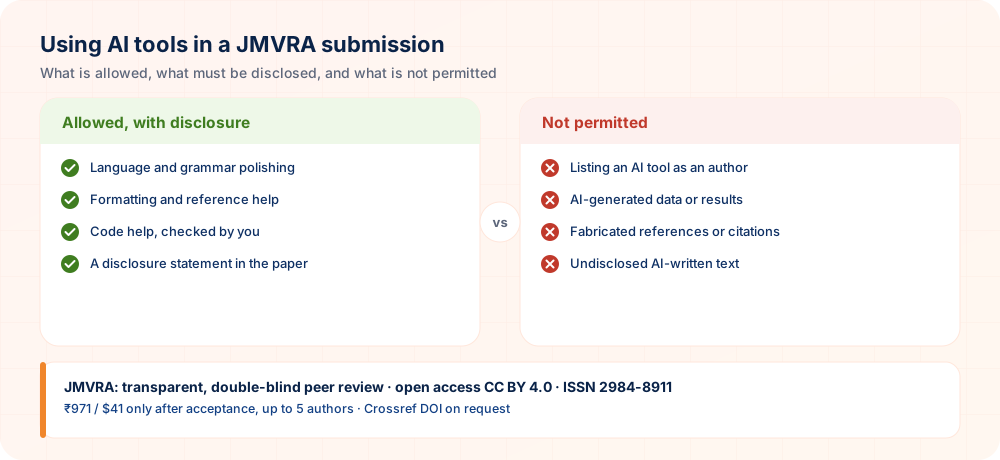
- Polishing the grammar, clarity and readability of text the author wrote
- Arranging references, tables or manuscript structure in the journal's style
- Condensing background literature that the author has read and checked personally, for the author's own grasp of it
- Helping write data-analysis code, as long as the data and results underneath are the author's own genuine work
Disclosure Requirements
Whenever an AI tool contributes substantively to preparing a manuscript, the Acknowledgments or Methods section must say so, naming the specific tool (e.g. ChatGPT, Grammarly AI) and stating what it was used for. Basic spelling or grammar prompts that standard word processors provide automatically, being purely mechanical, need no disclosure; what matters is whether the tool shaped the manuscript's language or content beyond simple correction.
The Reason AI Cannot Be Named as an Author
Being an author brings duties that only a human can carry: answering for the accuracy and integrity of the work, giving informed consent to its publication, and staying available for questions or corrections once it is out. No AI tool can do any of this, so it may not be named as an author or co-author in any circumstance, however much drafting help it gave. The human author(s) named on the paper stay fully accountable for all content in the manuscript, including text or analysis produced with AI assistance.
Prohibited Uses
- Using an AI tool to invent data, outcomes or experimental findings
- Producing made-up or non-existent citations and references
- Passing off AI-written manuscript text as original human analysis without saying so
- Employing AI tools to reword another author's published work so that plagiarism checks miss it
Screening by Editors and Peer Reviewers
Submissions can be checked for AI-generated content in addition to the regular plagiarism check (Turnitin/iThenticate, below 15% similarity). Reviewers themselves may not place manuscripts under review into third-party AI tools or chatbots, because that could reveal an author's unpublished work to an outside service before it is published; such an act counts as a confidentiality breach under JMVRA's Reviewer Policy.
| Scenario | Outcome |
|---|---|
| AI declared, used solely for language or formatting | Regarded as ordinary practice and moves on through the usual review |
| AI-assisted language editing that is acceptable in itself but was not declared | Sent back so the author can declare it before review goes on |
| AI employed to make up data, results or citations | Manuscript rejected |
| Fabrication found once the paper is published | Handled as misconduct according to the COPE Ethics Policy, which can go as far as retraction |
| An AI tool named as author or co-author | Disallowed; the author list is fixed before the process moves on |
| A reviewer submits a manuscript to an outside AI tool | Breach of confidentiality, dealt with through the Reviewer Policy |
How to Word an AI Disclosure Statement
| Use | Example statement |
|---|---|
| Language editing support | “An AI tool was used to improve grammar; the authors reviewed all changes.” |
| Code assistance | “An AI assistant suggested code, which the authors tested and verified.” |
| No use | “No AI tools were used in preparing this manuscript.” |
Vetting AI-Assisted Writing Ahead of Submission
- Confirm each fact — by comparing with the original sources
- Make sure each reference is real — AI tools are able to fabricate citations
- Put it in your own words — and make sure it is accurate
- Maintain a log — showing how the tools were applied
Practical Tips for Using AI Tools Responsibly in Manuscripts
Writing aids can save time, but responsibility for every sentence stays with the human authors. These habits keep your use of automated tools honest, verifiable and easy to disclose.
- Keep a usage log. Note which tool you used, for what purpose and on which section. A simple record makes your disclosure statement accurate and quick to write when submission day arrives.
- Verify every factual claim. Automated text can sound confident while inventing sources, figures or quotations. Check each reference and statement against the original material before it enters your manuscript.
- Never upload confidential material. Do not paste unpublished data, participant details or another person's manuscript into public tools. Doing so may breach confidentiality even if the output is never used.
- Use tools for language, not ideas. Limit assistance to grammar, clarity and formatting, while the research questions, analysis and conclusions remain your own intellectual work.
- Agree on rules with co-authors. Discuss as a team what is acceptable before drafting begins, so that no one introduces generated text that others cannot vouch for.
Record what you used, check everything it produced, and disclose it plainly, because accountability for the paper rests with the authors.
Questions Researchers Often Ask
At-a-Glance Checklist
- Usage declaredWhich tool, and why
- Authors answerableFor each sentence
- Genuine referencesAll verified
- Authentic dataNo AI-produced results
- Applies to reviewersManuscripts stay out of AI tools
Your Paper's Journey at JMVRA, From Submission to Publication
- SubmitReceive your paper ID
- ScreenScope & similarity
- ReviewDouble-blind
- DecideEmail & SMS
- RevisionComment by comment
- AcceptCopyright & fee
- ProduceDOI at the author's request
- PublishMonthly issue
How long review takes depends on the reviewers and on any revision required, so no set turnaround is promised; you are told of acceptance or rejection by email and WhatsApp.
Ready to Publish? Submit to JMVRA
JMVRA is aligned with UGC's Suggested Parameters for Choosing Peer-Reviewed Journals.
JMVRA is a Transparent, Peer-Reviewed, Open Access Journal (Refereed Journal). Following the discontinuation of the UGC and UGC-CARE journal listing, and in alignment with the latest UGC-CARE recommendations and guidelines, JMVRA is aligned with UGC’s Suggested Parameters for Choosing Peer-Reviewed Journals.
Quick links across jmvra.org
Key Terms
Subjects and search phrases this article addresses.
Related Reading
Further reading on the same theme from the JMVRA blog.
Copyright Infringement
Read the guide RelatedDrafting a Peer Review Policy for a New Journal
Read the guide RelatedLaunching a Journal: 50 Items to Finish Before Issue 1
Read the guide RelatedRequesting Conference Publication With JMVRA
Read the guide RelatedGetting an ISSN for a New Journal (Online & Print)
Read the guide RelatedConference Proposal
Read the guideKeep Reading on the JMVRA Blog
Our JMVRA journal blog carries this guide along with other practical advice on publishing, indexing, metrics and research integrity, all written so that claims can be verified and nothing is promotional.