
Reporting Infringement
Should you think that material published in JMVRA violates your copyright, send a formal notice to [email protected] that contains:
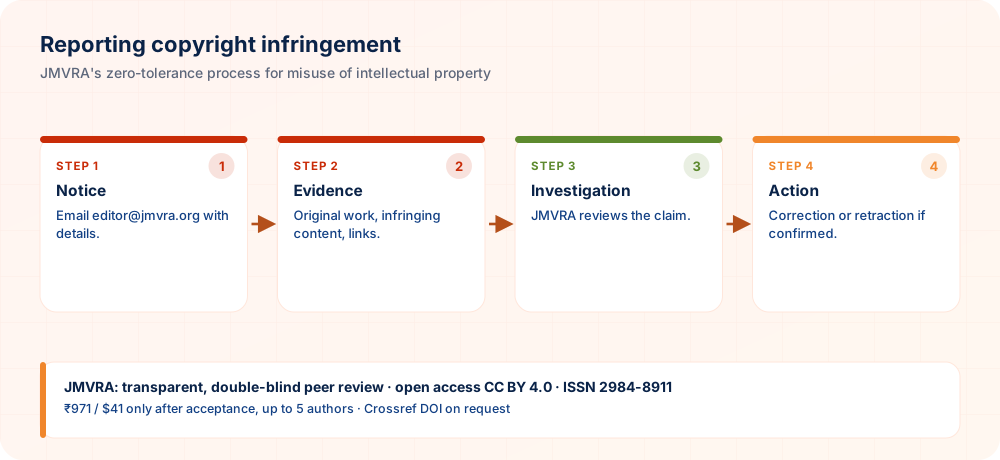
- Your complete name, postal address and contact details
- A description of the copyrighted work that you believe was infringed
- The URL or other identification of the infringing content on JMVRA
- A declaration that you believe in good faith the use was not authorized by the copyright owner
- A declaration that the notice's information is accurate
- Your signature, either electronic or physical
JMVRA's Process for Responding
- Your claim is acknowledged within 48 hours
- The investigation finishes within 10 working days
- A confirmed infringement leads to the immediate retraction of the article
- A retraction notice takes the article's place
- Where legal proceedings require it, JMVRA cooperates in full
Plagiarism Check Ahead of Submission
Before peer review begins, every manuscript is screened for plagiarism with Turnitin and/or iThenticate. Any manuscript whose similarity exceeds 15% goes back to the authors unreviewed, and authors alone bear responsibility for the originality of what they submit. Running your own similarity check beforehand helps you catch accidental overlaps.
Gathering Evidence for an Infringement Report
| Item | Example |
|---|---|
| Your original work | Reference details, DOI or link, and the publication date |
| The infringing copy | The link, screenshots and the date of discovery |
| Matching passages | Page or section numbers from both works |
| Your contact details | Allowing the editorial office to follow up |
Correct Reuse of Open Access Work
Articles in JMVRA appear under CC BY 4.0, a licence that permits reuse as long as proper attribution is given. Such credited reuse is not infringement, whereas copying without credit or passing the work off as one’s own is. When in doubt, quote briefly and cite the source clearly.
Practical Tips for Responding to Copyright Infringement of Your Work
Finding your article copied or reposted without permission is upsetting, but a calm, organised response works best. These steps help you protect your work and keep your report credible.
- Capture evidence immediately. Save dated screenshots and page addresses of the offending material before it changes. Archive copies of both the original and the suspect text so comparisons are straightforward later.
- Check your own licence first. Open access articles are often meant to be reused under stated conditions. Confirm whether the other party is actually breaching those conditions, for example by omitting attribution, before calling it infringement.
- Compare passages side by side. Prepare a simple table placing your original sentences next to the copied ones, with locations. Specific, verifiable comparisons help editors act faster than general accusations.
- Contact the right party. Report to the journal or the hosting platform through their stated process, and keep a tone that is factual and courteous. Angry public posts can complicate an otherwise clear case.
- Prevent problems in advance. Keep drafts, data files and submission records with dates, and run a similarity check on your own manuscripts so you can demonstrate original authorship.
Gather dated evidence, check the licence terms, and report through the proper channel with a clear, factual comparison.
Questions Researchers Often Ask
At-a-Glance Checklist
- Original pinpointedIncluding publication details
- Link to infringing itemArticle and page
- Contact information suppliedFor follow-up
- Evidence enclosedSide by side where possible
- Similarity testedPrior to submitting your own work
Comparing Open Access Models
Under CC BY 4.0 JMVRA works as a gold open access journal: articles can be read free with no embargo, and ₹971 INR / $41 USD is payable solely after a paper has been accepted.
Ready to Publish? Submit to JMVRA
JMVRA is aligned with UGC's Suggested Parameters for Choosing Peer-Reviewed Journals.
JMVRA is a Transparent, Peer-Reviewed, Open Access Journal (Refereed Journal). Following the discontinuation of the UGC and UGC-CARE journal listing, and in alignment with the latest UGC-CARE recommendations and guidelines, JMVRA is aligned with UGC’s Suggested Parameters for Choosing Peer-Reviewed Journals.
Further reading on jmvra.org
Key Terms
Subjects and search phrases this article addresses.
Related Reading
Further reading on the same theme from the JMVRA blog.
Terms & Conditions
Read the guide RelatedJMVRA Open Access Policy: Free to Read
Read the guide RelatedCompany Policy
Read the guide RelatedJMVRA Peer Review Policy: Double-Blind by Experts
Read the guide RelatedReviewer Policy
Read the guide RelatedJW Book: Self-Publish With ISBN and Global Reach
Read the guideKeep Reading on the JMVRA Blog
This article sits on the JMVRA journal blog, where practical guidance covering publishing, indexing, metrics and research integrity is written to be verifiable, not promotional.