
A Themed Collection Inside the Journal
A journal special issue is a themed set of articles published within an existing journal under that journal's own ISSN, centred on a topic narrower than its general scope. One or more guest editors usually coordinate it — subject experts invited or appointed to run that issue's call, screening and often reviewer coordination — while the journal's overall editorial standards and peer-review process still apply. Check the call itself for who is responsible for each stage.
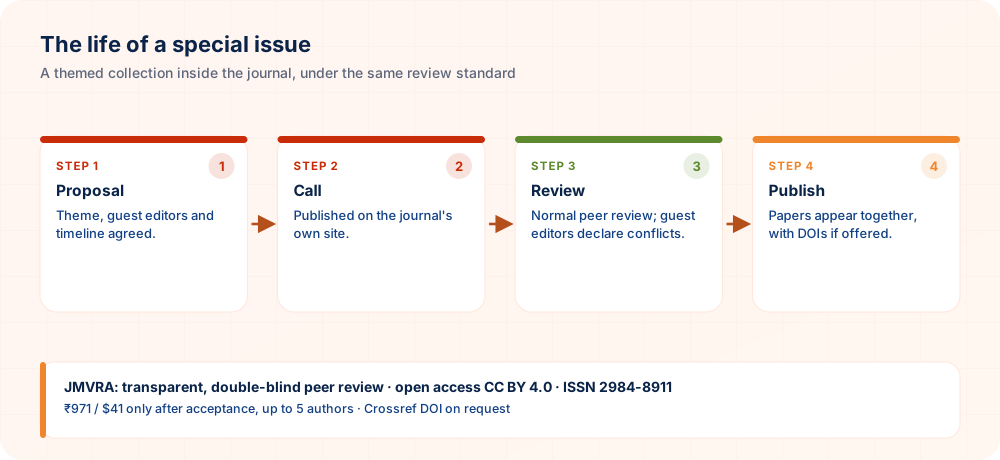
Special Issue Compared with Regular Issue
| Aspect | Regular issue | Special issue |
|---|---|---|
| Scope | The journal's entire general scope | Narrower, specific theme |
| Coordination | Regular editorial team | Guest editor(s), supervised by the journal |
| Deadline | Rolling submission | Fixed submission window |
| Peer review | The journal's usual process | Same standard process |
| ISSN | Journal's ISSN | The journal's own ISSN — not a separate one |
How a Special Issue Progresses
1. Proposal
A theme is put forward by a guest editor, a conference organiser or the editorial board.
2. Approval
Editors assess the proposed theme and guest editor(s) against the journal's scope and standards before going ahead.
3. Call for papers
Released along with the theme, scope, deadline and way to submit.
4. Submission & review
Ordinary peer review, coordinated by the guest editor.
5. Compilation
The accepted papers are put together into the themed issue.
6. Publication
Published under the journal's current ISSN, next to regular issues.
Guest Editing a Special Issue: Habits That Help
Guest editors carry responsibility for a themed collection without owning the journal. These habits help you manage authors, reviewers and the host journal's staff with fairness and good communication.
- Agree expectations with the journal. Before inviting anyone, confirm the scope, the review rules, the deadlines and who makes final decisions. Written agreement avoids friction when difficult cases arise.
- Invite a broad range of contributors. Reach beyond your own circle and colleagues, and approach scholars from different institutions and regions. A varied set of authors makes the collection more credible and more useful.
- Declare your own submissions. If you wish to contribute a paper, let the journal handle its review independently of you. Handling your own work would be a clear conflict of interest.
- Track every manuscript in a sheet. Keep a simple log of invitations, submissions, reviewers and decisions. A shared record helps you chase late reports and answer author queries accurately.
- Write a thoughtful editorial. Use the introduction to explain the theme, relate the papers to each other and point to open questions. A good editorial turns separate papers into a coherent collection.
Agree the rules in writing, manage conflicts openly, track every manuscript and write an editorial that unites the contributions.
What a Special Issue Proposal Includes
| Section | Content |
|---|---|
| Theme and rationale | The case for a collection on this topic at this time |
| Guest editors | Who the editors are, their affiliations and expertise |
| Call for papers | Scope, subject areas and deadlines |
| Review plan | Reviewers, and measures against conflicts |
Safeguarding Special Issue Quality
Independent review
Guest editors keep out of the handling of their own papers.
Open calls
Submissions are not limited to invitees from one group.
Journal oversight
The journal’s editors make the final decisions.
Same standards
Papers face the same similarity, ethics and review checks as regular ones.
Special Issue FAQs
What does a journal special issue mean?
A themed set of articles in a journal, normally guest-edited, published under the same ISSN as the regular issues.
In what way does it differ from regular issues?
A narrower theme, coordination by guest editors, and usually a set deadline — the peer-review standard does not change.
Who suggests a special issue?
Guest editors, conference organisers or the journal's own editorial board.
Does it get an ISSN of its own?
No, it appears under the ISSN of the parent journal.
Might a proposal be turned down before submissions begin?
Yes, the journal usually screens the theme and the guest editor beforehand.
Is indexing of special issue articles handled the same way?
Generally yes, because they belong to the same journal and share its ISSN.
What is the usual duration of a special issue?
There is no universal timeline — look at the schedule given for the particular issue.
May I propose a special issue to JMVRA?
Write to [email protected] giving your theme, your rationale and a proposed timeline.
May a guest editor publish a paper in their own special issue?
Only if another editor handles it independently, and if the journal permits it.
Are special issue papers cited in the same way as regular papers?
Yes. They count as journal articles.
Related Searches
Read Next
Do You Have a Themed Proposal?
Reach out to the JMVRA editorial team to talk about special-issue opportunities available now.
Email [email protected]At-a-Glance Checklist
- Guest editors screenedExpertise and conflicts
- Call officially issuedOn the journal site
- Review the sameEqual to regular issues
- Fees disclosedIn advance
- Integrity safeguardsNo self-publishing by guest editors
Conference Proceedings vs Journal Special Issue
| Aspect | Conference proceedings | Journal special issue |
|---|---|---|
| Format | An edited book of conference papers | A journal issue featuring selected articles |
| Review | Conference committee review | Full peer review carried out by the journal |
| Length | Shorter, fewer references | A complete article, with extended papers usually adding ~30% new material |
| Timing | Commonly prepared by the time of the event | Following review and acceptance |
| Best for | Documenting the presented work | Citable articles in a journal drawn from top papers |
Planning an event? JMVRA invites your conference or special issue proposal.
Ready to Publish? Submit to JMVRA
JMVRA is aligned with UGC's Suggested Parameters for Choosing Peer-Reviewed Journals.
JMVRA is a Transparent, Peer-Reviewed, Open Access Journal (Refereed Journal). Following the discontinuation of the UGC and UGC-CARE journal listing, and in alignment with the latest UGC-CARE recommendations and guidelines, JMVRA is aligned with UGC’s Suggested Parameters for Choosing Peer-Reviewed Journals.
More useful pages at jmvra.org
Key Terms
Subjects and search phrases this article addresses.
Related Reading
Further reading on the same theme from the JMVRA blog.
JW Publication
Read the guide RelatedKeeping Publication Moving Without Rushing Review
Read the guide RelatedWhere JMVRA Sits Among Peer Review Transparency Models, from Open Reports to Open Identities
Read the guide RelatedFAQ
Read the guide RelatedContact Us
Read the guide RelatedRefund Policy
Read the guideKeep Reading on the JMVRA Blog
You are reading part of the JMVRA journal blog, a source of hands-on guidance about publishing, indexing, metrics and research integrity that aims to be verifiable, not promotional.