
Are you searching for high impact factor journals in Oman? Promotions and grants frequently hinge on impact factors, quartiles and rankings, yet these figures are simple to misunderstand and even to counterfeit. Here you will find what the principal metrics mean, ways to steer clear of fake impact factors, the journals published in Oman that report international indexing, and a stepwise approach for locating the highest-impact titles in your discipline. The guide is aimed at researchers in Muscat, Oman; Nizwa, Oman; Sohar, Oman; Salalah, Oman.
What a High Impact Factor Actually Tells You
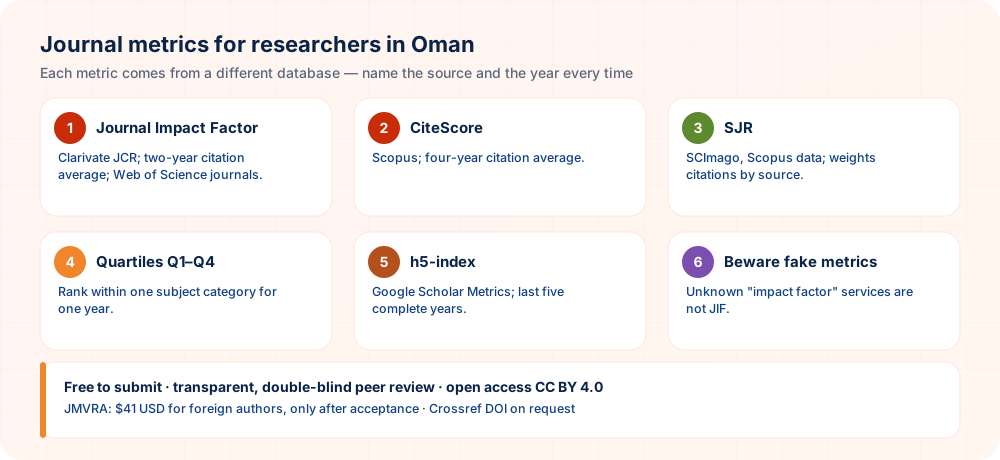
Impact metrics add up a journal's citations over a set period. The Journal Impact Factor is fed by two years of Web of Science data, CiteScore by four years of Scopus data, and SJR weighs each citation by the prestige of the citing journal. Fields cite in different ways, so researchers in Oman should limit comparisons to the same subject category. Read the metric's definition first to avoid misreading a number.
| Metric | Data source | Window | Where to check |
|---|---|---|---|
| Journal Impact Factor | Web of Science (Clarivate) | 2 years | Journal Citation Reports |
| CiteScore | Scopus (Elsevier) | 4 years | Scopus Sources |
| SJR | Scopus data, SCImago | Calculated across 3 years with prestige weights | SCImago Journal & Country Rank |
| Quartile (Q1–Q4) | JCR or SCImago | A one-year figure for one subject category | JCR or SCImago |
| h5-index | Google Scholar Metrics | 5 years | Google Scholar Metrics |
Invented Impact Factors and Misleading Metrics
Plenty of sites market or give away “impact factors” that are not related to Clarivate's Journal Impact Factor. A journal that boasts a high figure from an unknown service, or claims a JIF while absent from the Master Journal List, is misleading you. Three questions settle it: which database, which year, and is the number visible on the database's own site?
Indexed Journals From Oman
Medical titles make up the bulk of Oman’s indexed journals, and Scopus and PubMed coverage is reported by both the Sultan Qaboos University Medical Journal and the Oman Medical Journal.
| Journal | Publisher | Subject | Reported coverage |
|---|---|---|---|
| Sultan Qaboos University Medical Journal (SQUMJ) | Sultan Qaboos University, Muscat | Medicine | Reported: Scopus, PubMed and PubMed Central |
| Oman Medical Journal | Oman Medical Specialty Board, Muscat | Medicine | Reported: Scopus and PubMed Central |
The journals and publishers themselves supplied these coverage details, as of 4 October 2026. For the present Journal Impact Factor and quartile, check Journal Citation Reports; for CiteScore or SJR, check Scopus Sources or SCImago. Metrics move, so cite them with the date of your check.
Oman’s Online Journals and Platforms
E-journals are now the usual format for journals in Oman. The services below help you discover them, weigh them against one another and verify their standing:
- SQU journals portal — The journal platform of Sultan Qaboos University, which hosts its titles in arts and social sciences, education, agriculture, engineering, science and medicine.
- Ministry of Higher Education, Research and Innovation — Supervises Oman’s higher education and research sector.
- Directory of Open Access Journals — Look up open access journals that satisfy DOAJ’s criteria, narrowing results by publisher country (Oman) or by “without fees”.
- SCImago country rankings — Journal rankings built on Scopus and limited to titles published in Oman, showing quartiles and SJR.
- ISSN Portal — Find out a journal's ISSN, exact title and country of publication before deciding whether to trust it.
Sitting on a platform or in a directory does not guarantee high impact or international indexing; look each journal up in the citation databases.
Locating Top-Tier Journals in Your Field
- Identify the JCR and SCImago category that matches your subject.
- Pull up the category's journals in JCR or SCImago, ranked by the metric your requirement asks for.
- Read three recent papers from each shortlisted journal and judge whether yours belongs among them.
- Check the current year's metric and quartile at the original source.
- Before submitting, check the fees, open access options and any waivers.
| Field | Journals based in Oman | Then search |
|---|---|---|
| Medicine | Sultan Qaboos University Medical Journal; Oman Medical Journal | JCR and Scopus subject categories in medicine |
| Engineering & science | SQU journals (check indexing) | Scopus engineering; SCIE |
| Agriculture & marine sciences | SQU journal (check indexing) | Scopus agricultural and aquatic sciences |
| Education | SQU journal (check indexing) | SSCI, ESCI and Scopus education |
| Arts & social sciences | SQU journal (check indexing) | AHCI, SSCI and Scopus |
Open Access, Costs and Impact
Authors can often choose open access in high-impact journals by paying an article processing charge, some titles are diamond open access, and many subscription journals charge no author fee. Although open access broadens readership, especially where libraries cannot afford subscriptions, its connection to citations differs by field, so impact alone does not justify a large APC.
- Account for the fee when drawing up your shortlist, along with metric and fit.
- Enquire about waivers: publishers can often grant them to authors from lower- and middle-income countries.
- Look to self-archiving: if the journal's policy allows, upload the accepted manuscript to a repository at no charge.
- Check with your library to learn if an agreement with the publisher pays for, or reduces, the APC for authors in Oman.
A Practical Path to High-Impact Publication
It is the quality and reach of the research that creates impact, not the journal on its own. Assemble peer-reviewed papers that suit their venues, join forces with people who contribute expertise, and hold your most dependable, widely applicable work for the most influential journals of your field. A clear research agenda helps each paper support the others.
- Fortify the study: what it needs is a clear question, sound design, adequate sample size and complete reporting.
- Give it an international angle: show what readers beyond Oman can take away from the work.
- Join forces where doing so adds expertise or data.
- Treat reviewer feedback seriously and reply in full — most high-impact papers go through revision.
Preparing to Submit to a Top-Tier Journal
- Category agreesThe subject category of the journal is the one your paper requires
- Metric double-checkedJIF or quartile compared through JCR or SCImago for this year
- Suitability assessedThree recent papers read; yours would belong among them
- Costs understoodAPC, waivers and open access choices all known
- Backup lined upA credible alternative journal chosen early
How JMVRA suits authors in Oman
Based in India, JMVRA (ISSN 2984-8911) is an international open access journal covering many disciplines. It is not a Omani journal, but it accepts papers from authors in Oman. JMVRA does not have a Clarivate impact factor; it is a good fit for papers that need an affordable, peer-reviewed open access home rather than a Scopus or WoS-indexed one.
- Fee: Foreign authors are charged $41 USD, requested only upon acceptance and covering up to 5 authors.
- Review: transparent, double-blind review by peers in the subject; similarity needs to be below 15%.
- Access: open access free to readers under the CC BY 4.0 licence; a Crossref DOI is available on request.
- Indexing, stated honestly: you will find the journal in Google Scholar, and it is not in Scopus, Web of Science or DOAJ.
A Phased Path Toward High-Impact Journals From Oman
| Stage | Goal |
|---|---|
| First papers | Sound research, reported with care and published in bona fide peer-reviewed journals |
| Building | Joint work across the Gulf (GCC), bigger samples and sturdier methods |
| Targeting | Confirm through JCR or Scopus that a journal is Q1 or Q2 in your subject category |
| Sustaining | Consistent research focus, together with sharing data and reviewing for journals |
The Role of Metrics in Oman
- Declare the metric you used — JIF, CiteScore or SJR, or a number taken from Google Scholar
- State who provides it — and find the journal on that site by yourself
- Keep comparisons to one field — rather than crossing fields
- Log the checks you did — with the date, for any evaluator
Journal Submission Preparation for Researchers in Oman
Researchers in Oman often work in internationally connected teams and apply for institutional support. These suggestions help you present findings in a way that is persuasive, transparent and ready for review.
- Align the paper with a single question. Papers that try to answer too many questions confuse readers. State one clear research question near the start and make sure every section helps answer it.
- Check funding acknowledgements. If a grant or sponsor supported the work, record its name and any required wording. Accurate acknowledgements protect you from compliance problems after publication.
- Declare competing interests honestly. Disclose any relationship that could influence interpretation, even if it seems minor. Openness builds trust with editors and readers and rarely harms a submission.
- Design figures for quick understanding. Label axes, units and legends clearly, and make sure each figure can be understood without searching the text. Clean visuals help reviewers grasp results rapidly.
- Prepare a concise cover letter. Explain why the study fits the journal's scope and what readers will gain. Keep it professional and brief, and avoid exaggerated claims about importance.
Focus on a single question, disclose funding and interests openly, and present results visually clearly so reviewers can evaluate them with confidence.
Questions Researchers Often Ask
Summary and What to Do Next
Publishing in high-impact journals from Oman is realistic when you pair a strong paper with a suitable journal and read the metrics honestly. Check each number at its source, choose according to fit within your category, and build your record gradually. Share your shortlist with a mentor or librarian for a second opinion before you commit.
- Define your subject category along with your requirement.
- Build a shortlist using JCR or SCImago, then go through some recent articles.
- Confirm metrics and fees before submitting.
- Related guides cover low-cost journal publication in Oman as well as Scopus and Web of Science journals in Oman.
Ready to send in your paper?
Submission to JMVRA is online and free. Review always comes first; the $41 USD publication fee applies only after your paper is accepted.
Related searches
Readers in Oman who use this guide often go on to search for Scopus and Web of Science indexing, Q1 and Q2 journals, high impact factor journals and methods for checking a journal’s metrics. The guides below respond to those needs:
References and Sources
Checked on 4 October 2026. Metrics are updated every year, so confirm them at the original source.
Getting Published From Oman Through JMVRA
- Submit onlineAuthors from every country are welcome; submission is free
- First reviewScope and similarity (below 15%) are checked on the paper
- Double-blind reviewSpecialist reviewers assess it; you receive the decision by email
- Accepted — $41 USDSingle charge for as many as 5 authors
- PublishedCC BY 4.0 open access
Details: Publication charges · Peer review · Advice for authors outside India.
Ready to Publish? Submit to JMVRA
JMVRA is aligned with UGC's Suggested Parameters for Choosing Peer-Reviewed Journals.
JMVRA is a Transparent, Peer-Reviewed, Open Access Journal (Refereed Journal). Following the discontinuation of the UGC and UGC-CARE journal listing, and in alignment with the latest UGC-CARE recommendations and guidelines, JMVRA is aligned with UGC’s Suggested Parameters for Choosing Peer-Reviewed Journals.
Pages worth visiting on jmvra.org
Key Terms
Subjects and search phrases this article addresses.
Related Reading
Further guides for researchers in Oman.
Keep Reading on the JMVRA Blog
As part of the JMVRA journal blog, this guide shares practical help on publishing, indexing, metrics and research integrity, and is written to be verifiable rather than promotional.