
Are you searching for high impact factor journals in Morocco? Promotions and grants frequently hinge on impact factors, quartiles and rankings, yet these figures are simple to misunderstand and even to counterfeit. Here you will find what the principal metrics mean, ways to steer clear of fake impact factors, the journals published in Morocco that report international indexing, and a stepwise approach for locating the highest-impact titles in your discipline. The guide is aimed at researchers in Rabat, Morocco; Casablanca, Morocco; Fez, Morocco; Marrakesh, Morocco.
What a High Impact Factor Actually Tells You
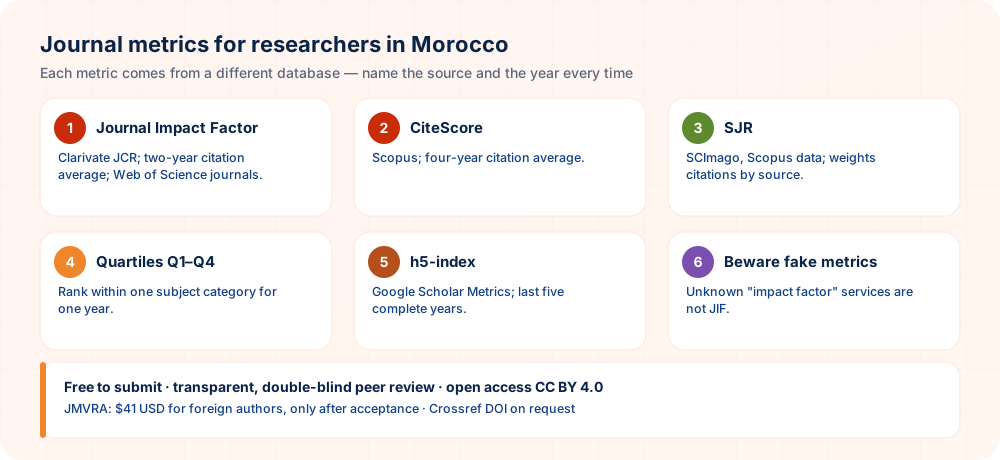
An impact factor is a ratio-based average: citations received in one year by items from the journal’s previous two years, divided by its citable items. Clarivate calculates it for journals in the Web of Science Core Collection only. CiteScore (Scopus, four-year window) and SJR (SCImago, prestige-weighted) approach similar questions with other data, which authors in Morocco will also come across.
| Metric | Data source | Window | Where to check |
|---|---|---|---|
| Journal Impact Factor | Web of Science (Clarivate) | 2 years | Journal Citation Reports |
| CiteScore | Scopus (Elsevier) | 4 years | Scopus Sources |
| SJR | Scopus data, SCImago | Over 3 years, weighted by prestige | SCImago Journal & Country Rank |
| Quartile (Q1–Q4) | JCR or SCImago | A single year within a single category | JCR or SCImago |
| h5-index | Google Scholar Metrics | 5 years | Google Scholar Metrics |
Invented Impact Factors and Misleading Metrics
Several websites sell or distribute “impact factors” that have no tie to Clarivate’s Journal Impact Factor. A journal that boasts a large figure from an unknown service, or claims a JIF while missing from the Master Journal List, is misleading you. Ask three questions: which database, which year, and can the database’s own website confirm it?
Indexed Journals From Morocco
Several Moroccan titles report that Scopus covers them, including Hespéris-Tamuda (from 2024), the Moroccan Journal of Chemistry and the Moroccan Journal of Pure and Applied Analysis.
| Journal | Publisher | Subject | Reported coverage |
|---|---|---|---|
| Moroccan Journal of Chemistry (MorJChem) | Hosted by IMIST (CNRST), Rabat | Chemistry | Reported: Scopus (CNRST) and ESCI |
| Moroccan Journal of Pure and Applied Analysis | Sidi Mohamed Ben Abdellah University, Fez | Mathematical analysis | Reported: Scopus |
| Hespéris-Tamuda | Faculty of Arts and Humanities, Mohammed V University, Rabat | History, humanities, Maghreb studies | Reported: Scopus (2024) and ESCI |
Each journal or publisher supplied the figures given here on 4 October 2026. Anyone wanting current numbers should open Journal Citation Reports for the Journal Impact Factor and quartile, or Scopus Sources or SCImago for CiteScore or SJR.
Morocco’s Online Journals and Platforms
E-journals are now the usual format for journals in Morocco. The services below help you discover them, weigh them against one another and verify their standing:
- Portal of Moroccan Scientific Journals (PRSM) — Operated by IMIST within CNRST, it hosts more than 160 journals from public laboratories and non-profit societies, lists over 60 additional ones, and provides hosting and an editorial workflow at no charge.
- CNRST — The National Centre for Scientific and Technical Research, which backs research infrastructure such as the journals portal.
- IMIST — The Moroccan Institute of Scientific and Technical Information, a CNRST unit that gives access to scientific information and hosts journals.
- Directory of Open Access Journals — Look up open access journals that satisfy DOAJ’s criteria, narrowing results by publisher country (Morocco) or by “without fees”.
- SCImago country rankings — Journal rankings built on Scopus and limited to titles published in Morocco, showing quartiles and SJR.
- ISSN Portal — Before trusting a journal, verify its ISSN, exact title and country of publication.
Being on a platform or in a directory does not automatically signal high impact or international indexing, so look each journal up in the citation databases.
Locating Top-Tier Journals in Your Field
- Determine the subject category, as defined in JCR and SCImago, into which your paper falls.
- Pull up the category in JCR or SCImago, then rank its journals on whichever metric your requirement specifies.
- Read three recent articles from each shortlisted journal to test how well your paper fits.
- Check the current year's metric and quartile at the original source.
- Before submitting, check the fees, open access options and any waivers.
| Field | Journals based in Morocco | Then search |
|---|---|---|
| Chemistry | Moroccan Journal of Chemistry | Scopus and SCIE chemistry |
| Mathematics | Moroccan Journal of Pure and Applied Analysis | Scopus mathematics; SCIE |
| History & humanities | Hespéris-Tamuda | AHCI, ESCI and Scopus arts and humanities |
| Engineering | University journals on IMIST (check indexing) | Scopus engineering; SCIE |
| Social sciences | Use francophone and international journals | SSCI, ESCI and Scopus |
Open Access, Costs and Impact
Open access is available in many high-impact journals against an article processing charge; a handful are diamond open access, while many subscription journals charge authors nothing. Open access reaches more readers, most of all where libraries cannot pay for subscriptions, but the citation effect depends on the field, which is why a large APC should not be paid for impact alone.
- Weigh up fees before drawing a shortlist, as well as the metric and the fit.
- Ask about waivers: authors in lower- and middle-income countries are granted them by many publishers.
- Put self-archiving to use: if the journal’s policy permits, you may place your accepted manuscript in a repository free of charge.
- Check with your library to learn if an agreement with the publisher pays for, or reduces, the APC for authors in Morocco.
A Practical Path to High-Impact Publication
Aim high, but plan the steps. Every paper should go to the journal where it truly stands a chance: preliminary or local studies to respected national outlets, firmer studies to indexed regional or international ones, and your best work, carefully designed, clearly framed and relevant worldwide, to the leading journals of your category.
- Build a stronger study: ask a clear question, adopt a sound design, collect an adequate sample and report everything.
- Give it an international angle: show what readers beyond Morocco can take away from the work.
- Collaborate when others bring expertise or data that you lack.
- Reply to reviewers thoroughly — most high-impact papers pass through revision on the way.
Preparing to Submit to a Top-Tier Journal
- Category correctYour paper fits the journal’s subject category
- Metric looked upThe current year’s JIF or quartile found in JCR or SCImago
- Fit judgedAfter reading three recent articles you find your paper would belong among them
- Fees clarifiedYou understand the APC, waivers and open access options
- Reserve preparedA reliable alternative journal selected in advance
How JMVRA suits authors in Morocco
Based in India, JMVRA (ISSN 2984-8911) is an international open access journal covering many disciplines. It is not a Moroccan journal, but it accepts papers from authors in Morocco. JMVRA does not have a Clarivate impact factor; it is a good fit for papers that need an affordable, peer-reviewed open access home rather than a Scopus or WoS-indexed one.
- Fee: A foreign author pays $41 USD, but only after acceptance, and that sum covers up to 5 authors.
- Review: the double-blind review by subject experts is transparent, and similarity needs to be lower than 15%.
- Access: open access under a CC BY 4.0 licence; ask if you would like a Crossref DOI.
- Indexing, stated upfront: the journal can be found in Google Scholar, while Scopus, Web of Science and DOAJ do not include it.
A Phased Path Toward High-Impact Journals From Morocco
| Stage | Goal |
|---|---|
| First papers | Rigorous studies, reported properly, in genuine peer-reviewed journals |
| Building | Joint work across the Maghreb and francophone Africa, bigger samples and sturdier methods |
| Targeting | Journals of your category placed in Q1 or Q2, quartile checked in JCR or Scopus |
| Sustaining | Sharing data, reviewing for journals and holding to one unified line of research |
The Role of Metrics in Morocco
- Grasp what is being measured — JIF, CiteScore, SJR, or a score computed from Google Scholar
- Find the place it is published — and confirm the journal at that source personally
- Make comparisons field by field — never across them
- Make a dated note of your checks — useful for evaluators
Practical Publishing Advice for Moroccan Researchers
Researchers in Morocco often write in several languages and address both regional and international audiences. These tips help you present work clearly and select venues that suit your language and subject.
- Choose the manuscript language deliberately. Decide whether your intended readers are best served in English, French or another language. Then confirm that the journal accepts your choice and offers a proper abstract in a widely read language.
- Keep terminology consistent. Translate key technical terms once, agree on the preferred English form, and use it throughout. Inconsistent vocabulary confuses reviewers and weakens otherwise strong results.
- Cite regional literature alongside global work. Include relevant studies from your own region to show context, while also engaging with international debates. Balanced referencing signals that you know the field at every level.
- Verify the editorial board independently. Look up a few board members through their institutional pages and confirm that they actually serve the journal. Real, reachable editors are a sign of a serious operation.
- Test your abstract on an outsider. Ask a researcher from a different field to summarise your abstract in their own words. If their summary misses the point, revise until the contribution is obvious.
Be deliberate about language and terminology, cite widely, and confirm that editors are genuine before you submit anything.
Questions Researchers Often Ask
Summary and What to Do Next
Publishing in high-impact journals from Morocco is realistic when you pair a strong paper with a suitable journal and read the metrics honestly. Check each number at its source, choose according to fit within your category, and build your record gradually. Progress is easier to sustain when each submission teaches you something for the next one.
- Work out your subject category and requirement.
- Create a shortlist through JCR or SCImago and go through recent articles.
- Confirm metrics and fees before submitting.
- Related guides cover low-cost journal publication in Morocco as well as Scopus and Web of Science journals in Morocco.
Ready to send in your paper?
Submission to JMVRA is online and free. Review always comes first; the $41 USD publication fee applies only after your paper is accepted.
Related searches
Readers in Morocco who use this guide often go on to search for Scopus and Web of Science indexing, Q1 and Q2 journals, high impact factor journals and methods for checking a journal’s metrics. The guides below respond to those needs:
References and Sources
Checked on 4 October 2026. Metrics are updated every year, so confirm them at the original source.
Getting Published From Morocco Through JMVRA
- Submit onlineWherever you live; there is no fee to submit
- Pre-reviewScope assessment and similarity (below 15%)
- Double-blind reviewExperts in the field review the paper and email you the decision
- Accepted — $41 USDOne charge applies to up to 5 authors
- PublishedPublicly accessible under CC BY 4.0
Details: Publication charges · Peer review · Advice for authors outside India.
Ready to Publish? Submit to JMVRA
JMVRA is aligned with UGC's Suggested Parameters for Choosing Peer-Reviewed Journals.
JMVRA is a Transparent, Peer-Reviewed, Open Access Journal (Refereed Journal). Following the discontinuation of the UGC and UGC-CARE journal listing, and in alignment with the latest UGC-CARE recommendations and guidelines, JMVRA is aligned with UGC’s Suggested Parameters for Choosing Peer-Reviewed Journals.
Where to go next on jmvra.org
Key Terms
Subjects and search phrases this article addresses.
Related Reading
Further guides for researchers in Morocco.
Keep Reading on the JMVRA Blog
Find this guide on the JMVRA journal blog, a collection of practical guidance on publishing, indexing, metrics and research integrity that favours verifiable content over promotion.