
Trying to locate high impact factor journals in Iraq? Many a promotion or grant turns on impact factors, quartiles and rankings, yet they are easily misunderstood or forged. Inside you will find an account of the main metrics, advice on dodging fake impact factors, a view of which Iraq-published journals report international indexing, and a stepwise method for finding the top-impact journals in your discipline. It is meant for researchers in Baghdad, Iraq; Basra, Iraq; Mosul, Iraq; Erbil, Iraq.
What a High Impact Factor Actually Tells You
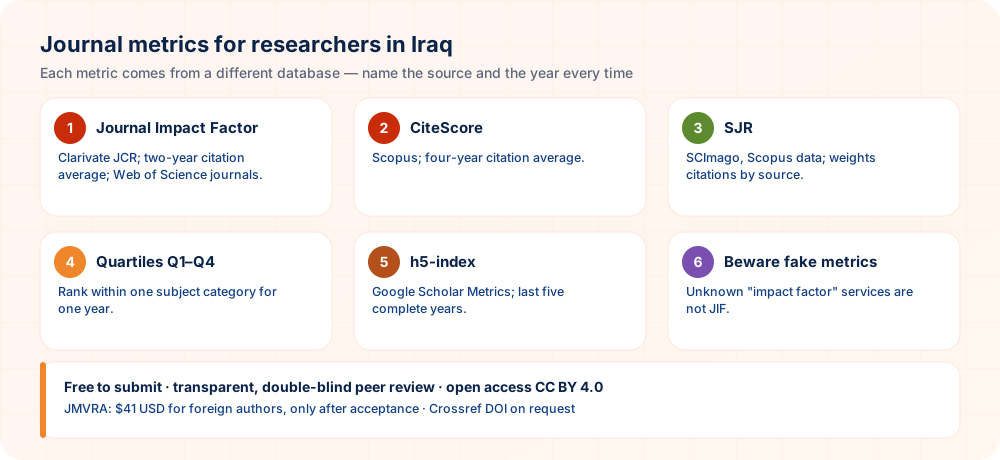
Dividing one year’s citations to a journal’s items from the previous two years by the number of citable items gives its impact factor, an average. Clarivate works it out only for journals in the Web of Science Core Collection. CiteScore (Scopus, four-year window) and SJR (SCImago, prestige-weighted) answer comparable questions using different data.
| Metric | Data source | Window | Where to check |
|---|---|---|---|
| Journal Impact Factor | Web of Science (Clarivate) | 2 years | Journal Citation Reports |
| CiteScore | Scopus (Elsevier) | 4 years | Scopus Sources |
| SJR | Scopus data, SCImago | Spanning 3 years and weighted for prestige | SCImago Journal & Country Rank |
| Quartile (Q1–Q4) | JCR or SCImago | Single-year, single-category measure | JCR or SCImago |
| h5-index | Google Scholar Metrics | 5 years | Google Scholar Metrics |
Invented Impact Factors and Misleading Metrics
Countless websites sell or give out “impact factors” that have no connection to Clarivate’s Journal Impact Factor. A journal advertising a large number from an unrecognised service, or claiming a JIF without being listed in the Master Journal List, is misleading you. Check three points: the database, the year, and whether the database’s own website confirms it.
Indexed Journals Based in Iraq
Iraq’s Scopus-listed journals cluster at the University of Baghdad, for instance the Baghdad Science Journal and the Iraqi Journal of Science. Statuses change: the Iraqi Journal of Agricultural Sciences joined Scopus in 2017, yet its coverage may have ended since.
| Journal | Publisher | Subject | Reported coverage |
|---|---|---|---|
| Baghdad Science Journal | College of Science for Women, University of Baghdad | Biology, chemistry, physics, mathematics, computing | Reported: Scopus; Web of Science |
| Iraqi Journal of Science | College of Science, University of Baghdad | Sciences | Reported: Scopus |
| Iraqi Journal of Pharmaceutical Sciences | College of Pharmacy, University of Baghdad | Pharmacy | Reported: Scopus; DOAJ |
The coverage below is as each journal or publisher reported on 4 October 2026. To see current figures, open Journal Citation Reports for the Journal Impact Factor and quartile, and Scopus Sources or SCImago for CiteScore or SJR. Always record the date of any metric you cite.
Online Journals and Portals in Iraq
E-journals are now the usual format for journals in Iraq. The services below let you locate them, compare options and verify their reputation:
- Iraqi Academic Scientific Journals (IASJ) — A platform from the Ministry of Higher Education and Scientific Research that brings together several hundred Iraqi academic journals, each edited by its own university or institute.
- Ministry of Higher Education and Scientific Research — Supervises universities and research in Iraq, the IASJ platform among its responsibilities.
- University of Baghdad journals — A listing of journals from the University of Baghdad, the largest university publisher in the country.
- Directory of Open Access Journals — Look up open access journals that satisfy DOAJ’s criteria, narrowing by the publisher’s country (Iraq) or by “without fees”.
- SCImago country rankings — Journal rankings drawn from Scopus, limited to titles published in Iraq and showing quartiles and SJR.
- ISSN Portal — Cross-check the exact title, ISSN and country of publication of any journal you are considering.
A journal’s presence in a platform or directory does not itself imply high impact or international indexing; inspect each one in the citation databases.
Locating Top-Tier Journals in Your Field
- Select your field’s subject category (the one JCR and SCImago use).
- Within JCR or SCImago, view the category’s journals and sort by the metric your requirement stipulates.
- Gauge how well your work fits by reading three recently published articles per shortlisted journal.
- Check the current year's metric and quartile at the original source.
- Before submitting, check the fees, open access options and any waivers.
| Field | Journals based in Iraq | Then search |
|---|---|---|
| Sciences | Baghdad Science Journal; Iraqi Journal of Science | Scopus and SCIE |
| Pharmacy | Iraqi Journal of Pharmaceutical Sciences | Scopus pharmacology and pharmaceutics |
| Agriculture | Iraqi Journal of Agricultural Sciences (check current status) | Scopus agricultural sciences |
| Engineering | University engineering journals (check indexing) | Scopus engineering; SCIE |
| Social sciences & humanities | Few Iraqi titles indexed | SSCI, AHCI, ESCI and Scopus |
Open Access, Costs and Impact
High-impact journals often provide open access for an article processing charge; certain journals are diamond open access, and many subscription journals publish with no author fee. Wider readership is the benefit of open access, particularly where libraries cannot afford subscriptions, but its influence on citations varies with the field. Do not pay a large APC for the sake of impact alone.
- Settle the fee question before shortlisting, beside the metric and the fit.
- Look into waivers: a lot of publishers provide them for researchers in lower- and middle-income countries.
- Rely on self-archiving: if the policy of the journal allows, make the accepted manuscript available in a repository at no charge.
- Check with your library to learn whether a publisher deal pays for, or reduces, the APC for authors in Iraq.
A Practical Path to High-Impact Publication
Set ambitious targets but plan the sequence. Match each paper to a journal where it has a fair chance: early or local work belongs in respected national journals, more robust work in indexed regional or international ones, and the leading journals in your category deserve your best research, which should be well designed, clearly framed and of international relevance.
- Raise the standard of the study: question clarity, design soundness, sample adequacy and complete reporting all count.
- Present it globally: show what readers beyond Iraq can take away from your work.
- Collaborate when it brings in extra expertise or data.
- Handle reviewer comments in full — revising is typical for high-impact papers.
Preparing to Submit to a Top-Tier Journal
- Category alignedThe journal’s subject category suits your paper
- Metric provenJIF or quartile verified through JCR or SCImago for this year
- Compatibility testedThree recently published articles read; yours fits alongside them
- Charges checkedAPC, waivers and the open access options established
- Reserve choice madeA credible second journal lined up ahead of time
How JMVRA suits authors in Iraq
Based in India, JMVRA (ISSN 2984-8911) is an international open access journal covering many disciplines. It is not a Iraqi journal, but it accepts papers from authors in Iraq. JMVRA does not have a Clarivate impact factor; it is a good fit for papers that need an affordable, peer-reviewed open access home rather than a Scopus or WoS-indexed one.
- Fee: Foreign authors are asked for $41 USD only following acceptance, and the amount is good for up to 5 authors.
- Review: subject experts carry out a transparent double-blind peer review of each paper, with similarity kept under 15%.
- Access: open access with a CC BY 4.0 licence; a Crossref DOI can be requested at any point.
- Indexing, plainly put: you will find us in Google Scholar and not in Scopus, Web of Science or DOAJ.
A Step-by-Step Path to High-Impact Journals From Iraq
| Stage | Goal |
|---|---|
| First papers | Sound, fully reported studies placed with genuine peer-reviewed journals |
| Building | Partnerships across the Middle East, bigger samples and sturdier methods |
| Targeting | Journals ranked Q1 or Q2 in your subject’s category, their rank verified through JCR or Scopus |
| Sustaining | Acting as a manuscript reviewer, sharing data and staying with one research theme |
The Role of Metrics in Iraq
- State which metric it is — JIF, CiteScore, SJR, or a figure derived from Google Scholar
- Go to the source — and confirm the journal’s entry yourself
- Judge against the same field — and not against other fields
- Log your verification — add the date for evaluators
Preparing a Strong Journal Submission in Iraq
Researchers in Iraq often balance teaching loads, limited laboratory time and promotion requirements. These practical suggestions focus on planning a submission so that effort goes into quality rather than guesswork.
- Check your institution's expectations. Ask your department what evidence it accepts for promotion or degree completion. Knowing the rule before you choose a journal prevents rewriting or resubmitting a paper later.
- Build a reading list from recent papers. Gather recent articles from journals you admire and note how they structure introductions and conclusions. Imitating good structure, not wording, speeds up drafting and improves clarity.
- Protect your original datasets. Keep raw data, questionnaires and instrument settings in a backed-up folder with clear file names. Reviewers sometimes ask for supporting material, and tidy records let you respond calmly.
- Seek a language check before sending. Clear English matters because reviewers judge ideas through the text. Ask a fluent colleague or a professional editing service to polish grammar without altering your findings.
- Respond to reviewers point by point. When comments arrive, prepare a table listing each remark, your action and the page changed. Polite, specific replies show respect for the process and often decide the outcome.
Plan around your institution's requirements, keep records tidy, and answer reviewers courteously and precisely to give any submission its best chance.
Questions Researchers Often Ask
Summary and What to Do Next
Achieving high-impact publication from Iraq is realistic when you pair the right paper with the right journal and read the metrics honestly. Verify each figure at its source, select by fit within your category, and build your record gradually. Read the author guidelines closely before drafting, since formatting mismatches cost time.
- Find your subject category and note your requirement.
- Narrow the field with JCR or SCImago and read recent articles.
- Confirm metrics and fees before submitting.
- Go on to journals in Iraq indexed in Scopus and Web of Science and low-cost journal publication in Iraq.
Ready to send in your paper?
Submission to JMVRA is online and free. Review always comes first; the $41 USD publication fee applies only after your paper is accepted.
Related searches
People in Iraq who consult this guide frequently want to know about high impact factor journals, Q1 and Q2 titles, indexing in Scopus and Web of Science, and how a journal’s metrics can be verified. Answers follow in these guides:
References and Sources
Checked on 4 October 2026. Metrics are updated every year, so confirm them at the original source.
Publish From Iraq Through JMVRA
- Submit onlineAuthors from Iraq and everywhere else may submit, and nothing is charged at submission
- ScreeningSubject fit and similarity review (below 15%)
- Double-blind reviewExperts in the subject evaluate it and the verdict reaches you by email
- Accepted — $41 USDJust one fee, with up to 5 authors included
- PublishedReleased as open access (CC BY 4.0)
Details: Publication charges · Peer review · Advice for authors outside India.
Ready to Publish? Submit to JMVRA
JMVRA is aligned with UGC's Suggested Parameters for Choosing Peer-Reviewed Journals.
JMVRA is a Transparent, Peer-Reviewed, Open Access Journal (Refereed Journal). Following the discontinuation of the UGC and UGC-CARE journal listing, and in alignment with the latest UGC-CARE recommendations and guidelines, JMVRA is aligned with UGC’s Suggested Parameters for Choosing Peer-Reviewed Journals.
Handy links within jmvra.org
Key Terms
Subjects and search phrases this article addresses.
Related Reading
Further guides for researchers in Iraq.
Keep Reading on the JMVRA Blog
The JMVRA journal blog includes this guide, one of many practical pieces on publishing, indexing, metrics and research integrity, prepared so readers can verify them without any sales pitch.