
A search for “fast paper publishing sites” returns a blend of peer-reviewed journals, repositories, preprint servers, academic social networks and, now and then, plain scams. These are different things. For most academic purposes, uploading to a repository does not count as publication, and a site offering to accept any paper within hours is not running peer review. Being able to tell them apart guards your money as well as your reputation. When in doubt, look for a named review process before you upload anything.
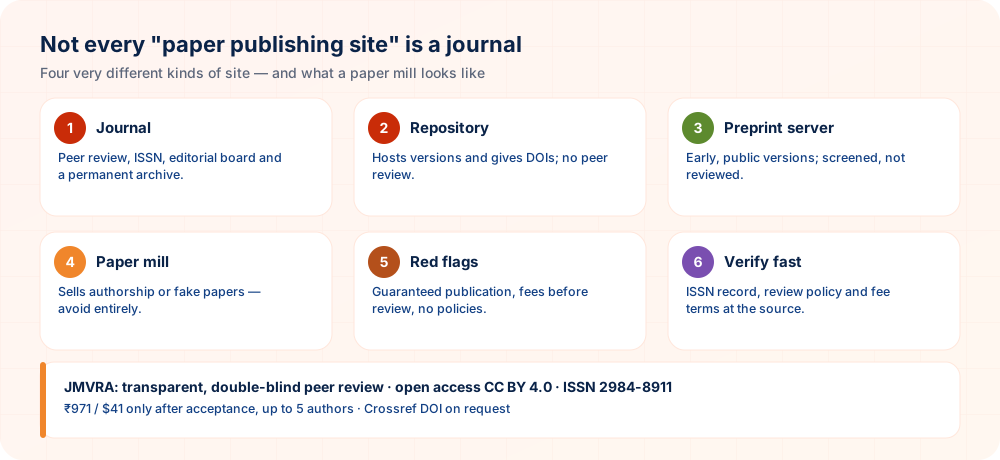
Four Quite Different Types of Site
| Kind of site | Peer reviewed? | Does it count as a journal publication? |
|---|---|---|
| Peer-reviewed journal | Yes | Yes |
| Preprint server (arXiv, SSRN, bioRxiv) | No | No, though it is public and time-stamped |
| Repository (Zenodo, institutional) | No | No — it is an archive copy |
| Academic social network (ResearchGate, Academia.edu) | No | No — it is a platform for sharing |
Fake Journals and Paper Mills
Paper mills trade in ready-made or ghost-written papers and in places on the author list, while fake or hijacked journals copy genuine ones. Both prey on authors who are short of time. Papers published through them may be retracted, and institutions are looking into such cases more and more. A quick check of the journal’s identity before paying can save a great deal of trouble later.
Warning Signs of Fake Fast Publication
- Acceptance promised, or guaranteed, within hours
- Money demanded ahead of any review
- No named editor, or a board that cannot be checked
- Indexing claims that the database does not confirm
- The website’s domain does not match the ISSN or database record
- Unrequested emails flattering your “excellent paper”
Genuine Routes to Quick Visibility
- Post a preprint. It is public at once, and numerous journals allow it.
- Pick an efficient peer-reviewed journal. Look for rolling submission and fast screening, with the review kept in place.
- Spread the word about your published article. List it on Google Scholar, ORCID and your institutional repository.
Check Any Site Within Five Minutes
- Look up the ISSN on the ISSN Portal.
- Try resolving two article DOIs at doi.org.
- Look for the journal’s articles in Google Scholar.
- Verify any indexing claim in the database itself.
- Search for the journal’s name together with “predatory” or “hijacked” to find reports from the community.
If You Suspect You Used a Fake Site
- Pay nothing more. Refuse any “release”, “processing” or “indexing” fees.
- Gather proof. Keep emails, invoices, payment receipts and the website pages.
- Ask for withdrawal in writing. Give your paper ID and request removal.
- Get in touch with your bank or payment provider. Find out whether the payment can be disputed.
- Inform your supervisor or institution. This matters most if the paper appears in any official record.
- Publish the right way elsewhere. After withdrawal, send the paper to a genuine journal and mention the history if you are asked.
The 10 Most-Searched Questions on This Topic
Here are the ten questions researchers search for most on this subject, each with a direct answer.
fast publication paper publishing sites
A mixture of journals, repositories and scams — confirm that a site is a peer-reviewed journal before you submit.
paper publishing sites list
Keep peer-reviewed journals apart from preprint servers, repositories and social networks.
is ResearchGate a journal
No. It is a social network where researchers share their work.
is Zenodo publication
Zenodo is a repository; an uploaded file is archived and receives a DOI, but it is not peer reviewed.
paper mill meaning
A business that sells invented or ghost-written papers and authorship.
hijacked journal meaning
A counterfeit website posing as a real journal, frequently borrowing its name and ISSN.
publish paper in 24 hours
Genuine peer review cannot be completed in 24 hours; regard such offers as a warning sign.
preprint server list
arXiv, SSRN, bioRxiv, medRxiv, Research Square and others, each for particular fields.
how to identify fake journal
Verify the ISSN, the DOIs, the indexing at its source, the editorial board and when payment is requested.
fast legitimate publication
An efficient peer-reviewed journal combined with a preprint for early visibility.
How JMVRA Fits In
JMVRA is a Transparent, Peer-Reviewed, Open Access Journal (Refereed Journal). Following the discontinuation of the UGC and UGC-CARE journal listing, and in alignment with the latest UGC-CARE recommendations and guidelines, JMVRA is aligned with UGC’s Suggested Parameters for Choosing Peer-Reviewed Journals. UGC public notice (PDF)
JMVRA is a peer-reviewed journal, neither a repository nor a posting site, with ISSN 2984-8911 and Crossref DOIs, and it charges fees only once a paper has been accepted.
- ISSN
- 2984-8911 (online) · publishing since June 2023
- Issues
- Monthly issues across many disciplines
- Review
- Two-way anonymous review by specialists
- Access
- Open access published under CC BY 4.0
- Fee
- ₹971 INR for Indian and $41 USD for foreign authors, due only after acceptance
- DOI
- Crossref — available as an optional extra
- Indexing
- Reachable via Google Scholar, not via Scopus, Web of Science or DOAJ
- Impact factor
- 11.25, derived from Google Scholar data
Screening begins the moment a paper arrives and each decision is sent as soon as it is reached, yet JMVRA never promises a set number of days: actual review time depends on the reviewers and on how much revision the paper needs.
At-a-Glance Checklist
- Type of site recognisedJournal, repository or preprint server
- ISSN verifiedOn the ISSN Portal
- Review policy locatedA named model and process
- Authorship is not for saleNever pay for a place on a paper
- Response plan readySteps to take if you used a fake site
Common Paper-Mill Offers
Authorship for sale
A paid place on a paper that already exists.
Guaranteed acceptance
Pledged ahead of any review.
Package deals
Writing, “publication” and a certificate bundled into one fee.
Fake indexing
Scopus or WoS listing claims that cannot be verified.
How to Report a Suspicious Site
- Preserve the evidence — emails, payment requests and web pages
- Notify your institution — the research office or ethics committee
- Alert colleagues — stick to facts, and back them with evidence
- Inform the journal being impersonated — when the site imitates a real one
Practical Tips for Judging Paper Publishing Websites Safely
Many websites promise quick results, and not all are what they seem. These simple precautions help you protect your manuscript, your name and your career before sending anything.
- Look for named, reachable people. Genuine journals list editors with institutions and working contact details. If you cannot identify a real person responsible for decisions, hold back your manuscript.
- Search for independent comments. Look up the site's name with words such as complaint or review, and read what other researchers report. Absence of any independent footprint is itself a signal to be cautious.
- Keep your files private until sure. Do not upload data, signed forms or identity documents until you have verified the venue. Unpublished work is valuable, and withdrawals are sometimes ignored by poor operators.
- Read the withdrawal terms. Check whether you may withdraw a paper and under what conditions before paying anything. Unclear or missing terms usually point to a site that serves its own interest.
- Consult your library. Institutional librarians and research offices often keep guidance on trusted venues. A short conversation can prevent a costly mistake and a poor entry on your record.
Verify who runs a site, what happens to your files and how withdrawal works before you submit or pay.
Questions Researchers Often Ask
Warning Signs Compared With Signs of Trust
Red flags
- Acceptance or publication guaranteed within days
- Money demanded up front, before peer review
- Indexing logos without a record you can check
- A name or domain that nearly matches a known journal
- Editors without affiliations
Trust signals
- An ISSN that resolves on the ISSN Portal
- Fee stated in advance, charged once accepted
- Editorial board listed by name and institution
- DOIs that lead to the journal’s own website
- Indexing described honestly, gaps included
Free tools: Think. Check. Submit. · Retraction Watch Hijacked Journal Checker · ISSN Portal · JMVRA Journal Verification.
Ready to Publish? Submit to JMVRA
JMVRA is aligned with UGC's Suggested Parameters for Choosing Peer-Reviewed Journals.
JMVRA is a Transparent, Peer-Reviewed, Open Access Journal (Refereed Journal). Following the discontinuation of the UGC and UGC-CARE journal listing, and in alignment with the latest UGC-CARE recommendations and guidelines, JMVRA is aligned with UGC’s Suggested Parameters for Choosing Peer-Reviewed Journals.
Quick links across jmvra.org
Key Terms
Subjects and search phrases this article addresses.
Related Reading
Further reading on the same theme from the JMVRA blog.
Does a Low-Cost Journal Really Peer Review?
Read the guide RelatedOnline Paper Publishing for First-Time Authors
Read the guide RelatedSpeed, Cost or Prestige: Choosing Your Trade-Off
Read the guide RelatedRecognising a Predatory Journal
Read the guide RelatedAcademia.edu, ResearchGate or Google Scholar?
Read the guide RelatedZenodo DOI or Journal Crossref DOI? Choosing Right
Read the guideKeep Reading on the JMVRA Blog
Our JMVRA journal blog carries this guide along with other practical advice on publishing, indexing, metrics and research integrity, all written so that claims can be verified and nothing is promotional.